Key Highlights
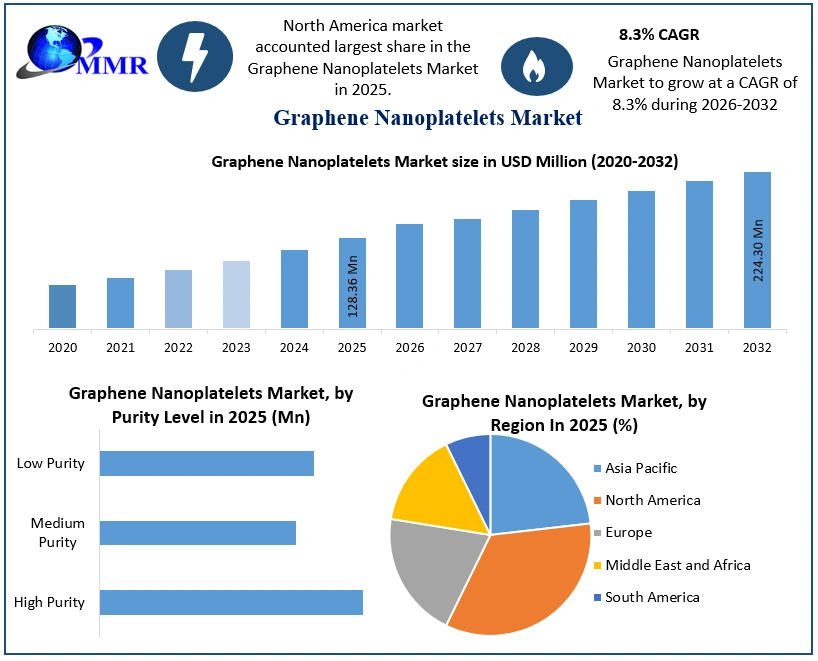
Market Valuation: The market was valued at USD 128.36 Million in 2025.
Revenue Forecast: Expected to reach USD 224.30 Million by 2032.
CAGR: Growing at a rate of 8.3% from 2026 to 2032.
Dominant Segment: Composites currently represent the leading application area.
Regional Leader: North America holds the largest market share, driven by rapid R&D and industrial adoption.
Key Industrial Trend: Commercial-scale integration of graphene into construction materials (cement) for carbon footprint reduction.
Why This Matters Now
The threshold between nanotechnology research and industrial-scale commodity application has been crossed. Chemical manufacturers relying on legacy materials risk obsolescence as competitors integrate graphene nanoplatelets to achieve superior thermal, mechanical, and electrical properties in lightweight components.
Market Overview
The global Graphene Nanoplatelets Market is a high-growth segment within the broader specialty chemicals industry. Defined by two-dimensional carbon structures—either single or multilayered—these materials provide exceptional electrical conductivity, thermal stability, and mechanical strength. In 2025, the market reached a valuation of USD 128.36 million. The forecast anticipates a steady trajectory, with revenue projected to climb to USD 224.30 million by 2032, supported by a 8.3% CAGR. This growth is shifting from academic interest to hard-asset, multi-tonne industrial applications.
Key Trends Driving Growth
The transition toward lightweighting in the automotive and aerospace industries remains a primary growth vector. Manufacturers are utilizing graphene nanoplatelets to enhance the mechanical properties of composite materials, effectively reducing vehicle weight without compromising structural integrity.
Simultaneously, the energy storage sector is capitalizing on graphene’s ability to improve energy density and charging speeds in lithium-ion batteries. From a sustainability standpoint, the material is disrupting the construction industry; graphene-enhanced cement is now achieving double-digit reductions in carbon footprints. This shift towards “green” additives positions graphene nanoplatelets as a critical tool for meeting global emission reduction mandates.
Segment Insights
Dominant Segment (Application): The Composites segment dominated the market in 2025. Its widespread adoption across aerospace, automotive, and infrastructure sectors reflects the material’s unique ability to impart strength and reduce weight in traditional material matrices.
Fastest-Growing Segment: Energy storage and protective coatings are emerging as the most rapidly scaling application areas, fueled by the urgent need for high-performance batteries and corrosion-resistant industrial barriers.
Regional Growth Story
North America remains the dominant regional market, anchored by significant investment in the United States and Canada. This dominance is supported by robust R&D ecosystems and institutional backing, such as the European Union’s Graphene Flagship, which influences global innovation trajectories. While North America leads, Asia-Pacific and Latin America are increasingly adopting these technologies, driven by rising demand for advanced electronics and modern construction materials. The concentration of manufacturing hubs in these regions is expected to accelerate the commercialization of large-scale, cost-effective production methods.
Competitive Landscape
The competitive environment is shifting toward strategic industrial alliances rather than isolated product innovation. Key players like First Graphene Limited, NanoXplore, and Graphite India Limited are focusing on high-volume commercialization. Recent partnerships, such as Graphite India’s exclusive agreement to commercialize heat transfer additives, signal a market transition toward specialized, high-margin functional additives.
The industry is also moving to overcome the “scaling hurdle.” While manufacturing complexity remains a barrier to entry, companies that successfully standardize quality control and production metrics are securing significant price-setting power. Smaller, specialized firms are increasingly being absorbed into broader industrial ecosystems as large conglomerates seek to secure their supply chain of high-performance nanomaterials.
Recent Developments
First Graphene Limited (April 2026): Confirmed a successful production trial of concrete roof tiles using 40 tonnes of PureGRAPH-enhanced cement, achieving a 14% reduction in cradle-to-gate carbon emissions.
HydroGraph Clean Power Inc. (March 2026): Signed a Letter of Intent with Sparc Technologies to integrate proprietary Fractal Graphene into protective industrial coatings, demonstrating a 39% to 60% reduction in scribe corrosion creep.
Breedon Group PLC & First Graphene (December 2025): Scaled production to 600 tonnes of low-carbon cement incorporating graphene, proving the commercial viability of nanomaterial additives at an industrial scale.
Graphite India Limited (December 2025): Partnered with Kivoro to distribute advanced Heat Transfer Additives, targeting the energy efficiency needs of the corrugated paperboard industry.
Graphenea Semiconductor (November 2025): Initiated a collaboration with Melexis to develop an integrated graphene field-effect transistor (GFET) platform, bridging the gap between prototype biosensors and scalable diagnostic tools.
Strategic Implications
Procurement leaders must recognize that the graphene nanoplatelets market is no longer a niche, high-cost curiosity. It is an industrial lever. Integrating these materials requires a fundamental rethink of product architecture—moving from additive-based property enhancements to system-level design optimization.
The primary business risk remains the lack of industry-wide standardized testing. Manufacturers who prioritize internal quality control and secure stable supply lines for high-purity nanoplatelets will gain a distinct technical advantage over competitors. As regulatory bodies continue to scrutinize nanomaterial usage, firms that align with sustainability metrics and demonstrate transparent health and safety protocols will capture the largest market share.
Future Outlook
Winners in this market will be defined by their ability to scale production while ensuring consistent quality across high-volume industrial applications like construction and automotive composites. The primary risk for incumbents is the failure to adapt to standardized regulatory frameworks, which could stifle market penetration in sensitive sectors like biomedicine. Strategic opportunity lies in the rapid conversion of laboratory-tested nanomaterials into standardized, commoditized industrial additives that drive both cost-efficiency and environmental sustainability.
Analyst Perspective
“The transition to commercial scale is the defining shift for the graphene nanoplatelets market,” says Ankita Kagawade, Analyst at Maximize Market Research. “Strategic dominance is now determined by those who move beyond material testing into the full industrial integration of carbon-based additives into high-volume sectors like construction and energy storage.”
About Maximize Market Research
Maximize Market Research Pvt. Ltd. (MMR) is a global market research and consulting company that provides reliable, data-focused, and practical business insights. The firm serves a wide range of industries, including healthcare, pharmaceuticals, technology, automotive, electronics, chemicals, personal care, and consumer goods. Through market forecasts, competitive analysis, strategic consulting, and industry impact assessments, MMR helps organizations understand changing market conditions, identify growth opportunities, and make informed business decisions for long-term success.
2nd Floor, Navale IT Park Phase 3
Pune Banglore Highway, Narhe
Pune, Maharashtra 411041, India
+91 9607365656
sales@maximizemarketresearch.com
