Key Highlights
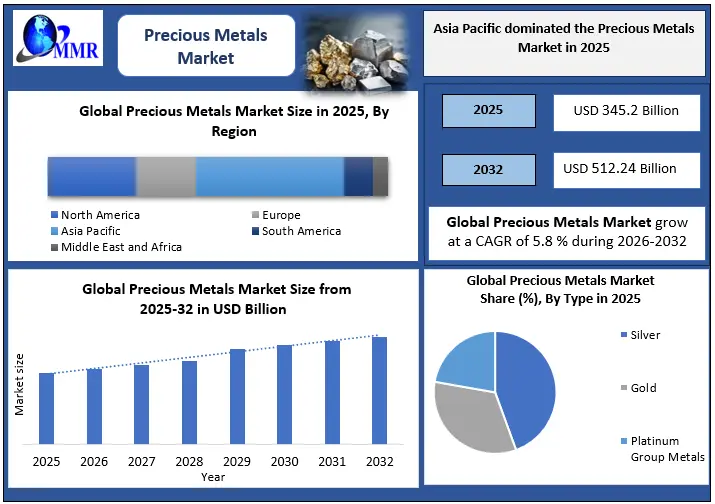
The Precious Metals Market was valued at USD 345.2 billion in 2025 and is expected to reach USD 512.24 billion by 2032 at a 5.8% CAGR.
Gold remains the dominant segment, supported by jewelry demand, investment inflows and central-bank purchases.
Silver is the fastest-growing segment, driven by photovoltaic, electronics and industrial applications.
Recycling is gaining strategic importance as miners face permitting delays, declining ore grades and higher operating costs.
Asia Pacific leads consumption and refining activity, while North America and Europe remain key technology and recycling hubs.
Why This Matters Now
Precious metals have moved from a defensive asset class to a strategic industrial input. Manufacturers are competing with investors and central banks for the same ounces of gold, silver, platinum and palladium. That competition is tightening supply chains and raising procurement risks.
The market’s next phase will be determined less by headline prices and more by who controls refined supply, recycling capacity and long-term industrial contracts. Battery manufacturers, solar developers, electronics producers and automotive suppliers are already adjusting sourcing strategies as volatility increases.
Market Overview
The Precious Metals Market Size was valued at USD 345.2 billion in 2025, and the total revenue is expected to grow at a CAGR of 5.8% from 2026 to 2032, reaching USD 512.24 billion by 2032. The market covers gold, silver, platinum and palladium used across jewelry, investment products, electronics, solar panels, catalysts and chemical processing.
Gold continues to anchor market value because it serves both as a consumer product and a reserve asset. Silver is becoming increasingly important to industrial buyers because photovoltaic installations and electronics manufacturing require significant volumes of conductive metal. Platinum and palladium remain closely tied to automotive catalyst demand, although changing vehicle technologies are altering consumption patterns.
Supply growth is proving harder to achieve. New mining projects face longer approval timelines, higher energy costs and environmental scrutiny. As a result, refiners and recyclers are becoming more influential in determining available supply.
Key Trends Driving Growth
Investment demand remains elevated as governments and central banks diversify reserves. Gold purchases by official institutions have strengthened the market’s floor price and reduced the likelihood of sharp demand collapses during economic uncertainty. For miners and refiners, that creates a more stable long-term demand base.
Industrial consumption is shifting toward silver. Solar-cell manufacturing, advanced electronics and electrical infrastructure projects require high-purity silver, creating demand that is less sensitive to short-term investor sentiment. This trend is widening the gap between silver’s industrial role and gold’s monetary role.
Recycling is becoming a strategic supply source. Scrap jewelry, industrial residues and spent catalysts are supplying a growing share of refined metal. Companies that secure recycling feedstock gain protection against mining disruptions and geopolitical shocks.
Environmental regulations are also changing procurement behavior. Buyers increasingly favor suppliers with traceable sourcing, lower emissions and certified refining practices. Sustainability credentials are becoming a competitive requirement rather than a marketing advantage.
Segment Insights
Dominant Segment: Gold — Gold leads the market because it combines jewelry consumption, investment demand and central-bank reserve accumulation. This diversified demand base gives producers greater resilience during industrial slowdowns.
Fastest-Growing Segment: Silver — Silver is expanding fastest due to rising photovoltaic installations, electronics production and electrical applications. The metal is increasingly tied to energy-transition investment rather than discretionary consumer spending.
Platinum — Demand remains supported by chemical processing and automotive catalysts, while hydrogen-related technologies are creating additional long-term opportunities.
Palladium — The market remains heavily dependent on automotive emissions-control demand. Supply concentration keeps pricing sensitive to geopolitical and operational disruptions.
Regional Growth Story
China remains the largest force in refining, jewelry manufacturing and industrial silver consumption. Its solar manufacturing base continues to absorb significant silver volumes, giving Chinese buyers growing influence over global trade flows.
India remains a critical gold-import market. Jewelry demand, cultural purchasing patterns and investment buying continue to make India one of the most important demand centers for bullion suppliers and refiners.
Germany plays a pivotal role in recycling and industrial processing. European environmental regulations are accelerating recovery of precious metals from electronic waste and catalytic materials, strengthening Germany’s position in secondary supply.
Japan and South Korea remain major consumers of high-purity precious metals for electronics, semiconductor manufacturing and advanced materials. Their demand is less visible than jewelry demand but carries higher value-added margins.
North America, led by the United States, continues to attract investment in refining, recycling and precious-metals-backed financial products. The region benefits from strong institutional investment demand and growing interest in supply-chain localization.
Competitive Landscape
The market remains fragmented across miners, refiners, recyclers and bullion distributors, but competitive advantages are shifting. Scale alone is no longer enough. Companies that control multiple stages of the value chain are gaining stronger pricing power.
Mining groups are prioritizing operational efficiency and reserve replacement rather than aggressive production expansion. Refiners are investing in traceability systems and low-emission processing to meet procurement standards from industrial customers. Recycling specialists are gaining leverage because secondary supply can be expanded faster than new mining capacity.
Partnerships between miners, refiners and industrial users increasingly resemble long-term supply-security agreements. These arrangements reduce spot-market exposure and help buyers manage price volatility. The trend points toward tighter integration across the supply chain rather than purely transactional trading relationships.
Recent Developments
Refining companies expanded recycling capacity to recover gold, silver, platinum and palladium from industrial scrap and electronic waste.
Mining operators accelerated automation and ore-processing upgrades to offset rising labor and energy costs.
Industrial buyers signed longer-term supply agreements to secure silver and platinum availability for manufacturing programs.
Producers increased investment in traceability and responsible-sourcing systems to comply with tightening environmental and procurement standards.
Strategic Implications
Procurement leaders should expect greater competition for high-purity silver and recycled platinum-group metals. Dependence on spot purchases will become riskier as industrial demand grows and mining supply remains constrained.
Investors should watch recycling capacity as closely as mine output. Secondary supply is becoming a key determinant of market balance, particularly in regions with strong environmental regulations and established collection networks.
For chemical manufacturers and catalyst producers, supply-chain resilience now depends on supplier diversification and metal-recovery programs. Companies that treat precious metals solely as commodity inputs may face higher volatility and tighter availability during demand surges.
Future Outlook
Gold will continue to benefit from reserve accumulation and investment demand, but the market’s most significant structural change is the industrialization of silver demand through solar and electronics production. Recycling will capture a larger share of supply growth as new mining projects become harder and slower to develop. Companies that secure recycled feedstock, maintain traceable sourcing and lock in long-term industrial contracts will hold the strongest position as competition for refined metal intensifies.
Analyst Perspective
“The next competitive divide in precious metals will not be between miners and investors. It will be between companies that control reliable refined supply and those exposed to volatile spot markets. Recycling, traceability and industrial contracts are becoming the decisive strategic assets.”
— Ankita Kagawade, Analyst
About Maximize Market Research
Maximize Market Research Pvt. Ltd. (MMR) is a global market research and consulting company that provides reliable, data-focused, and practical business insights. The firm serves a wide range of industries, including healthcare, pharmaceuticals, technology, automotive, electronics, chemicals, personal care, and consumer goods. Through market forecasts, competitive analysis, strategic consulting, and industry impact assessments, MMR helps organizations understand changing market conditions, identify growth opportunities, and make informed business decisions for long-term success.
2nd Floor, Navale IT Park Phase 3
Pune Banglore Highway, Narhe
Pune, Maharashtra 411041, India
+91 9607365656
sales@maximizemarketresearch.com
