Key Highlights
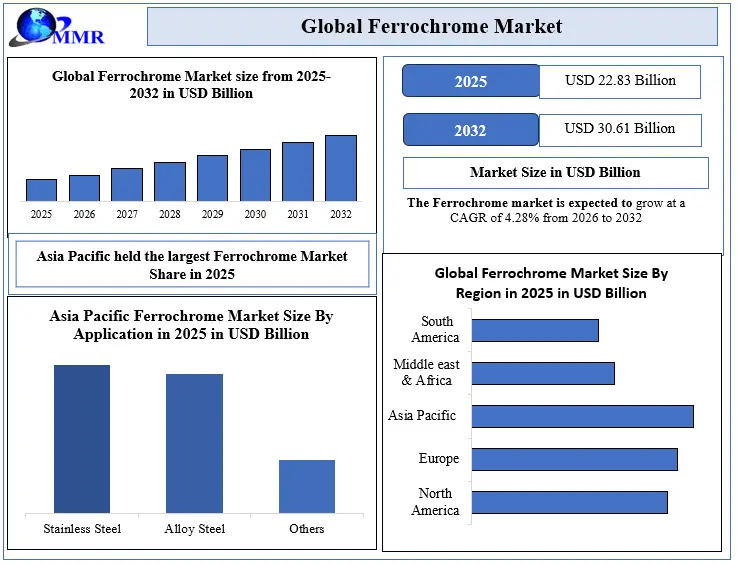
Market valuation expands from USD 22.83 Billion in 2025 to USD 30.61 Billion by 2032.
A compound annual growth rate (CAGR) of 4.28% regulates the industry’s multi-year trajectory.
High-carbon ferrochrome remains the dominant market segment due to its extensive use in bulk stainless steel manufacturing.
China anchors the global landscape as both the primary consumer and largest producer of the alloy.
Escalating environmental compliance requirements and carbon reduction mandates dictate smelting capacity expansions.
Raw material cost volatility and electricity supply disruptions emerge as the primary risks to margin stability.
Why This Matters Now
Volatile power grids and tightening carbon emission caps are forcing an immediate structural realignment across global ferroalloys supply chains. Industrial buyers and procurement leaders can no longer rely on legacy sourcing patterns as rising electricity costs threaten traditional smelting hubs. This supply-side vulnerability coincides with a structural surge in downstream infrastructure spending, altering the margin profile for chemical and metallurgical manufacturers worldwide.
What changed is the baseline operational cost of thermal smelting. High-energy manufacturing processes face unprecedented regulatory penalties, which compresses producer margins in carbon-intensive regions while favoring assets with access to renewable grids. Industrial buyers must act now to lock in long-term supply agreements or risk exposure to severe spot-market volatility and localized export restrictions.
Market Overview
The global Ferrochrome Market Size operates as the foundation of the modern corrosion-resistant metallurgy sector. Valued at USD 22.83 Billion in 2025, the industry is on a definitive trajectory to reach USD 30.61 Billion by 2032, sustaining a CAGR of 4.28%. This steady expansion reflects the non-substitutable nature of chromium in stainless steel formulations, where it provides essential anti-corrosive and structural properties.
The market relies on a tightly consolidated raw material supply chain primarily dependent on chromite ore extraction. Smelting operations convert this ore into various grades of ferrochrome through energy-intensive carbothermic reduction processes. Because energy constitutes a massive percentage of total production costs, regional power pricing and grid stability directly dictate global market availability and pricing structures.
Key Trends Driving Growth
Accelerating urbanization and multi-billion-dollar infrastructure renewals across developing economies serve as the primary engines for industry expansion. High-strength alloys and stainless steel components see expanding integration in modern construction projects, bridges, and commercial transit systems. This sustained baseline demand prevents structural gluts and maintains steady pull-through for raw alloy inputs.
Simultaneously, the automotive sector’s ongoing evolution creates a secondary demand channel focused on specialized, lightweight steel grades. Vehicle manufacturers require higher tensile strength and superior corrosion resistance to meet extended warranty standards and strict safety regulations. This shift compels steelmakers to optimize their metallurgical mixes, driving predictable, high-volume consumption of high-carbon and medium-carbon ferrochrome variants.
Segment Insights
Dominant Segment: High-Carbon Ferrochrome holds the largest revenue and volume share of the market due to its lower production cost and high efficiency in standard stainless steel manufacturing.
Fastest-Growing Segment: Low-Carbon Ferrochrome exhibits the highest growth velocity as specialty steel manufacturers scale production of superalloys and customized, corrosion-resistant components.
Feedstock Segment: Chromite ore continues to govern upstream value dynamics, where localized mining disruptions immediately alter the production economics of downstream smelters.
Application Segment: Stainless steel production consumes the vast majority of global output, cementing a direct, unbreakable economic correlation between steel utilization and alloy demand.
Regional Growth Story
China maintains its position as the undisputed center of gravity for both production and consumption within the global landscape. The country’s massive domestic stainless steel manufacturing complex absorbs vast quantities of imported chromite ore, transforming it into usable alloy via localized smelting clusters. However, tightening domestic environmental inspections and localized power rationing present ongoing disruptions to consistent output.
In contrast, the Indian market is expanding rapidly, backed by domestic chromite reserves and state-supported infrastructure programs. India’s growing manufacturing capacity positions it as an increasingly critical exporter to mature western markets, including Germany and the United States. Meanwhile, legacy producers in Europe face severe headwinds from elevated electricity tariffs, prompting a gradual shift toward import reliance for their premium steelmaking operations.
Competitive Landscape
The global market features a highly consolidated competitive structure dominated by a small number of diversified mining conglomerates and dedicated ferroalloy producers. These entities exert significant pricing power through their control over upstream chromite ore assets, creating high barriers to entry for independent smelters. Corporate strategy centers heavily on securing low-cost, long-term power contracts to insulate operations from regional energy shocks.
Strategic positioning is increasingly defined by geographic proximity to major deep-water ports and primary downstream steel mills. This spatial optimization minimizes freight costs and mitigates logistical bottlenecks in the international trade of bulk commodities. Key operators are also focusing investments on upgrading furnace efficiencies and implementing advanced pre-heating technologies to reduce overall coke consumption.
Recent Developments
Upstream mining asset acquisitions by major producers indicate a clear industry drive toward total vertical integration.
Smelters are forming joint ventures with regional renewable energy developers to secure dedicated green power allocations.
Smelting facilities are deploying automated furnace control systems to optimize thermodynamic efficiency and lower electrode consumption.
Strategic storage hubs are expanding near major Asian ports to buffer against sudden maritime trade and shipping disruptions.
Manufacturers are executing long-term supply pacts directly with major automotive tier-one suppliers to stabilize order books.
Strategic Implications
Every major capacity expansion and technology investment signals a fundamental shift toward margin defense through energy insulation. Companies investing in captive power generation or localized renewable grids are effectively decoupling themselves from highly volatile public electricity markets. This structural insulation grants these specific producers superior pricing power during periods of regional energy crises or peak seasonal grid demand.
Furthermore, the industry’s focus on securing upstream chromite reserves reveals a collective fear of supply chain fragmentation. Independent smelters lacking captive mining assets will find themselves highly vulnerable to margin compression as ore exporters maximize their own downstream value retention. Procurement leaders must interpret these maneuvers as a clear signal that unhedged, spot-market sourcing will become increasingly high-risk over the coming decade.
Future Outlook
The global market will navigate a landscape defined by diverging regional regulatory regimes and a persistent push toward manufacturing modernization. As carbon-tax frameworks become more stringent across Europe and the Americas, carbon-intensive smelting hubs will face escalating economic pressures to relocate or transform. This structural evolution will likely accelerate the concentration of production capacity within regions that offer a combination of abundant chromite ore and stable, low-emission power matrices.
Over the long term, the industry will experience a sustained shift toward circular economy principles, characterized by the increased recovery and recycling of chromium-bearing steel scrap. While primary alloy production will remain indispensable to meet absolute demand growth, scrap utilization will increasingly serve as a vital secondary supply valve. Ultimately, market dominance will belong exclusively to vertically integrated producers capable of guaranteeing both low-carbon footprints and absolute supply continuity to an increasingly demanding downstream industrial customer base.
Analyst Perspective
“The global ferrochrome sector is moving rapidly past a simple volume-driven growth model,” says Ankita Kagawade, Analyst at Maximize Market Research. “What we are witnessing now is an intense structural contest focused entirely on energy sourcing and carbon efficiency. The winners over the next decade will be those operations that successfully couple secure, high-grade chromite access with insulated, low-emission power inputs, effectively redefining the baseline economics of global steel supply chains.”
About Maximize Market Research
Maximize Market Research Pvt. Ltd. (MMR) is a global market research and consulting company that provides reliable, data-focused, and practical business insights. The firm serves a wide range of industries, including healthcare, pharmaceuticals, technology, automotive, electronics, chemicals, personal care, and consumer goods. Through market forecasts, competitive analysis, strategic consulting, and industry impact assessments, MMR helps organizations understand changing market conditions, identify growth opportunities, and make informed business decisions for long-term success.
2nd Floor, Navale IT Park Phase 3
Pune Banglore Highway, Narhe
Pune, Maharashtra 411041, India
+91 9607365656
sales@maximizemarketresearch.com
