Key Highlights
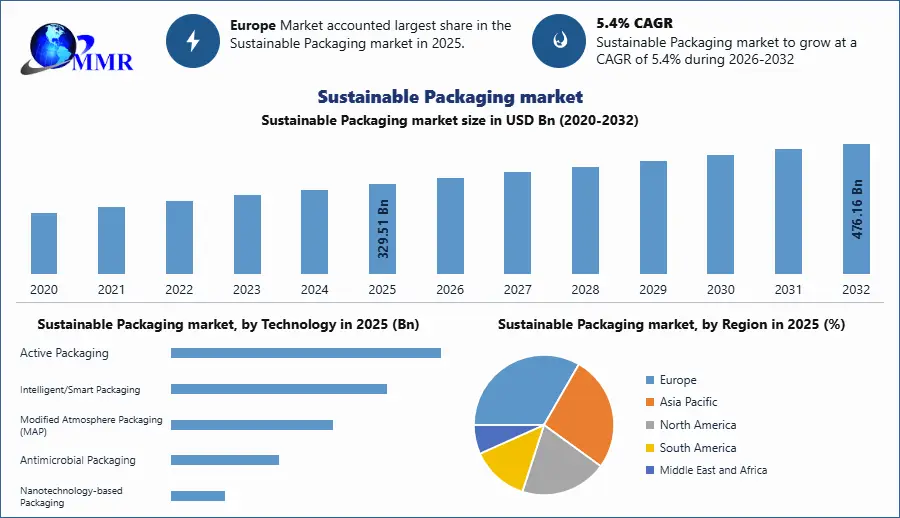
- The Sustainable Packaging Market was valued at USD 329.51 billion in 2025 and is projected to reach USD 476.16 billion by 2032.
- Sustainability regulations, corporate ESG commitments and consumer demand are accelerating the shift from conventional packaging.
- Paper and paperboard dominated the material segment with a 22.8% revenue share in 2025 due to recyclability and renewable sourcing advantages.
- Food and beverage remained the largest end-user segment, accounting for 57.6% market share in 2025.
- Europe led global adoption due to strict environmental regulations and circular economy policies.
- Strategic acquisitions and investments are reshaping competition, with companies expanding recyclable and fiber-based packaging capabilities.
Why This Matters Now
Packaging waste has become a major environmental and regulatory concern as urbanization increases consumption and waste generation. More than half of the global population now lives in urban areas, creating higher demand for packaging systems that reduce landfill impact and improve recyclability.
Companies across food, beverage, healthcare and personal care industries are redesigning packaging portfolios to meet sustainability targets. The shift is creating new opportunities for suppliers of recycled materials, fiber-based packaging and biodegradable alternatives while increasing pressure on traditional plastic packaging producers.
Market Overview
The Sustainable Packaging Market Size covers packaging solutions designed to reduce environmental impact through recyclable, biodegradable, reusable and renewable materials. These solutions include paper-based packaging, bio-based plastics, compostable materials, recycled polymers and advanced packaging technologies.
The market reached USD 329.51 billion in 2025, supported by rising environmental awareness, government regulations and corporate sustainability commitments. Businesses are increasingly adopting sustainable packaging to reduce carbon emissions, comply with waste management policies and strengthen brand positioning among environmentally conscious consumers.
Food and beverage companies represent the largest demand base as brands seek alternatives to single-use plastics while maintaining product safety and shelf life. Pharmaceutical, personal care and consumer goods manufacturers are also investing in sustainable packaging formats to align with ESG goals.
Supply dynamics are influenced by availability and cost of sustainable raw materials. Limited production capacity for certain bio-based materials and higher manufacturing costs remain barriers, encouraging companies to invest in recycling infrastructure and scalable production technologies.
Key Trends Driving Growth
Circular Economy Reshapes Packaging Strategies
Circular economy principles are becoming central to packaging decisions. Companies are increasing the use of recycled materials, designing recyclable structures and improving collection systems to reduce waste generation.
Large packaging producers are shifting from linear production models toward closed-loop systems where materials remain in circulation longer. This transition benefits companies with recycling capabilities and advanced material expertise.
Growth of Paper-Based Packaging
Paper and paperboard packaging are gaining market share because of their renewable sourcing, recyclability and lower environmental impact compared with conventional plastics.
Retail, food delivery and e-commerce companies are increasing adoption of paper-based solutions to reduce plastic dependence and meet sustainability commitments.
Smart and Advanced Packaging Technologies
Technology integration is improving packaging performance. Active packaging, intelligent packaging and modified atmosphere packaging solutions are helping companies extend shelf life, improve product safety and reduce food waste.
These technologies create value by combining sustainability goals with operational efficiency.
Explore detailed analysis, insights, and growth opportunities
Regulatory Pressure and ESG Commitments
Governments worldwide are implementing stricter recycling targets and restrictions on packaging waste. These regulations are forcing manufacturers to redesign products and increase recycled content usage.
Corporate sustainability commitments are also accelerating investment as global brands seek measurable reductions in environmental impact.
Segment Insights
Paper and Paperboard Lead Material Segment
Paper and paperboard dominated the Sustainable Packaging Market in 2025 with a 22.8% revenue share. The segment benefits from strong recyclability, renewable sourcing and consumer acceptance.
Companies are replacing plastic-based packaging with paper alternatives in shipping materials, food containers and consumer product packaging. This trend supports manufacturers with strong fiber-based production capabilities.
International Paper and Smurfit Kappa are positioned to benefit from increased demand for renewable packaging formats.
Food and Beverage Remains Largest End User
The food and beverage segment accounted for 57.6% market share in 2025 due to rising demand for recyclable and reusable packaging solutions.
Food companies are investing in sustainable packaging to reduce waste, improve consumer perception and comply with environmental regulations. Recycled plastics, compostable materials and fiber-based packaging are gaining adoption across beverages, snacks and prepared foods.
Rigid Packaging Maintains Strong Demand
Rigid sustainable packaging accounted for a significant market share due to its durability, product protection and transportation advantages.
Bottles, containers and jars made from recycled materials are increasingly used in beverages, healthcare and household products. Companies are improving rigid packaging sustainability through recycled PET and renewable material integration.
Technology-Based Packaging Gains Importance
Smart packaging, antimicrobial packaging and nanotechnology-based solutions are gaining attention because they improve product safety and reduce waste.
These technologies are particularly valuable in food and pharmaceutical industries where shelf life and quality control directly impact profitability.
Regional Growth Story
Europe Leads Sustainable Packaging Adoption
Europe dominated the Sustainable Packaging Market in 2025 due to strict environmental regulations, advanced recycling infrastructure and strong consumer awareness.
Government policies supporting circular economy models are encouraging companies to increase recycled content and adopt recyclable designs. European packaging manufacturers are investing heavily in fiber-based solutions and low-carbon production methods.
North America Expands Through Corporate Sustainability Programs
North America recorded strong growth due to established recycling infrastructure and increasing corporate commitments toward sustainable packaging.
Food and beverage companies are major contributors as brands respond to consumer demand for environmentally responsible packaging. Investments in lightweight packaging and recycled materials continue to increase.
Asia Pacific Becomes a High-Growth Market
Asia Pacific is emerging as a major growth region due to rising urbanization, expanding e-commerce and increasing sustainability awareness.
China, India, Indonesia and South Korea are investing in recycling systems and sustainable packaging technologies. South Korea’s regulatory reforms around packaging recyclability are encouraging companies to adopt greener solutions.
Middle East, Africa and South America
Developing markets are gradually adopting sustainable packaging as governments introduce waste reduction policies and industries modernize supply chains.
Competitive Landscape
The Sustainable Packaging Market is undergoing consolidation as companies expand through acquisitions, partnerships and technology investments.
Amcor plc is strengthening its sustainability position through recyclable packaging development and strategic acquisitions. Its acquisition of Berry Global expanded its scale in circular packaging solutions and recyclable mono-material technologies.
Ball Corporation is advancing lightweight recycled metal packaging solutions, helping beverage companies reduce transportation emissions and improve material efficiency.
Mondi plc continues expanding renewable packaging solutions through paper-based innovations.
Tetra Pak International S.A. focuses on renewable carton packaging solutions designed to reduce environmental impact while maintaining food safety.
Sealed Air Corporation is investing in sustainable protective packaging solutions for food, healthcare and e-commerce applications.
Competition is shifting toward companies capable of combining sustainability, material innovation and large-scale manufacturing capacity.
Recent Developments
- Ball Corporation – March 2026: Commercialized the ReAl® alloy can using 50% recycled content and reducing weight by 30%, helping beverage brands lower transportation-related emissions.
- Pactiv Evergreen – February 2026: Launched SmartPour renewable gable-top packaging to replace rigid plastic containers in food and home care applications.
- Green Bay Packaging – June 2025: Began development of a USD 1 billion kraft linerboard mill in Arkansas to expand renewable paper-based packaging production.
- Amcor – April 2025: Completed the USD 10.4 billion acquisition of Berry Global, creating a larger sustainable packaging platform focused on recyclable technologies.
- Sonoco – April 2025: Divested thermoformed and flexible packaging operations to Toppan Holdings to focus on sustainable fiber-based and industrial packaging segments.
- Five Star Holding – January 2025: Acquired Anduro Manufacturing to expand customized flexible packaging capabilities across North America and Latin America.
Future Outlook
The Sustainable Packaging Market will be led by companies that scale recyclable materials, fiber-based solutions and circular systems while overcoming raw material availability and cost challenges.
Analyst Perspective: Yash Ghosalkar
The Sustainable Packaging Market is shifting from a niche environmental initiative into a core business strategy for packaging manufacturers and consumer brands. Regulatory pressure, ESG commitments and rising consumer awareness are forcing companies to redesign packaging systems around recyclability, renewable materials and reduced carbon impact.
About Maximize Market Research
Maximize Market Research Pvt. Ltd. (MMR) is a global market research and consulting company that provides reliable, data-focused, and practical business insights. The firm serves a wide range of industries, including healthcare, pharmaceuticals, technology, automotive, electronics, chemicals, personal care, and consumer goods. Through market forecasts, competitive analysis, strategic consulting, and industry impact assessments, MMR helps organizations understand changing market conditions, identify growth opportunities, and make informed business decisions for long-term success.
Contact Us :
2nd Floor, Navale IT Park Phase 3
Pune Banglore Highway, Narhe
Pune, Maharashtra 411041, India
+91 9607365656
sales@maximizemarketresearch.com
