Key Highlights
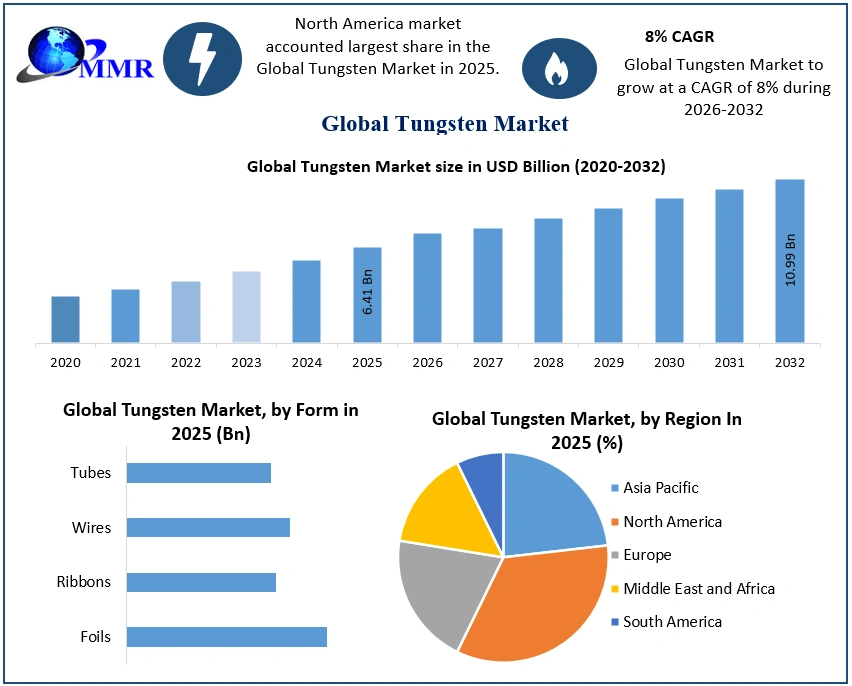
Market Valuation: Global market scale expands from USD 6.41 billion in 2025 to a projected USD 10.99 billion by 2032.
Compounding Growth: Structural demand across downstream manufacturing verticals sustains an absolute CAGR of 8.0% throughout the forecast timeline.
Dominant Architecture: The Tungsten Carbide segment secures the highest single share of market volume due to heavy machine tool utilization.
Growth Accelerant: Metal Alloys register the fastest year-on-year expansion velocity, driven by aerospace and thermal management requirements.
Geographic Concentration: Asia Pacific dictates absolute production and consumption volumes, anchored by extensive infrastructure inside China.
Sourcing Friction: Export controls, elevated processing costs, and mine-level resource protectionism represent the primary market bottlenecks.
Why This Matters Now
Volatile raw material availability and aggressive export restrictions in primary mining jurisdictions have destabilized legacy chemical and metallurgical procurement frameworks. For chemical processing operations, aerospace manufacturers, and industrial buyers, tungsten is not an optional additive but an irreplaceable structural component defined by unmatched thermal resilience and tensile density.
Failing to secure consistent feedstock allocations now exposes chemical companies and industrial manufacturers to immediate margin compression as spot prices react to structural deficits. The rapid acceleration of downstream fabrication technologies, specifically high-precision electronics and complex military hardware, means that securing reliable, long-term output contracts is now a core operational necessity.
Market Overview
The structural parameters of the global Tungsten Market Size are expanding rapidly as basic engineering and advanced high-tech components demand unprecedented thermal and physical tolerances. Valued firmly at USD 6.41 billion in 2025, the market is on a rigid trajectory to hit USD 10.99 billion by 2032, advancing at a sustained CAGR of 8.0%.
This expansion reflects a baseline shift in how modern industrial economies process raw refractory metals into high-value chemical inputs and downstream components. This demand surge places immediate strain on upstream extraction operations, transforming traditional buyer-supplier relationships into highly defensive structural partnerships.
What has fundamentally changed is the global baseline requirement for material performance across legacy manufacturing sectors and emerging technological applications alike. High melting points, extreme density, and exceptional hardness make tungsten a foundational material in heavy industrial ecosystems.
As a result, chemical manufacturers and intermediate metallurgical processing hubs are forced to scale up production capacities to prevent widespread manufacturing stoppages across key downstream sectors. This shifting dynamic benefits primary extraction firms and fully integrated refiners possessing independent processing assets, while squeezing unhedged downstream blending operations.
Key Trends Driving Growth
Advanced manufacturing requirements are shifting toward ultra-precise, high-durability components, which directly drives the adoption of industrial powder metallurgy and specialized tungsten carbide formulations. In semiconductor fabrication and heavy thermal management applications, legacy materials fail under elevated operating temperatures, leaving tungsten as the only viable technical alternative.
Concurrently, the rapid scale-up of modern defense production and commercial aerospace programs requires massive volumes of high-performance superalloys capable of enduring extreme mechanical stress. This dual-sector pull creates a continuous demand pipeline that insulates the tungsten market from broader macroeconomic cyclical downturns.
Simultaneously, major manufacturing economies are aggressively pursuing supply chain localization to mitigate the risks of geopolitical resource hoarding and unexpected logistics bottlenecks. This trend has triggered a wave of new capital investments into domestic refining facilities, secondary recycling operations, and localized distribution networks.
This infrastructure buildup allows tier-one suppliers to stabilize their delivery schedules, directly benefiting specialized industrial buyers who require constant, predictable deliveries. This structural shift moves the market away from vulnerable just-in-time spot purchasing models toward highly secure, long-term supply agreements.
Segment Insights
Dominant Segment: Tungsten Carbide holds the largest overall market share, retaining its dominant position through 2032 due to its massive application footprint in replaceable cutting tools, structural wear inserts, and heavy precision machining environments.
Fastest-Growing Segment: Metal Alloys are projected to achieve the highest rate of market expansion, accelerated by surging design integration in commercial aerospace components, specialized high-performance engineering assemblies, and advanced industrial machinery.
Downstream Applications: The Automotive segment is on a clear path to achieve an 8.0% CAGR through 2032, driven by the expanding use of pure tungsten, specialized alloys, and carbide compounds inside heavy-duty tire studs, structural ball joints, brake assemblies, heavy crankshafts, and hot-zone mechanical parts.
Form Factors: Industrial manufacturing channels are consuming increasing volumes of specialized wires, thin foils, protective tubes, and precision ribbons to fulfill stringent engineering specifications across the electronics and defense sectors.
Regional Growth Story
The Asia Pacific region maintains absolute control over the global tungsten landscape, and it is firmly projected to hold the largest market share through 2032. China functions as the primary pillar of this regional concentration, leveraging immense national reserves, highly integrated mining operations, and centralized government policies that shield local tungsten producers.
This vast, low-cost processing footprint allows regional manufacturers to control international pricing dynamics, making Asia Pacific the primary hub for downstream consumer electronics and bulk industrial tool fabrication.
In contrast, North America is emerging as a high-velocity growth center, characterized by accelerating industrial output and rising public infrastructure expenditure. This regional expansion is driven by a structural shift toward domestic advanced manufacturing, creating a substantial demand increase for specialized drilling, boring, and heavy cutting equipment.
As North American aerospace and defense manufacturers continuously increase production quotas, local sourcing agents are aggressively pursuing long-term agreements with regional refiners to insulate themselves from overseas supply disruptions.
Competitive Landscape
The global competitive environment is highly consolidated, with market structure and pricing power concentrated among a small group of multinational mining conglomerates and advanced materials refiners. Top-tier operators like China Minmetals Corporation, Almonty Industries Inc., Sandvik AB, Kennametal Inc., and H.C. Starck Tungsten GmbH leverage fully integrated supply chains to navigate raw feedstock volatility.
These industry leaders are systematically expanding their processing footprints and acquiring localized recycling operations to lock in secondary material streams, directly enhancing their pricing leverage over unintegrated downstream competitors.
This ongoing corporate consolidation signals a clear shift toward vertical integration, effectively raising the entry barriers for newer, standalone chemical processors. By controlling every stage from raw ore extraction to final powder metallurgy formulation, these dominant corporations can optimize capacity utilization across their global manufacturing networks.
This structural control leaves smaller market followers highly vulnerable to sudden shifts in raw material costs, accelerating a trend where major players acquire specialized niche processors to expand their high-margin product portfolios.
Recent Developments
Advanced Material Scaling: Major global suppliers are expanding specialized manufacturing assets to produce high-purity tungsten powders optimized for additive manufacturing and advanced thermal spray applications.
Strategic Sourcing Alliances: Leading aerospace manufacturers are entering long-term supply agreements directly with integrated tungsten refiners to bypass volatile open-market spot trading channels.
Supply Chain Localization: Tier-one industrial tool producers are building out new regional processing hubs in North America and Western Europe to satisfy strict domestic sourcing mandates for military and aerospace programs.
Mine-Level Infrastructure Upgrades: Selected mining operators are deploying automated extraction technologies to offset rising labor costs and maintain stable output levels under challenging geological conditions.
Strategic Implications
For procurement organizations and industrial operations managers, the structural reality of the tungsten market requires an immediate shift away from transactional spot purchasing toward long-term strategic asset management. Organizations that rely on unhedged market channels remain highly exposed to sudden export halts, rapid price spikes, and unexpected logistics disruptions.
To mitigate these systemic vulnerabilities, forward-thinking corporate entities are actively diversifying their supplier networks, funding domestic reprocessing facilities, and building localized safety buffers.
Furthermore, the rapid growth of the high-margin metal alloys segment means that chemical and materials companies must continuously upgrade their domestic processing capabilities to remain competitive. Maintaining legacy commodity processing lines will no longer yield sufficient returns as downstream clients demand highly specialized, tailormade tungsten formulations.
Consequently, forward-looking market participants are focusing capital investments on advanced powder metallurgy assets and specialized high-purity processing technologies to capture value in high-growth defense, electronic, and aerospace applications.
Future Outlook
The global tungsten market will maintain its upward momentum through 2032, driven by irreplaceable material characteristics and expanding industrial manufacturing across major global economic hubs. While raw material volatility and processing costs present persistent operational hurdles, the steady demand from aerospace, automotive, and machine tool sectors guarantees a highly resilient long-term consumption curve.
Ultimate market success will belong exclusively to vertically integrated operators who successfully secure independent raw material feedstocks while executing high-efficiency regional production strategies.
Analyst Perspective
“The global tungsten market has transitioned from a standard industrial commodity lifecycle into a highly strategic asset class defined by structural supply vulnerability and accelerating high-tech consumption,” states Ankita Kagawade, Lead Analyst at Maximize Market Research.
“Procurement organizations can no longer view tungsten as a basic industrial input; it requires a dedicated sourcing strategy built on direct mine-to-refinery visibility, localized processing redundancies, and a clear understanding of regional trade regulations.”
About Maximize Market Research
Maximize Market Research Pvt. Ltd. (MMR) is a global market research and consulting company that provides reliable, data-focused, and practical business insights. The firm serves a wide range of industries, including healthcare, pharmaceuticals, technology, automotive, electronics, chemicals, personal care, and consumer goods. Through market forecasts, competitive analysis, strategic consulting, and industry impact assessments, MMR helps organizations understand changing market conditions, identify growth opportunities, and make informed business decisions for long-term success.
2nd Floor, Navale IT Park Phase 3
Pune Banglore Highway, Narhe
Pune, Maharashtra 411041, India
+91 9607365656
sales@maximizemarketresearch.com
