Key Highlights
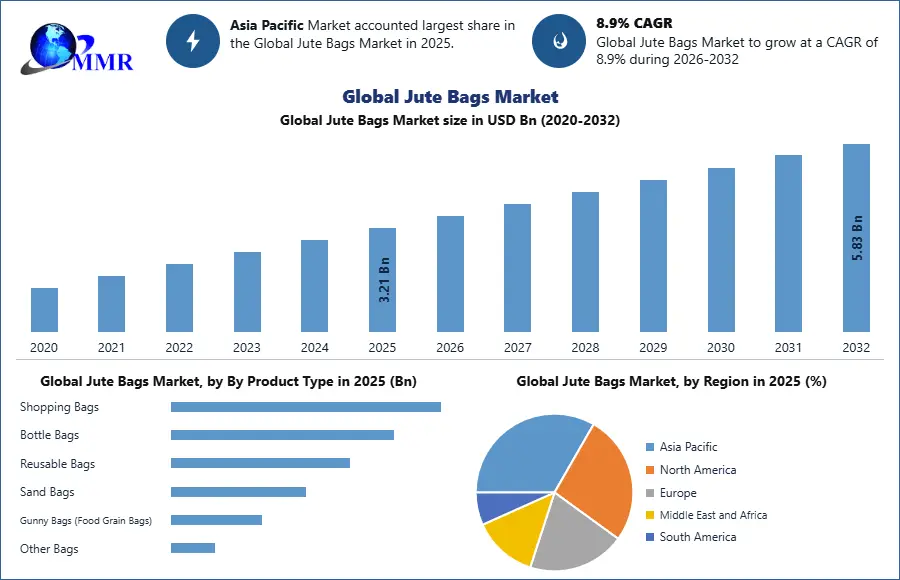
- The global Jute Bags Market reached USD 3.21 billion in 2025 and is expected to reach USD 5.83 billion by 2032.
- The market is growing at an 8.9% CAGR due to plastic restrictions and rising demand for biodegradable packaging.
- Shopping and reusable bags dominate demand as retailers replace single-use plastic carry bags.
- Asia Pacific leads the market due to strong jute production, manufacturing capacity and government sustainability initiatives.
- Premium customized jute bags are gaining traction in gifting, corporate branding and fashion applications.
- Retail, agriculture and food sectors remain the largest users of jute-based packaging solutions.
Why This Matters Now
The global shift away from single-use plastics is creating new demand for natural fiber alternatives. Governments are implementing plastic restrictions, while companies are adopting sustainable packaging to reduce environmental impact and strengthen brand positioning.
Jute bags are benefiting from this transition because they combine biodegradability, durability and affordability. Unlike synthetic alternatives, jute provides a renewable material option with applications ranging from retail shopping bags to agricultural storage sacks.
The market is also gaining importance as businesses seek packaging solutions that support sustainability commitments without significantly increasing costs.
Market Overview
The Jute Bags Market Size includes bags produced from natural jute fibers derived from the bark of jute plants. Known as the “golden fiber” due to its appearance and texture, jute offers strong tensile strength, low thermal conductivity and moderate moisture resistance.
The market reached USD 3.21 billion in 2025, driven by increasing environmental awareness, government policies restricting plastic bags and growing consumer preference for reusable products.
Retail remains a major demand contributor as supermarkets, fashion brands and e-commerce companies adopt reusable shopping bags. Agriculture continues to generate stable demand through gunny bags used for grain storage and transportation.
Supply dynamics are supported by strong jute cultivation and manufacturing capabilities in Asia Pacific, particularly India and Bangladesh. However, availability of quality raw materials, seasonal production cycles and competition from synthetic alternatives influence pricing and profitability.
Urbanization is creating additional opportunities as consumers increasingly use jute bags for shopping, fashion accessories and daily lifestyle applications.
Key Trends Driving Growth
Plastic Restrictions Accelerate Adoption
Government bans on single-use plastics are one of the strongest growth drivers for jute bags. Retailers and consumers are shifting toward reusable alternatives that meet environmental regulations.
This regulatory shift benefits jute manufacturers by expanding demand across supermarkets, shopping centers and institutional buyers.
Rising Demand for Sustainable Retail Packaging
Brands are using jute bags as a marketing tool because of their durability and premium appearance. Customized designs, logos and printed patterns allow companies to combine sustainability with promotional value.
Corporate gifting and event-based packaging are creating new revenue opportunities beyond traditional shopping applications.
Premiumization and Fashion Integration
Jute bags are moving beyond utility products into lifestyle categories. Designer bags, handbags and customized products are gaining popularity among urban consumers.
Fashion brands are adopting natural fiber products to appeal to environmentally conscious customers.
Growth in Agricultural Applications
Agriculture remains an important end-use sector due to demand for durable storage and transportation bags. Jute gunny bags continue to be widely used for grains and agricultural commodities because of their strength and breathability.
Explore detailed analysis, insights, and growth opportunities
Segment Insights
Shopping and Reusable Bags Dominate Product Demand
Shopping bags and reusable bags dominated the product segment in 2025 due to increasing replacement of plastic carry bags.
Retailers prefer jute bags because they are reusable, customizable and environmentally friendly. Their higher durability allows repeated use, improving consumer value compared with disposable alternatives.
This segment benefits directly from plastic regulations and sustainability-focused retail strategies.
Premium Segment Gains Momentum
The mass segment held the largest market share in 2025 due to affordability and widespread adoption across agriculture, retail and industrial sectors.
However, the premium segment is expanding as consumers seek stylish, customized and branded jute products. Urban markets and corporate gifting applications are supporting higher-value product demand.
Shopping Application Leads Market
Shopping remained the largest application segment in 2025 as retailers increasingly replace plastic bags with reusable alternatives.
Gifting applications are growing rapidly due to demand for sustainable packaging during corporate events, festivals and personal celebrations.
Promotional use is also expanding as companies use jute bags as reusable advertising platforms.
Retail Sector Maintains Leadership
The retail sector dominated end-use demand due to widespread adoption by supermarkets, stores and fashion brands.
Agriculture remains a key contributor through bulk storage requirements, while food and beverage companies are increasingly adopting jute packaging for sustainability-focused product lines.
Hospitality and government institutions are also increasing adoption as part of environmental initiatives.
Regional Growth Story
Asia Pacific Leads Global Production
Asia Pacific dominated the Jute Bags Market in 2025 due to abundant raw material availability, established manufacturing networks and strong export capabilities.
India and Bangladesh remain major production hubs because of favorable climatic conditions and long-standing jute cultivation expertise.
Government support for sustainable products is further strengthening regional demand and production capacity.
North America Focuses on Sustainable Consumption
North America is witnessing increased adoption due to consumer awareness and stricter plastic reduction policies.
Retail chains and corporate organizations are using reusable jute bags to meet sustainability targets and improve environmental branding.
Europe Drives Eco-Friendly Adoption
Europe continues to support market growth through strong environmental regulations and consumer preference for sustainable products.
Retailers and fashion companies are adopting natural fiber bags as part of broader sustainability strategies.
Emerging Markets Expand Usage
Latin America, Middle East and Africa are showing moderate growth as retail infrastructure improves and awareness of sustainable packaging increases.
Competitive Landscape
The Jute Bags Market remains fragmented, with manufacturers competing through product customization, pricing, export capabilities and sustainable production practices.
Gloster Limited is positioned as a major player due to its integrated jute manufacturing capabilities and export presence.
Cheviot Company Limited benefits from established production expertise and diversified jute product offerings.
Ludlow Jute & Specialities Ltd. focuses on specialty jute products for industrial and consumer applications.
H&M Group represents growing demand from global fashion brands incorporating sustainable materials into consumer products.
Birla Corporation Ltd contributes through diversified industrial capabilities and sustainable material applications.
Competition is increasingly shifting toward customized designs, branded products and environmentally certified manufacturing processes.
Recent Developments
- Companies across retail and packaging sectors expanded adoption of reusable jute bags as governments increased restrictions on single-use plastics.
- Manufacturers increased focus on customized jute bags for corporate gifting, promotional campaigns and premium retail applications.
- Jute producers in Asia Pacific strengthened supply capabilities to support rising global demand for sustainable packaging alternatives.
- Fashion and lifestyle brands increased integration of natural fiber bags to improve sustainability positioning.
Future Outlook
The Jute Bags Market will favor manufacturers that combine low-cost production, customization capabilities and sustainable supply chains as plastic restrictions reshape global packaging demand.
Analyst Perspective: Yash Ghosalkar
The Jute Bags Market is gaining strategic importance as governments, retailers and consumers accelerate the shift away from single-use plastics. The market’s growth is supported by jute’s combination of biodegradability, affordability and durability, making it a practical replacement for conventional plastic carry bags across retail and packaging applications.
About Maximize Market Research
Maximize Market Research Pvt. Ltd. (MMR) is a global market research and consulting company that provides reliable, data-focused, and practical business insights. The firm serves a wide range of industries, including healthcare, pharmaceuticals, technology, automotive, electronics, chemicals, personal care, and consumer goods. Through market forecasts, competitive analysis, strategic consulting, and industry impact assessments, MMR helps organizations understand changing market conditions, identify growth opportunities, and make informed business decisions for long-term success.
Contact Us :
2nd Floor, Navale IT Park Phase 3
Pune Banglore Highway, Narhe
Pune, Maharashtra 411041, India
+91 9607365656
sales@maximizemarketresearch.com
