Key Highlights
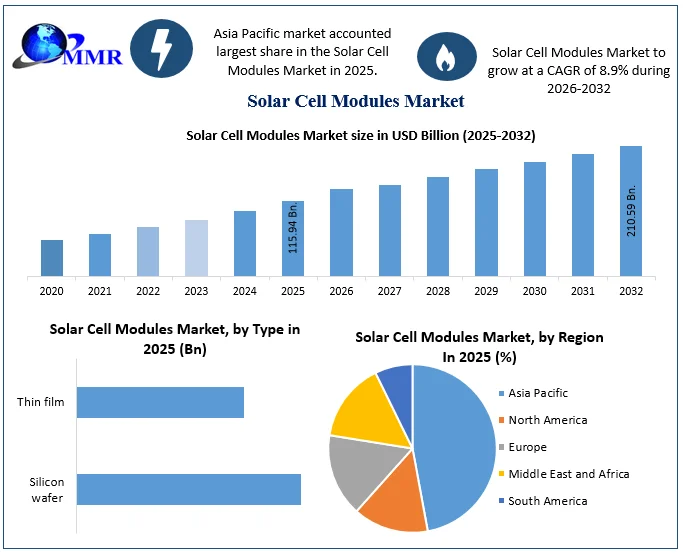
Market Scale: The global market reached USD 115.94 Billion in 2025 and is projected to expand to USD 210.59 Billion by 2032, registering an 8.9% CAGR.
Structural Materials: Silicon wafers and thin-film architectures dictate product forms, with arrays typically rated in a power consumption range of 50W to 350W.
Geographic Dominance: Europe maintains market dominance, closely followed by the Asia-Pacific region, which is backed by monumental industrial capital investments in China.
Upstream Bottlenecks: A global drop in raw industrial silicon manufacture has restricted feedstock availability, limiting structural supply-demand dynamics.
Emerging Opportunities: Decentralized off-grid electrification frameworks integrated with residential energy storage systems present massive scaling tracks in developing markets.
Why This Matters Now
A structural global shortage in raw silicon manufacturing has disrupted the upstream materials landscape, forcing solar array fabricators to re-engineer their raw material dependencies. At the same time, national federal governments are enforcing strict pollution controls on industrial manufacturing lines, transforming zero-emission energy generation into a compliance mandate. For chemical processors supplying foundational materials, utility investors, and energy procurement leaders, this supply chain strain requires an immediate pivot toward alternative architectures and localized raw material security. Delaying asset reallocations or failing to secure long-term feedstock contracts exposes manufacturing networks to high component pricing volatility and immediate project completion delays.
Market Overview
The global Solar Cell Modules Market achieved a valuation of USD 115.94 Billion in 2025. Driven by intense decarbonization mandates and expanding decentralized energy generation networks, total market revenue is expected to reach USD 210.59 Billion by 2032. This long-term expansion path represents a compound annual growth rate (CAGR) of 8.9%.
Commonly termed photovoltaic (PV) cells, these modules function as interconnected parallel or series arrays tied directly into local electrical grids. Commercial applications span highly structured configurations utilizing either conventional silicon wafers or advanced thin-film layouts. However, execution metrics face near-term infrastructure friction. High system entry costs and a lack of localized transmission grids in rural zones limit widespread, immediate utilization. To sustain this 8.9% growth path, manufacturers and utility groups must co-develop low-cost, decentralized storage technologies that balance grid load spikes without requiring immediate, extensive infrastructure overhauls.
Key Trends Driving Growth
Global federal authorities are deploying extensive financial assistance, tax benefits, optimized tariff plans, and low import duties to accelerate regional renewable adoption. These supportive regulatory frameworks insulate industrial buyers from initial capital strains, shifting corporate power procurement toward large-scale solar installations.
Concurrently, a massive surge in residential energy storage systems equipped with integrated PV charging panels is transforming regional consumer demand. More than 1 billion people globally currently operate with low or zero access to stable centralized electricity grids. Off-grid regional electrification initiatives, backed by institutional development programs, are rapidly deploying decentralized solar PV architectures across remote territories. This systemic shift toward independent domestic power production provides a reliable volume floor for module suppliers, bypassing historical dependencies on massive utility-scale grid connection.
Segment Insights
Dominant Product Type — Silicon Wafer Modules: Silicon wafers continue to command the primary volume share of the global manufacturing pipeline, serving as the core material foundation for traditional series and parallel grid arrays.
Fastest-Growing Product Type — Thin-Film Architectures: Thin-film layouts are expanding rapidly, driven by high demand for flexible integration and specialized, multi-source hybrid energy generation systems.
Dominant Applications — Monocrystalline and Multicrystalline: These applications dictate high-volume grid installations due to established efficiency metrics and standardized industrial production lines.
Emerging Applications — Cadmium Telluride (CdTe), Amorphous Silica (a-Si), and CIGS: Specialized materials like Copper Indium Gallium Selenide are capturing niche industrial shares where specific weight, flexibility, or unique light-absorption criteria are required.
Regional Growth Story
Europe currently maintains structural dominance across the global solar cell modules market. This leading position is sustained by aggressive consumer awareness programs, mandatory emission laws, and highly advanced financial support frameworks that incentivize immediate industrial and residential solar integration.
The Asia-Pacific region follows closely as a dominant production and consumption hub, characterized by massive capital deployment. In 2025, the photovoltaic sector in China recorded a massive direct investment of 80.8 Billion Yuan. Chinese manufacturing conglomerates are aggressively expanding their global reach by acquiring foreign manufacturers and constructing advanced production plants overseas. This outward investment strategy strengthens regional pricing power, allowing Asia-Pacific operations to export low-cost components worldwide.
Concurrently, the Middle East and Africa region is projected to experience a notable near-term solar PV installation expansion level of 7.5%. Faced with a scarcity of clean energy resources, regional governments are updating national development plans to balance their domestic power mix through large-scale renewable infrastructure mandates.
Competitive Landscape
The global competitive market features a concentrated mix of multi-billion-dollar international manufacturers and heavily subsidized state-backed energy enterprises. Key participants maintain market share through a combination of aggressive capacity additions, strategic mergers and acquisitions, and localized joint ventures designed to bypass national import tariffs.
To insulate operations from localized material shortages and intense pricing competition, market leaders are rapidly establishing vertically integrated production plants within key import regions. These strategic investments signal a shift toward regional supply localization, reducing international freight risks and protecting factory utilization rates. By locking in regional downstream consumption through direct utility partnerships, top-tier manufacturers can maintain stable production volumes even during periods of upstream feedstock volatility.
Recent Developments
China’s 80.8 Billion Yuan Outlay: China’s massive 2025 capital injection into its domestic PV infrastructure has accelerated the global deployment of high-volume silicon manufacturing lines.
Cross-Border Multi-Plant Expansions: Leading tier-one module suppliers initiated overseas factory constructions and international corporate acquisitions to maintain market access despite changing geopolitical tariff structures.
Hybrid Product Innovation: Engineering divisions launched multi-source renewable hybrid systems that combine traditional solar cell arrays with complementary alternative energy technologies to deliver continuous baseload power.
Strategic Implications
For supply chain directors and chemical procurement executives, managing a solar component portfolio requires navigating structural feedstock bottlenecks. Because a global drop in raw silicon manufacturing directly restricts the availability of foundational wafers, module buyers face sudden pricing spikes and extended procurement lead times.
To mitigate these supply constraints, procurement teams must move away from short-term spot-market purchasing and establish multi-year supply contracts directly with geographically diversified producers. Additionally, engineering teams must evaluate thin-film alternatives, such as Cadmium Telluride or CIGS architectures, to reduce reliance on standard silicon supply chains. As national regulations enforce stricter lifecycle tracking on industrial waste, chemical manufacturers that integrate circular recycling methods for retired solar panels will secure long-term preferential placement in public utility tenders.
Future Outlook
Long-term market consolidation will favor highly integrated manufacturing networks that control localized raw material refining and possess the capital to maintain overseas production facilities despite changing import duties. Foundries relying entirely on unhedged, third-party silicon wafer suppliers will face severe margin compression as raw material shortages and state-enforced industrial efficiency standards drive high-cost operations out of the market.
Analyst Perspective
“The solar cell modules sector is navigating a significant structural rebalancing where massive downstream volume demand is directly colliding with raw silicon feedstock constraints. While state-backed financial aid and decentralized residential projects continue to accelerate global module installations, securing upstream raw materials remains the primary operational challenge. The chemical processors and module manufacturers that successfully diversify into thin-film technologies while building localized, tariff-insulated production hubs will capture the next era of global clean energy infrastructure spending.” Ankita Kagawade, Materials & Chemicals Research Analyst, Maximize Market Research
About Maximize Market Research
Maximize Market Research Pvt. Ltd. (MMR) is a global market research and consulting company that provides reliable, data-focused, and practical business insights. The firm serves a wide range of industries, including healthcare, pharmaceuticals, technology, automotive, electronics, chemicals, personal care, and consumer goods. Through market forecasts, competitive analysis, strategic consulting, and industry impact assessments, MMR helps organizations understand changing market conditions, identify growth opportunities, and make informed business decisions for long-term success.
2nd Floor, Navale IT Park Phase 3
Pune Banglore Highway, Narhe
Pune, Maharashtra 411041, India
+91 9607365656
sales@maximizemarketresearch.com
