Key Highlights
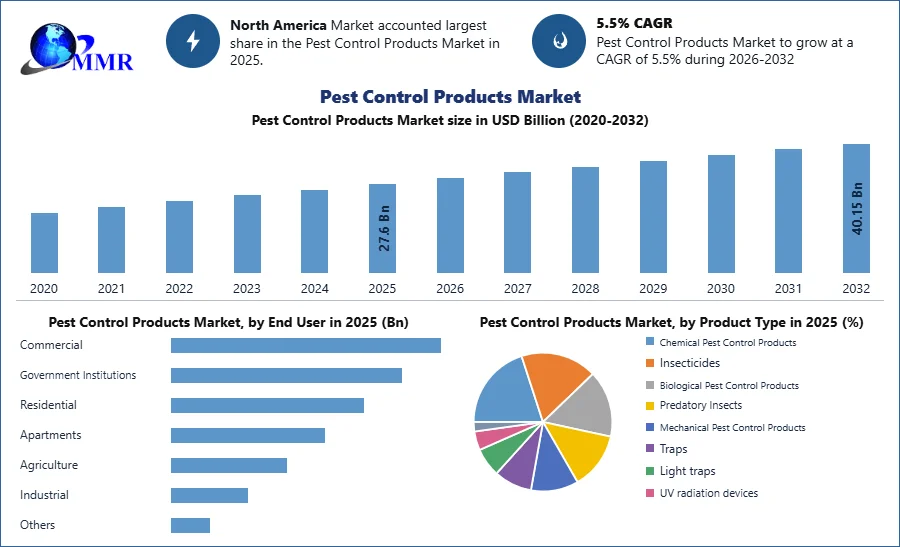
Market Expansion: The global market achieved a valuation of USD 27.6 Billion in 2025 and is projected to reach USD 40.15 Billion by 2032, advancing at a 5.5% CAGR.
Primary Application Drivers: Commercial establishments, food processing lines, and public facilities represent the largest consumption volume to meet mandatory hygiene rules.
Geographic Centers: North America retains the largest global market share, while the Asia-Pacific region functions as the fastest-growing geographical market.
Upstream Obstacles: Protracted business licensing timelines and extensive chemical registration testing costs delay direct market entry for new formulations.
Product Diversification: Growing biological resistance to conventional chemical formulations is forcing a shift toward targeted biopesticides and integrated management strategies.
Why This Matters Now
Escalating pest resistance to traditional chemical formulations has disrupted legacy product portfolios, forcing chemical manufacturers to invest heavily in advanced biological research. At the same time, national regulatory bodies are tightening maximum residue limits and chemical environmental assessments, making compliance a moving target. For specialty chemical executives, industrial procurement leaders, and facility operations directors, these shifting standards require an immediate move toward low-toxicity, targeted formulations. Continuing to rely entirely on standard, broad-spectrum commodity chemicals increases the risk of product bans, failed industrial hygiene audits, and costly delays in market entry.
Market Overview
The global Pest Control Products Market reached a valuation of USD 27.6 Billion in 2025. Driven by intense urbanization, changing climate patterns, and stricter corporate sanitation standards, total revenue is projected to expand to USD 40.15 Billion by 2032. This long-term growth path represents a steady compound annual growth rate (CAGR) of 5.5%.
Pest control involves the systematic prevention and mitigation of insects, rodents, and vector animals across agricultural, municipal, and commercial properties. However, suppliers face significant financial friction from extended testing cycles and multi-state registration fees. Because chemical registration and operational licensing demand significant capital and require multiple weeks for official review, smaller chemical formulators often face severe liquidity challenges before achieving commercial sales.
Key Trends Driving Growth
Rising public awareness regarding vector-borne infectious diseases—such as Zika virus, West Nile virus, and Lyme disease—is transforming residential and municipal purchasing patterns. Property owners are transitioning from reactive treatments to proactive, year-round preventive barrier methods to limit health risks and structural property damage.
Concurrently, strict corporate hygiene requirements across the food and beverage sectors are driving high-volume industrial product use. Global food processing hubs must undergo regular independent sanitation audits to retain operational permits. To comply with these standards, industrial facilities are partnering with professional pest management organizations that deploy targeted chemical and physical tracking tools. This regular audit cycle provides a stable, recession-resistant demand baseline for high-tier commercial formulations.
Segment Insights
Dominant End-User — Commercial Segment: Offices, hospitality networks, restaurants, and retail properties lead global volume consumption due to mandatory public health compliance codes and zero-tolerance sanitation policies.
Fastest-Growing Region — Asia-Pacific Infrastructure: Driven by rapid economic development and accelerating urbanization, this regional block leads global market acceleration at a 5.5% CAGR.
Primary Distribution Channel — B2B Procurement: Bulk procurement contracts, multi-facility institutional agreements, and direct agricultural supply networks command the primary market share.
Emerging Distribution Channel — B2C and Online Retail: The do-it-yourself (DIY) residential market is expanding rapidly via e-commerce, supported by targeted digital marketing and accessible doorstep delivery systems.
Value Drivers — Agricultural Crop Protection & Industrial Processing: Large-scale farming networks and manufacturing warehouses contribute significant high-value revenue through programmatic field and storage treatments.
Regional Growth Story
North America dominates the global pest control products market. This leading position is supported by high consumer awareness, advanced municipal vector-management programs, and strict public health frameworks tracking vector-borne pathogens. Rapid regional construction activity and commercial infrastructure additions regularly alter natural habitats, creating localized pest vectors that require proactive commercial management.
Europe represents the second-largest market region, characterized by a structural shift toward preventive management. European regulatory bodies enforce some of the strictest pesticide environmental restrictions globally, pushing chemical firms to develop biological alternatives.
In Asia-Pacific, rapid economic growth and urbanization are expanding habitats for urban pests, accelerating regional demand. Japan’s crop protection market is expanding at a 5.1% CAGR, driven by updated Maximum Residual Limits (MRLs) and strong government policies promoting sustainable farming practices.
Competitive Landscape
The global competitive environment is characterized by a concentrated group of multi-billion-dollar chemical corporations and international service consolidators. Top-tier participants protect their market positioning through extensive patent portfolios, proprietary active ingredients, and established international supply agreements.
To counter rising raw material volatility and bypass complex regional registration protocols, leading multinational firms are aggressively pursuing strategic joint ventures and research collaborations. These partnerships allow primary producers to leverage localized distribution networks and share the rising financial burden of regulatory testing. By co-developing specialized biopesticides with independent research institutions, major chemical firms can secure faster regional approvals, protect their pricing power, and maximize capacity utilization across specialized chemical synthesis reactors.
Recent Developments
Maximum Residual Limit Revisions: Regulatory adjustments in Japan forced global crop protection suppliers to reformulate active chemical matrices to maintain access to regional agricultural distribution networks.
Integrated Pest Management Expansion: Global service providers expanded their commercial service offerings, combining traditional chemical controls with biological and structural adjustments to minimize environmental footprints.
Biopesticide Asset Capitalization: Leading chemical enterprises increased capital allocations toward low-toxicity, targeted biological compounds to counter the spreading challenge of conventional chemical resistance.
Strategic Implications
For operations directors and chemical procurement executives, managing a pest control portfolio requires navigating intense regulatory compliance frameworks. Because changing environmental laws can phase out legacy active ingredients on short notice, manufacturing networks face sudden supply chain disruptions and raw material obsolescence.
To minimize these operational risks, procurement teams must move away from single-source chemical relationships and qualify alternative, low-toxicity formulations before regulatory changes occur. Furthermore, as corporate buyers place greater emphasis on ESG metrics, chemical suppliers that proactively commercialize certified biopesticides and integrated control tools will secure long-term contracts with major commercial facility managers.
Future Outlook
Long-term market consolidation will favor highly capitalized chemical enterprises capable of funding extended regulatory testing cycles while successfully transitioning their portfolios toward biological alternatives. Foundries and compounders that rely exclusively on legacy organophosphate or high-toxicity synthetic molecules will face structural margin erosion as state-enforced product bans and value-driven commercial procurement programs exclude high-risk chemicals from the market.
Analyst Perspective
“The global pest control products market is experiencing a profound structural shift where traditional chemical synthesis must adapt to tightening environmental boundaries and rising biological resistance. High-volume commercial compliance audits and expanding urbanization ensure a highly resilient downstream demand baseline. The chemical innovators that successfully navigate complex regional registration costs while commercializing targeted, low-toxicity biopesticides will command the next era of global industrial and agricultural sanitation supply chains.” Ankita Kagawade, Materials & Chemicals Research Analyst, Maximize Market Research
About Maximize Market Research
Maximize Market Research Pvt. Ltd. (MMR) is a global market research and consulting company that provides reliable, data-focused, and practical business insights. The firm serves a wide range of industries, including healthcare, pharmaceuticals, technology, automotive, electronics, chemicals, personal care, and consumer goods. Through market forecasts, competitive analysis, strategic consulting, and industry impact assessments, MMR helps organizations understand changing market conditions, identify growth opportunities, and make informed business decisions for long-term success.
2nd Floor, Navale IT Park Phase 3
Pune Banglore Highway, Narhe
Pune, Maharashtra 411041, India
+91 9607365656
sales@maximizemarketresearch.com
