Key Highlights
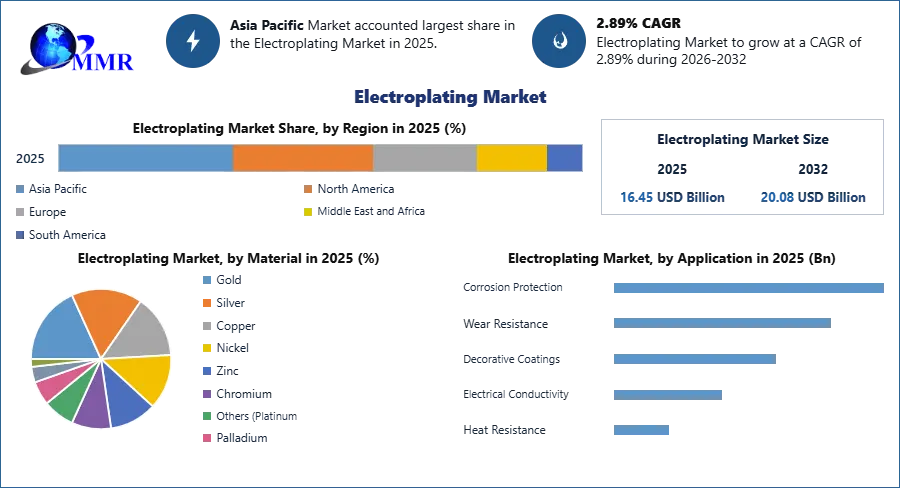
Market Expansion: Global valuation climbs from USD 16.45 million in 2025 to USD 20.08 million by 2032, maintaining a 2.89 percent CAGR.
Substrate Dominance: The nickel segment maintains its structural market leadership due to high-performance wear and corrosion resistance across severe environments.
Primary Functional Driver: Corrosion protection commands the largest application share, functioning as a critical production phase for maritime, infrastructure, and automotive components.
Geographic Concentration: The Asia-Pacific region dominates global consumption, fueled by China, Japan, India, and South Korea, which collectively generate over 50 percent of global passenger vehicle output.
Regulatory Headwinds: Strict cross-border environmental mandates regarding heavy metal effluents and cyanide-based electrolyte solutions restrict legacy operational capacities.
Why This Matters Now
Tightening environmental compliance frameworks and shifting downstream engineering standards are upending global surface finishing supply chains. Industrial manufacturers faces critical choices as traditional, low-cost chemical formulations clash with stringent toxic emission laws.
For procurement leaders and chemical suppliers, this structural transition alters material availability and pricing dynamics. Survival requires immediate capital alignment with advanced, non-cyanide electrolytes and high-durability chemistries. Failing to pivot threatens immediate regulatory closure or exclusion from top-tier aerospace and automotive supply networks.
Market Overview
The global Electroplating Market Size stood at USD 16.45 million in 2025 and is on track to reach USD 20.08 million by 2032, growing at a steady compound annual growth rate (CAGR) of 2.89 percent. This steady growth highlights the indispensable role of galvanic electrodeposition across major heavy industries. The process relies on passing electric currents through chemical solutions to reduce dissolved metal cations. This creates a uniform, high-performance metal layer on both ferrous and non-ferrous substrates.
Industrial supply chains depend on these microscopically thin coatings to protect high-value components from environmental degradation. However, chemical processors are currently squeezed between rising feedstock costs and strict waste disposal laws. The industry must invest heavily in chemical innovation to sustain margins while meeting strict toxicity rules.
Key Trends Driving Growth
Downstream automotive engineering remains the primary growth catalyst for the surface finishing sector. Automotiv Industry operations consume vast volumes of plating materials ranging from functional zinc to decorative gold. This sector values electroplating for its exceptional ability to halt long-term corrosion.
The industry’s rapid structural shift toward electric vehicles (EVs) has triggered an urgent need for specialized chemical coatings. EV components require palladium plating for advanced exhaust management systems and copper-nickel layers for high-voltage electronic assemblies.
Furthermore, industrial engineering projects are expanding rapidly into integrated smart vehicles and clean energy infrastructure. These modern applications require highly advanced metal coatings that can endure extreme thermal and electrical stress. This demand shifts production capacity away from basic commodity chemicals and toward higher-margin specialty formulations.
Segment Insights
Dominant Substrate Material: The Nickel Segment maintains structural leadership across the global market. Its dominance stems from unmatched corrosion resistance and physical durability. These traits are essential for high-wear automotive, aerospace, and semiconductor components.
Fastest-Growing High-Conductivity Material: The Gold and Copper Segments are expanding rapidly. This growth is driven by intense demand for high-performance printed circuit boards (PCBs) and electronic connector pins.
Dominant Application Layer: The Corrosion Protection Segment holds the largest operational market share. It remains a mandatory production step across the construction, marine, and automotive industries.
Dominant End-Use Sector: The Automotive Sector commands the highest volume of chemical consumption. It uses multi-layer decorative chrome and zinc-nickel alloys to extend vehicle lifespans.
Regional Growth Story
The Asia-Pacific region leads the global electroplating market, built on a dominant manufacturing base in China, Japan, India, and South Korea. These four countries generate more than 50 percent of global passenger vehicle manufacturing. This concentration gives local plating operations massive scale advantages.
China stands as the world’s largest automotive market, where intense domestic electric vehicle production by giants like BYD, Geely, and SAIC drives regional chemical consumption. These three manufacturers command over 35 percent of global plug-in EV sales. This creates a highly reliable pipeline of demand for specialty electrical and anti-corrosion plating solutions.
By 2026, Asia-Pacific is projected to control 31.64 percent of the global metal coatings market. North America will follow closely at 29.04 percent, led by heavy automotive and aerospace demand in the United States. Meanwhile, Europe is expected to secure a 28.39 percent market share, anchored by high manufacturing standards in Germany, France, and the United Kingdom.
Competitive Landscape
The global electroplating competitive landscape is defined by consolidation and rapid technological retooling. Leading chemical formulary firms are actively expanding production capacities and adjusting asset portfolios to protect their market positions. Tier-one suppliers are steering investments toward eco-friendlier chemical formulas to build long-term regulatory buffers.
This corporate focus on green chemistry directly shapes market pricing power. Firms with proprietary, low-toxicity formulas can command premium prices from automotive and electronics buyers who need to satisfy strict ESG mandates. Conversely, legacy factories reliant on basic cyanide or hexavalent chromium formulas face falling utilization rates as market demand shifts away from high-pollution methods.
Recent Developments
EV Supply Alignment: Plating corporations are shifting production lines to supply specialized high-conductivity copper and palladium chemistries tailored for global electric vehicle assembly plants.
Next-Generation R&D: Industrial laboratories are ramping up capital investments to develop multi-layer nickel and chromium processes that maximize rust prevention on thin, lightweight auto parts.
Alternative Technology Adoption: Chemical factories are installing alternative clean technologies to offset strict state caps on toxic air emissions and volatile organic compound (VOC) waste.
Strategic Implications
The major threat to long-term profitability centers on the severe environmental challenges tied to legacy plating processes. Heavy chemical operations involving cyanide and dense metals release hazardous air pollutants if left unmitigated. Degreasing lines also release volatile organic compounds that face strict state caps.
Because cyanide setups can damage respiratory and central nervous systems, environmental regulators are enforcing strict rules on effluent discharges. These clean water and air mandates impose heavy compliance costs on older factories. Consequently, surface finish procurement leaders must audit their vendor networks immediately. Buyers need to shift contracts toward modern, automated plants that use advanced closed-loop recycling to avoid sudden, state-enforced line closures.
Future Outlook
The global electroplating industry will transition over the next decade from basic commodity metal dipping into a high-precision chemical discipline. Profit margins will cluster around specialized suppliers capable of delivering uniform coatings for advanced micro-electronics and defense systems. Factories that rely on high-emission chemistry will face mounting financial pressure as carbon taxes and toxic waste fees increase. Ultimately, long-term market leadership belongs to chemical processors that integrate automated waste treatment directly into their production lines. This allows them to eliminate heavy metal emissions while maintaining high-volume output.
Analyst Perspective
“The global surface finishing market is undergoing a structural shift where environmental compliance dictates commercial survival. Manufacturers can no longer treat wastewater management as a secondary operational cost; it is now a core factor in retaining tier-one automotive and electronics contracts. As the Asia-Pacific region solidifies its vehicle manufacturing dominance, the chemical suppliers who master non-cyanide formulations and closed-loop resource recovery will secure long-term market share.”
— Ankita Kagawade, Chemicals & Materials Lead Analyst, Maximize Market Research
About Maximize Market Research
Maximize Market Research Pvt. Ltd. (MMR) is a global market research and consulting company that provides reliable, data-focused, and practical business insights. The firm serves a wide range of industries, including healthcare, pharmaceuticals, technology, automotive, electronics, chemicals, personal care, and consumer goods. Through market forecasts, competitive analysis, strategic consulting, and industry impact assessments, MMR helps organizations understand changing market conditions, identify growth opportunities, and make informed business decisions for long-term success.
2nd Floor, Navale IT Park Phase 3
Pune Banglore Highway, Narhe
Pune, Maharashtra 411041, India
+91 9607365656
sales@maximizemarketresearch.com
