Automotive e-axle Market: Driving the Next Wave of Electric Mobility Through Integrated Powertrain Innovation
Introduction
The global Automotive e-axle Market is emerging as a critical technology segment in the transition toward electrified transportation. As automakers accelerate electric vehicle (EV) development, integrated electric axle systems are becoming a preferred solution for improving vehicle efficiency, reducing component complexity, and optimizing overall performance. The growing adoption of battery electric vehicles (BEVs), hybrid electric vehicles (HEVs), and advanced commercial EV platforms is driving strong demand for compact, high-performance e-axle systems.
Automotive e-axles combine key drivetrain components, including the electric motor, power electronics, transmission, and differential, into a single integrated unit. This design enables manufacturers to reduce vehicle weight, improve energy efficiency, and enhance packaging flexibility. With governments worldwide introducing stricter emission regulations and investing in EV infrastructure, the automotive industry is witnessing a significant shift from traditional mechanical drivetrains toward intelligent electric propulsion technologies.
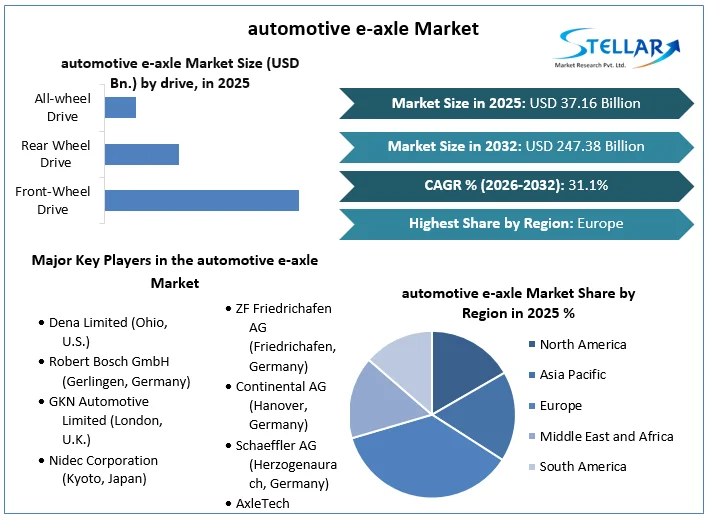
Automotive e-axle Market was valued at USD 37.16 billion in 2025. The global Automotive e-axle Market size is estimated to grow at a CAGR of 31.1 % over the forecast period.
Market Overview and Growth Outlook
The Automotive e-axle Market is experiencing rapid expansion due to increasing EV production, technological advancements in electric drivetrains, and rising consumer demand for sustainable transportation solutions. The market was valued at approximately USD 37.16 billion in 2025 and is projected to grow at a strong CAGR of 31.1% during the forecast period.
The rapid increase in electric vehicle sales across major automotive markets is one of the primary factors supporting market growth. Passenger cars, commercial vehicles, and electric buses are increasingly adopting e-axle systems because they offer higher efficiency compared with conventional drivetrain architectures.
Automotive manufacturers are focusing on developing lightweight and highly efficient e-axle solutions to improve driving range, charging efficiency, and vehicle performance. The integration of advanced semiconductor technologies, software-controlled power management, and high-density electric motors is further transforming the capabilities of modern electric drivetrains.
Key Factors Driving Automotive e-axle Market Growth
1. Rising Global Electric Vehicle Adoption
The expansion of the electric vehicle ecosystem is the most significant growth driver for the automotive e-axle market. Countries across North America, Europe, and Asia Pacific are implementing policies that encourage EV adoption through subsidies, emission reduction targets, and charging infrastructure development.
As electric vehicle manufacturers aim to improve efficiency and reduce manufacturing costs, integrated e-axle systems provide an attractive alternative to traditional drivetrain components. Their compact design allows automakers to maximize cabin space while improving vehicle performance.
The increasing production of electric passenger vehicles, delivery vans, and heavy-duty electric trucks is expected to create substantial opportunities for e-axle suppliers.
2. Demand for Lightweight and Efficient Powertrain Solutions
Vehicle efficiency has become a major priority for automotive manufacturers. Traditional drivetrains involve multiple components connected through complex mechanical systems, whereas e-axles integrate several functions into one compact assembly.
This integration reduces vehicle weight, minimizes energy losses, and improves overall drivetrain efficiency. Lightweight vehicle designs are especially important for EV manufacturers because reduced weight directly contributes to extended battery range.
The demand for advanced e-axle technologies is increasing as manufacturers compete to deliver EV models with longer driving ranges and improved performance characteristics.
3. Growth of Electric Commercial Vehicles
The electrification of commercial transportation is creating new opportunities for e-axle technology providers. Logistics companies, fleet operators, and public transportation agencies are increasingly adopting electric trucks, buses, and vans to reduce operating costs and meet sustainability objectives.
Electric commercial vehicles require durable and efficient drivetrain systems capable of handling higher loads and longer operating cycles. E-axles provide improved torque management and reliability, making them suitable for commercial applications.
The expansion of urban delivery networks and zero-emission transportation initiatives is expected to accelerate demand for heavy-duty e-axle solutions.
Technology Trends Transforming the Market
The automotive e-axle industry is witnessing rapid technological advancements aimed at improving efficiency, performance, and integration.
Integration of Silicon Carbide Power Electronics
The adoption of silicon carbide (SiC)-based power electronics is improving e-axle efficiency by reducing energy losses and supporting higher operating temperatures. SiC technology enables faster charging, improved thermal management, and better overall EV performance.
Software-Defined Electric Drivetrains
Modern e-axle systems are increasingly connected with vehicle software platforms that enable intelligent torque distribution, predictive maintenance, and optimized energy management.
Software-driven drivetrain control allows manufacturers to improve vehicle handling, increase battery efficiency, and deliver enhanced driving experiences.
Dual-Motor and All-Wheel Drive Applications
Demand for high-performance electric vehicles is encouraging the development of dual-motor e-axle systems. These solutions provide improved acceleration, enhanced traction, and better control in challenging driving conditions.
Luxury EV manufacturers and performance-oriented vehicle producers are increasingly adopting advanced e-axle configurations to differentiate their offerings.
Regional Market Insights
Asia Pacific: Leading Market Growth Region
Asia Pacific is expected to remain one of the dominant regions in the automotive e-axle market due to strong EV manufacturing capabilities, government support, and increasing investments in battery and electric drivetrain technologies.
Countries such as China, Japan, and South Korea are at the forefront of electric vehicle production. China, in particular, has become a major hub for EV manufacturing and component supply chains, supported by extensive charging infrastructure and favorable government initiatives.
The presence of established automotive suppliers and growing domestic EV demand continues to strengthen the region’s position in the global market.
Europe: Strong Focus on Sustainable Mobility
Europe is witnessing significant growth due to strict carbon emission regulations and ambitious electrification targets. Countries including Germany, France, and the United Kingdom are encouraging automakers to transition toward electric mobility.
European automotive manufacturers are investing heavily in EV platforms and localized drivetrain production to reduce dependency on traditional combustion technologies.
North America: Expanding EV Infrastructure
North America is experiencing rising demand for e-axle systems due to increasing electric vehicle investments by automakers and commercial fleet operators. Government initiatives supporting clean transportation and domestic EV manufacturing are creating new growth opportunities.
Challenges Affecting Market Expansion
Despite strong growth prospects, the automotive e-axle market faces several challenges.
One major challenge is the high initial cost associated with advanced electric drivetrain technologies. Manufacturing integrated e-axle systems requires significant investment in research, development, and specialized production facilities.
Supply chain constraints related to critical materials, semiconductor availability, and battery-related components can also impact production capacity.
Additionally, maintaining compatibility across different vehicle platforms remains a technical challenge for suppliers developing customized e-axle solutions.
𝐃𝐨𝐰𝐧𝐥𝐨𝐚𝐝 𝐅𝐫𝐞𝐞 𝐏𝐃𝐅 𝐁𝐫𝐨𝐜𝐡𝐮𝐫𝐞: https://www.stellarmr.com/report/req_sample/Automotive-e-axle-Market/719
Competitive Landscape
- Dena Limited (Ohio, U.S.)
- Robert Bosch GmbH (Gerlingen, Germany)
- GKN Automotive Limited (London, U.K.)
- Nidec Corporation (Kyoto, Japan)
- ZF Friedrichafen AG (Friedrichafen, Germany)
- Continental AG (Hanover, Germany)
- Schaeffler AG (Herzogenaurach, Germany)
- AxleTech (Michigan. U.S)
Future Outlook
The future of the Automotive e-axle Market looks promising as electric mobility continues to reshape the global automotive industry. Increasing EV penetration, government sustainability initiatives, and advancements in electric drivetrain technology will remain key growth catalysts.
Over the coming years, manufacturers are expected to focus on improving e-axle efficiency, reducing production costs, and developing scalable solutions for different vehicle categories. The integration of artificial intelligence, advanced sensors, and connected vehicle technologies will further enhance e-axle performance.
As automakers transition toward zero-emission transportation, automotive e-axles will play a central role in enabling efficient, lightweight, and high-performance electric vehicles. The market is positioned for significant expansion as the automotive sector moves toward a more sustainable and technology-driven future.
