Steering Column Control Module Market: Advancing Smart Vehicle Electronics Through Integrated Control Technologies
Introduction
The Steering Column Control Module Market is gaining momentum as modern vehicles become increasingly dependent on advanced electronic systems for improved safety, comfort, connectivity, and driving convenience. Steering column control modules have evolved from basic switching components into sophisticated electronic control units that manage multiple vehicle functions, including lighting controls, wipers, turn signals, steering wheel commands, and driver assistance interfaces.
The rapid transformation of the automotive industry toward connected, electric, and software-defined vehicles is creating significant opportunities for steering column control module manufacturers. Automakers are integrating more electronic features into vehicles to enhance user experience and comply with evolving safety regulations. As a result, demand for compact, reliable, and intelligent control modules is increasing across passenger vehicles, commercial vehicles, and electric mobility platforms.
With the growth of advanced driver assistance systems (ADAS), autonomous driving technologies, and vehicle electrification, steering column control modules are becoming an essential part of next-generation automotive architectures.
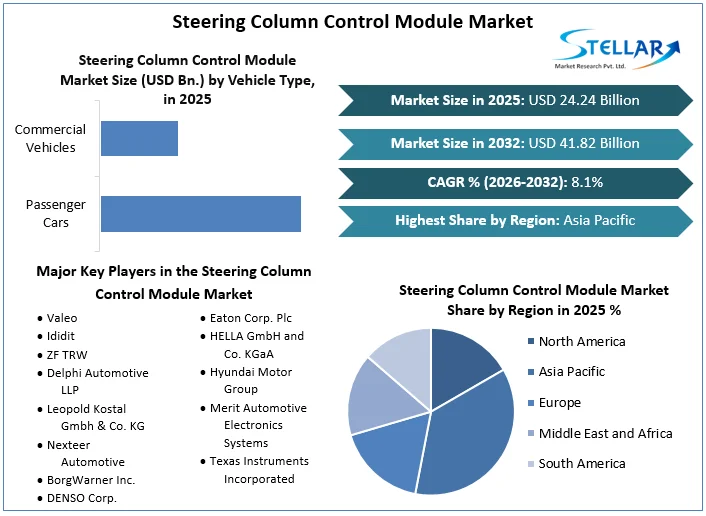
Steering Column Control Module Market was valued at USD 24.24 billion in 2025. Global Steering Column Control Module Market size is estimated to grow at a CAGR of 8.1% over the forecast period.
Market Overview and Growth Outlook
The Steering Column Control Module Market is expanding due to increasing vehicle electronics adoption and rising demand for integrated cockpit technologies. Traditional mechanical vehicle controls are being replaced by electronic systems that provide better functionality, improved reliability, and enhanced communication between vehicle components.
A steering column control module acts as an important interface between the driver and the vehicle’s electronic network. It allows drivers to operate essential functions conveniently while enabling manufacturers to reduce wiring complexity and improve vehicle design efficiency.
The growing production of passenger cars, electric vehicles, and premium automobiles is supporting market growth. Vehicle manufacturers are increasingly focusing on intelligent cockpit systems, digital interfaces, and enhanced safety features, which require advanced steering column electronics.
The increasing adoption of connected vehicles and centralized electronic architectures is expected to further accelerate demand for multifunctional steering column control modules during the coming years.
𝐃𝐨𝐰𝐧𝐥𝐨𝐚𝐝 𝐅𝐫𝐞𝐞 𝐏𝐃𝐅 𝐁𝐫𝐨𝐜𝐡𝐮𝐫𝐞: https://www.stellarmr.com/report/req_sample/Steering-Column-Control-Module-Market/721
Key Factors Driving Steering Column Control Module Market Growth
1. Increasing Vehicle Electrification and Advanced Electronics Integration
One of the major factors driving the steering column control module market is the rapid electrification of vehicles. Electric vehicles require advanced electronic control systems to manage various functions efficiently.
As EV manufacturers focus on improving driving experience, steering column modules are being integrated with additional features such as regenerative braking controls, drive mode selection, and intelligent vehicle interfaces.
The expansion of hybrid and battery electric vehicles is encouraging automotive suppliers to develop lightweight and highly efficient electronic modules compatible with modern vehicle platforms.
The shift toward electric mobility is also increasing demand for compact electronic architectures that reduce vehicle weight and improve energy efficiency.
2. Rising Adoption of Advanced Driver Assistance Systems (ADAS)
The growing implementation of ADAS technologies is another significant market driver. Modern vehicles are equipped with features such as lane assistance, adaptive cruise control, collision avoidance, and automated parking systems.
Steering column control modules play an important role in enabling communication between driver inputs, steering systems, and electronic control units. As vehicles become more automated, precise control mechanisms are becoming increasingly important.
Automakers are investing heavily in intelligent steering and control technologies to improve safety and create more responsive driving experiences.
3. Growing Demand for Premium and Connected Vehicles
Increasing consumer preference for connected and feature-rich vehicles is supporting the development of advanced steering column modules. Premium vehicles increasingly include multifunction steering systems, digital displays, voice-controlled features, and personalized driving settings.
The integration of multiple controls into a single electronic module helps manufacturers improve interior design flexibility while reducing component complexity.
As automotive brands compete through technology-driven differentiation, demand for advanced steering column control solutions continues to rise.
Technology Trends Transforming the Market
Integration with Vehicle Communication Networks
Modern steering column control modules are increasingly connected with vehicle communication systems such as Controller Area Network (CAN) and Automotive Ethernet. These technologies enable faster data exchange between different vehicle systems.
Improved connectivity allows steering column modules to support advanced vehicle functions while enhancing reliability and system performance.
Software-Defined Vehicle Architecture
The rise of software-defined vehicles is changing the role of automotive electronic components. Steering column modules are becoming programmable systems capable of receiving software updates and supporting new vehicle features.
This transformation allows manufacturers to enhance vehicle functionality throughout the vehicle lifecycle without major hardware modifications.
Miniaturization and Lightweight Design
Automotive suppliers are focusing on reducing module size and weight while increasing functionality. Compact designs help manufacturers optimize vehicle packaging and improve production efficiency.
Advanced semiconductor components and integrated electronic designs are enabling smaller and more powerful steering column control solutions.
Regional Market Insights
Asia Pacific: Leading Growth Opportunity
Asia Pacific is expected to remain a major market for steering column control modules due to strong automotive production, increasing vehicle electrification, and expanding electronics manufacturing capabilities.
Countries such as China, Japan, South Korea, and India are witnessing significant growth in automotive technology investments. China’s strong electric vehicle ecosystem and large-scale automotive manufacturing base make it one of the most important markets for vehicle electronic components.
India is also emerging as a promising market due to increasing vehicle production, growing demand for advanced safety features, and government initiatives supporting automotive manufacturing.
Europe: Strong Focus on Vehicle Safety and Innovation
Europe continues to experience demand growth due to strict vehicle safety regulations and rapid adoption of advanced automotive technologies.
Countries including Germany, France, and the United Kingdom are investing in electric mobility, autonomous driving research, and smart vehicle platforms. These developments are creating opportunities for steering column control module suppliers.
North America: Expansion Through Connected Mobility
North America is witnessing increasing demand due to growing electric vehicle adoption and investments in connected vehicle technologies.
Automakers and technology providers are focusing on developing intelligent vehicle systems that improve safety, convenience, and driving automation.
Market Challenges and Restraints
Despite positive growth prospects, the steering column control module market faces several challenges.
One major challenge is the increasing complexity of automotive electronic systems. As vehicles integrate more functions, manufacturers must ensure compatibility, cybersecurity, and reliability across multiple electronic platforms.
Another restraint is the pressure on suppliers to manage rising production costs. Advanced electronic components require significant investment in research, testing, and manufacturing capabilities.
Additionally, semiconductor supply chain disruptions can impact production timelines and increase component costs.
Competitive Landscape
- Valeo
- Ididit
- ZF TRW
- Delphi Automotive LLP
- Leopold Kostal Gmbh & Co. KG
- Nexteer Automotive
- BorgWarner Inc.
- DENSO Corp.
- Eaton Corp. Plc
- HELLA GmbH and Co. KGaA
𝐃𝐨𝐰𝐧𝐥𝐨𝐚𝐝 𝐅𝐫𝐞𝐞 𝐏𝐃𝐅 𝐁𝐫𝐨𝐜𝐡𝐮𝐫𝐞: https://www.stellarmr.com/report/req_sample/Steering-Column-Control-Module-Market/721
Future Outlook
The future of the Steering Column Control Module Market remains positive as automotive manufacturers continue transitioning toward smarter and more connected vehicles.
The increasing adoption of electric vehicles, autonomous technologies, and advanced cockpit systems will create new opportunities for market participants. Future steering column modules are expected to incorporate enhanced connectivity, artificial intelligence-based controls, and improved cybersecurity features.
As vehicle architectures become more centralized and software-driven, steering column control modules will continue evolving from simple control interfaces into advanced electronic platforms.
The growing focus on safety, automation, and user experience will ensure sustained demand for innovative steering column control solutions across global automotive markets.
