Key Highlights
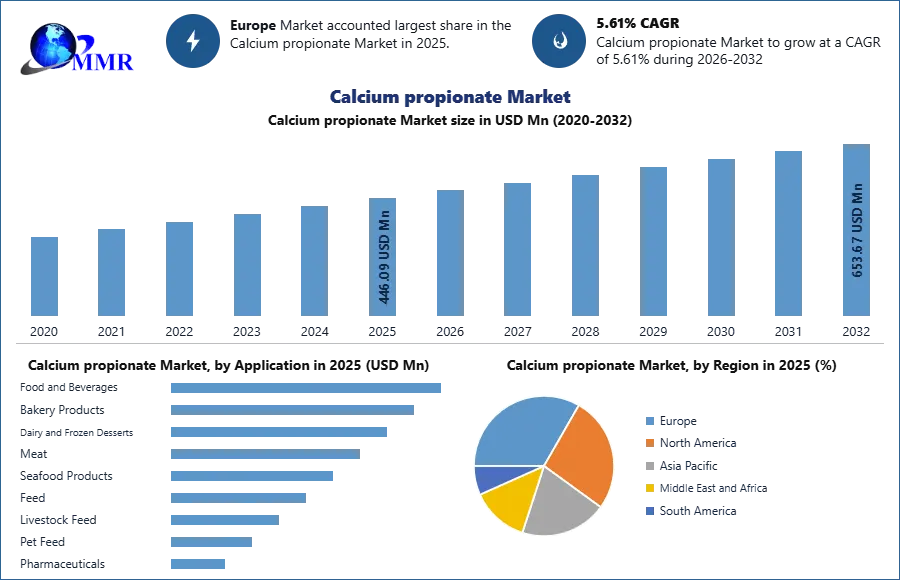
Market Valuation: The global calcium propionate market reached USD 446.09 Million in 2025 and is projected to expand to USD 653.67 Million by 2032.
Growth Velocity: The market exhibits a steady compound annual growth rate (CAGR) of 5.61% from 2026 to 2032, driven by industrial food preservation.
Primary Application: Bakery products remain the dominant application segment due to strict requirements for structural shelf-life extension and mold prevention.
Feedstock Sensitivity: Market stability remains heavily tied to the pricing, production capacity, and supply chains of raw propionic acid and calcium hydroxide.
Regulatory Pressures: Shifting international safety mandates regarding synthetic food additives are forcing manufacturers to optimize chemical purity levels.
Why This Matters Now
Volatile industrial logistics and shifting regulatory frameworks are forcing global food ingredient manufacturers to lock in long-term chemical supply contracts immediately. Companies that fail to adapt their procurement strategies risk severe margin compression as the cost of foundational feedstocks faces regional pricing spikes.
What changed is the baseline expectation for food shelf-life stability in urban supply networks. Rapid urbanization and consolidated industrial baking setups mean products require extended storage durability without compromising structural safety. Procurement leaders and chemical producers benefit from this shift because it establishes a recession-proof demand floor, though it simultaneously intensifies compliance costs for low-margin commodity chemical operations.
Market Overview
The global Calcium Propionate Market Size was valued at USD 446.09 Million in 2025. Total revenue generated by the industry is expected to grow at a CAGR of 5.61% from 2026 to 2032, reaching nearly USD 653.67 Million by the end of the forecast period. Functioning as a non-corrosive crystalline powder or granule, calcium propionate serves as a critical antimicrobial agent that inhibits mold and bacterial growth across multiple downstream industries.
The fundamental industrial value proposition of calcium propionate lies in its operational efficiency. Unlike alternative preservation agents, it does not interfere with the leavening action of yeast in baking processes, making it irreplaceable for large-scale bread production lines. This chemical property secures its position as a primary preservation asset for global food logistics systems.
Key Trends Driving Growth
Industrial food processing automation requires long-distance distribution networks, which directly boosts the consumption of effective preservation chemicals. The primary commercial driver is the rising volume of convenience food consumption across emerging economies, where ambient temperature supply chains lack widespread refrigeration. Consequently, industrial bakers utilize increased dosages of calcium propionate to minimize product spoilage and costly retail returns.
Simultaneously, the global animal feed industry is integrating calcium propionate into automated feeding systems to prevent mold formation in stored grain silos. This dual-market pull from both human nutrition and agricultural feed sectors protects chemical manufacturers against cyclical downturns in any single downstream market. Furthermore, advancements in dust-free granular formulations are improving factory-floor handling, reducing waste, and driving plant-level operational efficiencies.
Segment Insights
Dominant Segment: Food and Bakery Products. This application sector commands the highest market share because large-scale commercial bakeries require continuous mold inhibition to survive long-distance logistics.
Fastest-Growing Segment: Animal Feed and Agriculture. Rapidly expanding livestock sectors across developing nations are adopting this chemical to maintain nutritional integrity in compound feed during seasonal humidity spikes.
Feedstock Trends: The segment is dominated by the synthetic propionic acid pathway, though manufacturers face increasing pressure to stabilize raw material input costs amid fluctuating petrochemical pricing.
Regional Growth Story
North America represents the largest regional market for calcium propionate, underpinned by highly consolidated industrial bakery networks in the United States. The region’s advanced logistics systems require chemical preservatives that guarantee extended shelf-life across multiple time zones. High per-capita consumption of packed bakery items and strict food safety regulations enforced by the FDA ensure steady, high-volume demand from domestic chemical blenders.
In Europe, production centers in Germany face a complex landscape characterized by rigorous EFSA purity standards and carbon reduction mandates. German chemical producers are optimizing synthesis pathways to reduce energy consumption and manage high feedstock input costs. Meanwhile, the Asia-Pacific region, spearheaded by China and India, is experiencing the fastest manufacturing capacity additions. Local governments in these hubs are investing in food safety infrastructure, which accelerates the transition from traditional preservation methods to standardized calcium propionate application.
Competitive Landscape
The global calcium propionate market features a mix of multinational chemical conglomerates and specialized food ingredient producers. Top-tier manufacturers maintain market dominance through backward integration into propionic acid production, shielding themselves from raw material shortages. This structural integration gives large players significant pricing power over smaller, non-integrated competitors who must buy feedstocks on volatile spot markets.
Competitive pressure is manifesting through targeted regional capacity expansions rather than consolidation via mega-mergers. Companies are focusing capital investments on establishing local blending facilities close to major downstream bakery and feed clusters in East Asia and Latin America. This strategy reduces international shipping costs and allows chemical suppliers to offer highly responsive, just-in-time logistics services to major industrial food brands.
Recent Developments
Production Upgrades: Leading chemical enterprises have deployed advanced automated crystallization technologies to increase the purity index of food-grade calcium propionate.
Supply Chain Agreements: Major chemical distributors have formalized long-term sourcing partnerships with propionic acid manufacturers to guarantee uninterrupted production runs during energy supply disruptions.
Formulation Innovation: Manufacturers have introduced specialized low-dust granular formats to enhance workplace safety and minimize product loss during industrial mixing processes.
Strategic Implications
The shifting mechanics of the calcium propionate market signal a clear transition toward localized production and specialized chemical purity. For chemical manufacturers, investing in high-grade synthesis lines is no longer optional; it is a baseline requirement to enter premium Western supply chains. Procurement executives must move away from transactional spot-market purchasing and instead cultivate strategic supply alliances to insulate their production lines from feedstock pricing spikes.
As capacity continues to expand in the Asia-Pacific region, export dynamics will likely shift, creating a surplus of low-cost commodity-grade calcium propionate. This development will force Western producers to pivot toward premium, high-solubility specialty grades to protect their profit margins. Ultimately, manufacturers that achieve the lowest carbon footprint in their propionic acid sourcing will gain a structural competitive advantage in regions governed by strict environmental mandates.
Future Outlook
The trajectory of the calcium propionate market will be defined by the industry’s ability to balance cost efficiency with shifting regulatory standards. Companies that successfully implement energy-efficient manufacturing processes and secure reliable, non-volatile raw material streams will solidify their market share. Industrial buyers who diversify their supplier networks across multiple geographic hubs will successfully mitigate future trade bottlenecks and maintain continuous production capabilities.
Analyst Perspective
“The global calcium propionate market is undergoing a significant transformation driven by the modernization of food supply chains in developing economic zones,” said Ankita Kagawade, Analyst at Maximize Market Research. “Chemical producers who proactively optimize their feedstock supply chains and invest in high-purity granular formulations will capture the highest margin growth as downstream bakery and agriculture sectors demand stricter quality performance.”
About Maximize Market Research
Maximize Market Research Pvt. Ltd. (MMR) is a global market research and consulting company that provides reliable, data-focused, and practical business insights. The firm serves a wide range of industries, including healthcare, pharmaceuticals, technology, automotive, electronics, chemicals, personal care, and consumer goods. Through market forecasts, competitive analysis, strategic consulting, and industry impact assessments, MMR helps organizations understand changing market conditions, identify growth opportunities, and make informed business decisions for long-term success.
2nd Floor, Navale IT Park Phase 3
Pune Banglore Highway, Narhe
Pune, Maharashtra 411041, India
+91 9607365656
sales@maximizemarketresearch.com
