Hygroscopic Building Material Market: Sustainable Construction Trends Drive Demand for Moisture-Regulating Materials
The Hygroscopic Building Material Market is witnessing significant growth as the construction industry shifts toward sustainable, energy-efficient, and climate-responsive building solutions. Hygroscopic materials, which can naturally absorb and release moisture from the surrounding environment, are gaining importance due to their ability to improve indoor air quality, regulate humidity levels, and enhance occupant comfort.
With increasing awareness about green buildings, rising demand for eco-friendly construction materials, and stricter energy efficiency standards, architects, builders, and developers are increasingly adopting hygroscopic materials in residential, commercial, and industrial projects. The market is expected to expand steadily during the forecast period as sustainability becomes a central focus in modern construction practices.
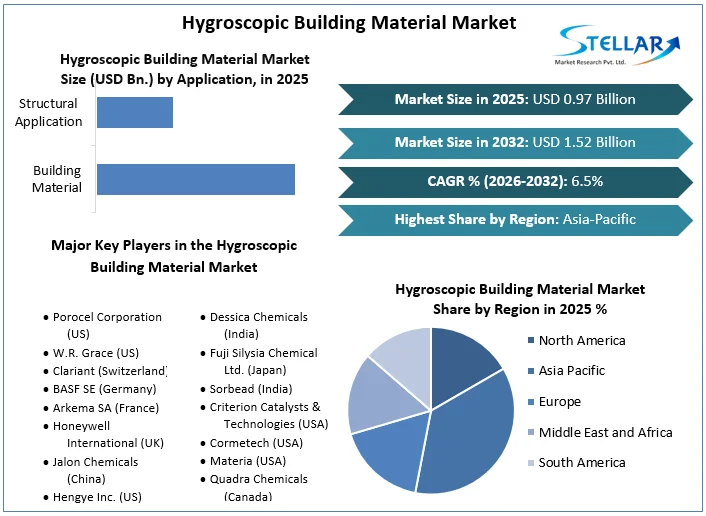
The Hygroscopic Building Material Market was valued at USD 0.97 billion in 2025, and is predicted to grow at a CAGR of 6.5 percent to USD 1.52 billion by 2032.
𝐃𝐨𝐰𝐧𝐥𝐨𝐚𝐝 𝐅𝐫𝐞𝐞 𝐏𝐃𝐅 𝐁𝐫𝐨𝐜𝐡𝐮𝐫𝐞: https://www.stellarmr.com/report/req_sample/Hygroscopic-Building-Material-Market/922
Understanding Hygroscopic Building Materials
Hygroscopic building materials are materials capable of interacting with atmospheric moisture by absorbing excess humidity and releasing it when the air becomes dry. These materials help maintain a balanced indoor environment without relying heavily on mechanical ventilation or artificial humidity control systems.
Common examples include wood, clay-based materials, cellulose insulation, natural fibers, lime-based products, and certain advanced composites. Unlike conventional construction materials that may trap moisture and contribute to mold growth or structural damage, hygroscopic materials support passive moisture management and improve building durability.
The growing preference for natural and renewable materials has positioned hygroscopic solutions as a key component of sustainable architecture and low-energy building designs.
Market Growth Drivers
Rising Demand for Sustainable Construction Solutions
One of the primary factors driving the Hygroscopic Building Material Market is the increasing adoption of sustainable construction practices. Governments, developers, and consumers are placing greater emphasis on reducing carbon emissions and improving building energy performance.
Green building certifications and environmental regulations are encouraging the use of materials with lower environmental impact. Hygroscopic materials contribute to sustainability by reducing dependence on mechanical climate control systems, thereby lowering energy consumption and operational costs.
Growing Focus on Indoor Air Quality
Indoor air quality has become a major concern, especially with increased awareness of the relationship between building environments and human health. Excess moisture can lead to mold formation, unpleasant odors, and respiratory issues, while excessively dry environments can cause discomfort.
Hygroscopic building materials help stabilize indoor humidity levels by naturally managing moisture fluctuations. This capability makes them increasingly attractive for residential buildings, healthcare facilities, schools, and office spaces where occupant well-being is a priority.
Expansion of Green Building Infrastructure
The global construction sector is experiencing rapid transformation due to smart city initiatives, sustainable urban development, and energy-efficient building requirements. Developers are incorporating advanced materials that support long-term environmental performance.
The growing number of green construction projects across regions such as Europe, North America, and Asia Pacific is creating new opportunities for manufacturers of hygroscopic materials.
Key Market Trends Shaping the Industry
Integration of Natural and Bio-Based Materials
A major trend influencing the Hygroscopic Building Material Market is the rising use of bio-based materials. Wood fiber insulation, hemp-based products, cellulose materials, and other renewable resources are gaining popularity due to their moisture regulation properties and environmental advantages.
Manufacturers are investing in research and development to improve the durability, fire resistance, and performance of natural materials while maintaining their sustainable characteristics.
Development of Advanced Composite Materials
While traditional hygroscopic materials remain widely used, technological advancements are leading to the development of engineered solutions with enhanced performance. Advanced composites combine natural fibers with modern processing techniques to improve strength, moisture resistance, and application flexibility.
These innovations are expanding the use of hygroscopic materials beyond traditional residential construction into commercial and industrial applications.
Increasing Adoption in Energy-Efficient Buildings
Energy-efficient buildings require materials that work alongside passive design strategies. Hygroscopic materials support these approaches by minimizing humidity fluctuations and improving thermal comfort.
As energy regulations become stricter worldwide, demand for materials that contribute to lower operational energy consumption is expected to increase.
Regional Market Outlook
Europe Leading Sustainable Material Adoption
Europe represents one of the most significant markets for hygroscopic building materials due to strong sustainability policies, advanced green construction standards, and high consumer awareness regarding environmentally friendly buildings.
Countries such as Germany, France, and the Nordic nations are actively promoting energy-efficient construction practices. The region’s focus on reducing carbon emissions from buildings is encouraging the adoption of renewable and moisture-regulating materials.
North America Witnessing Growing Demand
North America is experiencing rising demand for sustainable construction technologies due to increasing investments in green buildings and energy-efficient infrastructure. The United States and Canada are witnessing greater adoption of natural insulation materials and environmentally responsible construction solutions.
Growing awareness among homeowners and commercial developers regarding indoor air quality is further supporting market expansion.
Asia Pacific Emerging as a High-Growth Region
Asia Pacific is expected to provide significant growth opportunities due to rapid urbanization, infrastructure development, and increasing environmental concerns. Countries such as China, India, and Japan are investing in sustainable urban projects and energy-efficient buildings.
Government initiatives promoting green construction and the adoption of advanced building technologies are expected to create favorable opportunities for market participants.
Challenges Affecting Market Expansion
Despite strong growth prospects, the Hygroscopic Building Material Market faces certain challenges. Higher initial costs compared with conventional construction materials can limit adoption, particularly in price-sensitive markets.
Additionally, concerns related to material availability, installation expertise, fire resistance, and long-term performance may influence purchasing decisions. Manufacturers need to focus on improving product standardization, certification, and awareness among construction professionals.
Opportunities for Market Participants
The growing emphasis on carbon-neutral buildings presents significant opportunities for manufacturers and investors. Increasing demand for environmentally responsible materials creates opportunities for companies developing innovative solutions with improved performance characteristics.
Collaboration between material manufacturers, architects, construction firms, and research organizations can accelerate product development and market penetration.
The integration of digital building technologies, including building information modeling (BIM) and smart monitoring systems, can further enhance the effectiveness of hygroscopic materials by enabling better moisture management strategies.
Competitive Landscape
- Porocel Corporation (US)
- W.R. Grace (US)
- Clariant (Switzerland)
- BASF SE (Germany)
- Arkema SA (France)
- Honeywell International (UK)
- Jalon Chemicals (China)
- Hengye Inc. (US)
- Dessica Chemicals (India)
- Fuji Silysia Chemical Ltd. (Japan)
𝐃𝐨𝐰𝐧𝐥𝐨𝐚𝐝 𝐅𝐫𝐞𝐞 𝐏𝐃𝐅 𝐁𝐫𝐨𝐜𝐡𝐮𝐫𝐞: https://www.stellarmr.com/report/req_sample/Hygroscopic-Building-Material-Market/922
Future Outlook
The future of the Hygroscopic Building Material Market is closely linked with the global transition toward sustainable construction. As governments implement stricter environmental regulations and consumers demand healthier living spaces, moisture-regulating materials are expected to become an important part of modern building design.
Advancements in material science, increasing use of renewable resources, and growing investments in energy-efficient infrastructure will continue to support market growth. Companies that prioritize innovation, sustainability, and performance improvement are likely to benefit from emerging opportunities in this evolving market.
Overall, hygroscopic building materials represent a significant step toward creating resilient, energy-efficient, and environmentally responsible buildings. The market is expected to maintain steady expansion as the construction industry moves toward a greener and more sustainable future.
