Automated Construction Equipment Market: How Automation is Transforming the Future of Construction
The global construction industry is undergoing a remarkable transformation as automation, artificial intelligence (AI), and connected technologies redefine how infrastructure projects are planned and executed. Labor shortages, increasing infrastructure investments, rising safety concerns, and the need for greater operational efficiency have accelerated the adoption of automated construction equipment across residential, commercial, industrial, and mining applications. From autonomous excavators and bulldozers to GPS-guided graders and intelligent loaders, automation is helping construction companies improve productivity while reducing costs and project delays.
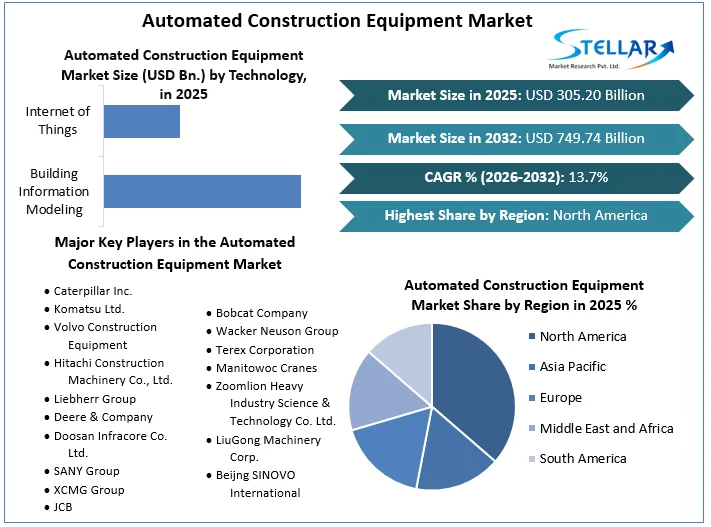
According to industry analysis by Stellar Market Research, the Automated Construction Equipment Market was valued at USD 305.20 billion in 2025 and is projected to reach USD 749.74 billion by 2032, expanding at a CAGR of 13.7% during the forecast period. This impressive growth reflects the increasing integration of digital technologies into heavy construction equipment worldwide.
𝐃𝐨𝐰𝐧𝐥𝐨𝐚𝐝 𝐅𝐫𝐞𝐞 𝐏𝐃𝐅 𝐁𝐫𝐨𝐜𝐡𝐮𝐫𝐞: https://www.stellarmr.com/report/req_sample/Automated-Construction-Equipment-Market/1550
Understanding Automated Construction Equipment
Automated construction equipment refers to heavy machinery equipped with advanced technologies that enable semi-autonomous or fully autonomous operation. These machines utilize GPS, LiDAR, sensors, machine vision, telematics, AI algorithms, and Internet of Things (IoT) connectivity to perform construction tasks with minimal human intervention.
Unlike conventional machinery, automated equipment can perform repetitive tasks with greater precision, monitor operating conditions in real time, optimize fuel consumption, and reduce operator fatigue. Equipment manufacturers are increasingly incorporating intelligent control systems that allow machines to operate more safely and efficiently even in challenging construction environments.
Common examples include:
Autonomous excavators
Automated bulldozers
Intelligent wheel loaders
Driverless dump trucks
Robotic concrete placement equipment
GPS-guided graders
Automated compactors
Remote-controlled demolition equipment
These technologies are becoming increasingly valuable as construction companies seek to complete projects faster while maintaining higher quality standards.
Key Factors Driving Market Growth
Rising Infrastructure Development
Governments worldwide continue investing heavily in transportation networks, smart cities, renewable energy projects, airports, railways, bridges, and urban housing. Massive infrastructure initiatives require high-performance machinery capable of operating continuously with minimal downtime.
Automation enables construction firms to manage large-scale projects more efficiently by reducing project delays and improving equipment utilization.
Labor Shortages Across Construction
One of the biggest challenges facing the construction industry is the shortage of skilled equipment operators. Many developed economies are experiencing aging workforces, while fewer young professionals are entering heavy equipment operations.
Automated construction equipment helps address this challenge by allowing fewer operators to supervise multiple machines simultaneously while improving productivity.
Improved Safety Standards
Construction remains one of the world’s highest-risk industries. Automated equipment significantly reduces human exposure to dangerous working conditions such as mining operations, tunnel construction, demolition sites, and hazardous environments.
Remote operation and autonomous navigation minimize workplace accidents while enhancing compliance with occupational safety regulations.
Growing Adoption of Artificial Intelligence
AI-powered construction equipment continuously analyzes operational data, identifies obstacles, optimizes machine movement, and predicts maintenance requirements. Predictive analytics reduce equipment downtime and improve project scheduling.
Machine learning algorithms are also helping equipment adapt to changing site conditions, making automation increasingly practical for complex construction projects.
Emerging Technologies Transforming the Industry
Automation in construction extends beyond autonomous driving. Several advanced technologies are shaping the future of heavy equipment.
Internet of Things (IoT)
Connected sensors monitor equipment performance in real time, enabling fleet managers to track machine health, fuel efficiency, engine temperature, and maintenance schedules remotely.
GPS and Machine Control
Advanced positioning systems improve grading accuracy, excavation depth, and site mapping. Automated machine control reduces material waste while improving construction precision.
Digital Twins
Construction companies increasingly use digital twin technology to create virtual models of equipment and project sites. These models help optimize workflows and simulate construction activities before physical work begins.
Remote Monitoring
Cloud-based fleet management platforms enable project managers to supervise equipment across multiple job sites from centralized control centers, improving operational visibility and reducing maintenance costs.
Market Challenges
Despite strong growth prospects, the market faces several obstacles.
High Initial Investment
Automated construction equipment requires substantial capital investment. Advanced sensors, AI software, automation systems, and connectivity features increase equipment costs, making adoption challenging for small and medium-sized contractors.
Cybersecurity Concerns
As equipment becomes increasingly connected, protecting operational data and preventing cyberattacks has become an important priority. Manufacturers continue investing in secure communication protocols and software updates to safeguard automated systems.
Technical Skill Requirements
Operating and maintaining intelligent construction equipment requires specialized technical expertise. Companies must invest in workforce training to maximize the benefits of automation technologies.
Regional Market Insights
North America Leads Adoption
North America remains one of the largest markets for automated construction equipment due to strong investments in transportation infrastructure, advanced mining operations, and widespread adoption of digital construction technologies. The region also benefits from high labor costs, encouraging contractors to invest in automation for improved efficiency.
Asia-Pacific Shows the Fastest Growth
Asia-Pacific is expected to witness the fastest market growth during the forecast period. Rapid urbanization, industrial expansion, smart city projects, and government infrastructure spending in countries such as China, India, Japan, and South Korea continue driving equipment demand.
China remains a major manufacturing hub for construction machinery, while India is investing significantly in highways, metro rail systems, airports, and affordable housing projects that require advanced construction equipment.
Europe Focuses on Sustainable Construction
European countries are increasingly adopting automated and electric construction equipment to reduce emissions and improve energy efficiency. Strict environmental regulations and sustainability goals are encouraging contractors to modernize their fleets with cleaner and smarter machinery.
𝐃𝐨𝐰𝐧𝐥𝐨𝐚𝐝 𝐅𝐫𝐞𝐞 𝐏𝐃𝐅 𝐁𝐫𝐨𝐜𝐡𝐮𝐫𝐞: https://www.stellarmr.com/report/req_sample/Automated-Construction-Equipment-Market/1550
Competitive Landscape
- Caterpillar Inc.
- Komatsu Ltd.
- Volvo Construction Equipment
- Hitachi Construction Machinery Co., Ltd.
- Liebherr Group
- Deere & Company
- Doosan Infracore Co. Ltd.
- SANY Group
- XCMG Group
- JCB
Future Opportunities
The future of automated construction equipment looks highly promising as digital transformation accelerates across the construction sector.
Several emerging opportunities are expected to drive long-term market expansion:
Fully autonomous construction sites
AI-assisted project management
Electric and hybrid heavy equipment
Integration with Building Information Modeling (BIM)
Robotics for repetitive construction activities
Drone-assisted site surveying
Predictive maintenance using big data analytics
5G-enabled connected construction equipment
Increasing investments in smart infrastructure and sustainable construction practices will further expand the adoption of intelligent machinery worldwide.
Conclusion
Automation is redefining the construction industry by making projects safer, faster, and more cost-effective. As labor shortages persist and infrastructure investments continue to rise, construction companies are increasingly turning to automated equipment to improve productivity and operational efficiency. Advances in artificial intelligence, IoT, GPS guidance, machine learning, and remote monitoring are enabling construction machinery to perform complex tasks with greater precision than ever before.
Although challenges such as high equipment costs and workforce training remain, continuous technological innovation and growing government support for infrastructure development are expected to sustain strong market growth. With the market projected to expand significantly through 2032, automated construction equipment will play a pivotal role in shaping the future of global construction, helping contractors deliver smarter, safer, and more sustainable projects across diverse industries.
