Key Highlights
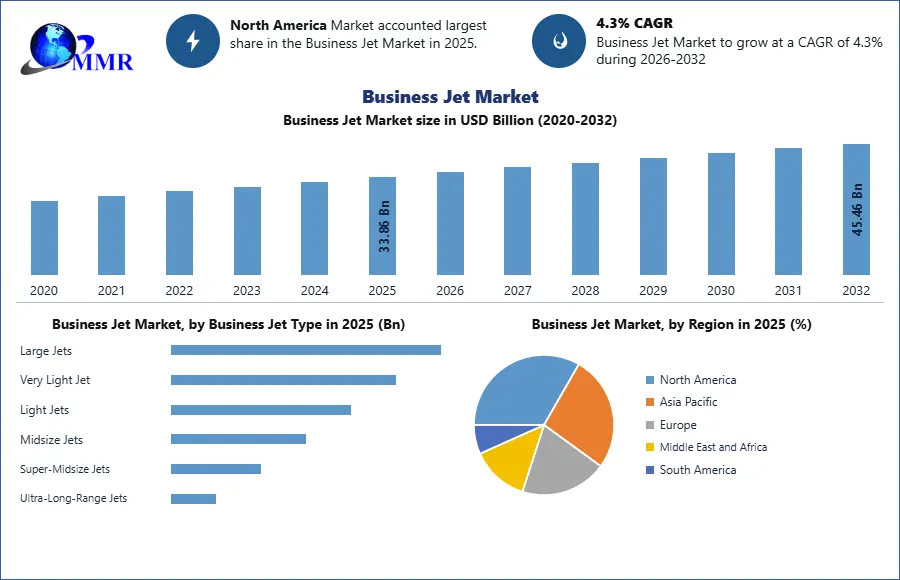
Market Capitalization: The global business jet market achieved a baseline valuation of USD 33.86 billion in 2025 and is projected to expand to USD 45.46 billion by 2032.
Expansion Velocity: The sector is growing at a compound annual growth rate (CAGR) of 4.3% across the 2026 to 2032 forecast horizon.
Structural Dominance: The large jet segment led the type classification in 2025, driven by higher unit pricing structures and spacious cabins accommodating up to 19 passengers.
Geographic Concentration: North America secured the dominant market share in 2025, supported by the world’s most dense corporate aviation airport network.
Core Growth Catalyst: Ongoing product innovation focused on next-generation propulsion, advanced composite materials, and enhanced range capabilities.
Why This Matters Now
Aerospace original equipment manufacturers face immediate operational bottlenecks as the demand for long-range, large-cabin corporate aircraft collides with rigid manufacturing tolerances and legacy production limitations. Aviation assembly lines can no longer rely on unmonitored manual fastening, disconnected supply networks, and static component testing without risking severe delivery delays and catastrophic quality control failures.
What changed? The design complexity of private aircraft has increased significantly, transforming the standard corporate jet into a high-density electronics installation that requires automated assembly checking and real-time process monitoring. Why now? Global corporate profitability has driven private aviation asset acquisition to record levels, forcing production plants to rapidly adopt flexible automation systems to fulfill extensive order backlogs. Who benefits? Industrial technology providers, system integrators, and precision tooling manufacturers who deploy advanced manufacturing execution systems (MES) stand to capture substantial multi-year contracts as airframe fabricators modernize their facilities.
What happens next? Aerospace engineering leaders will rapidly accelerate the installation of synchronized programmable logic controllers (PLCs), edge computing hardware, and automated machine vision arrays across their component production floors. This targeted factory modernization allows aircraft builders to scale the output of complex composite wing structures and advanced avionics bays while maintaining full traceability and safety compliance across every assembly step.
Market Overview
The global Business jet market Size functions at the absolute pinnacle of high-precision structural fabrication and advanced electronic systems integration. The industry is experiencing structural changes in its production base, moving away from customized, manual assembly methods toward standardized, data-driven manufacturing frameworks. Valued at USD 33.86 billion in 2025, the market’s steady climb to USD 45.46 billion by 2032 shows a massive capital commitment to advanced fleet deployment. This structural expansion highlights a major corporate requirement for rapid long-distance logistics rather than standard consumer luxury spending.
The technical foundation of modern business aviation relies entirely on continuous material and structural innovation. Producers must mix advanced aluminum alloys with carbon-fiber composites to optimize aircraft weight and maximize fuel range. Because these high-performance materials react severely to slight variations in factory humidity and temperature, production environments require continuous tracking using distributed control systems (DCS). This systematic environmental and process control reduces manufacturing waste, optimizes material consumption, and ensures that critical safety parts meet strict flight requirements.
Key Trends Driving Growth
The most critical catalyst redefining the aerospace manufacturing ecosystem is the extensive integration of digital twin technologies across the entire production lifecycle. By constructing a highly precise virtual replica of an aircraft’s structural and electronic systems, engineering teams can simulate mechanical strain and heat distribution long before physical assembly begins. This predictive software strategy enables plant managers to optimize robotic rivet placements and automated structural welding setups in real time. The immediate business outcome is a significant reduction in expensive structural re-work and a measurable improvement in overall factory line efficiency.
Concurrently, the expansion of localized airport infrastructure is directly widening the available customer base for long-range business jets. Enhanced private aviation facilities provide corporate flight departments with rapid runway access and minimized ground delays, which increases the total utility of private fleet assets. For instance, the United States leads global infrastructure density with more than 5,000 total airports, representing approximately one dedicated facility for every 60,000 individuals. In comparison, emerging industrial markets are building out their capabilities, with Brazil operating 734 airports, Russia utilizing 596, China managing 413, India supporting 251, Germany maintaining 218, the United Kingdom operating 198, and Japan running 144 facilities. This infrastructure footprint forces tier-1 component suppliers to scale up their production capacities using smart manufacturing initiatives.
Furthermore, the industry-wide push for sustainability requires major updates to traditional aircraft engine and fuel system manufacturing lines. Aerospace companies are allocating massive research budgets toward advanced propulsion systems that can run on sustainable aviation fuels (SAF) while cutting carbon emissions. To fabricate these intricate engine parts and high-pressure fuel injectors, factories are rapidly introducing collaborative robotics and advanced machine vision check stations. These automated production layers ensure strict compliance with international environmental standards while protecting the engine’s long-term performance and reliability.
Segment Insights
Dominant Segment [Large Jets]: Commanded the leading position within the aircraft type segment in 2025, capturing a significant share of total industry revenue due to higher unit prices and large cabins that hold up to 19 passengers.
Fastest-Growing Segment: Not explicitly isolated with a separate numerical growth metric in the supplied MMR report, though market capital strongly flows toward extended-range platforms that cater to international corporate clients.
Secondary Segment [Light & Mid-Size Jets]: Maintains steady regional market volume by offering lower operational costs for short-haul corporate travel and regional courier operations.
Structural Materials Classification: Focuses on the precision machining of specialized titanium components and automated layup processes for advanced carbon-fiber composite panels.
Avionics Subsystems Application: Comprises multi-screen glass cockpits, automated flight guidance networks, and localized edge-computing sensor blocks that track structural health during flight.
Regional Growth Story
North America secured the dominant global position in the business jet market in 2025, an achievement sustained by the region’s immense corporate capital base and mature business aviation culture. Within the United States, large corporations and high-net-worth individuals utilize private aircraft as essential business tools to transport personnel and high-value cargo rapidly. This deep market demand is supported by a robust network of domestic aircraft builders, including Gulfstream Aerospace, Bombardier, and Textron Aviation. These manufacturers have invested heavily in regional factory digitization, enabling their lines to respond quickly to complex custom cabin requests and strict government avionics updates.
Simultaneously, major industrial automation and aerospace markets across Europe and the Asia-Pacific region are expanding their component production assets. Industrial centers in Germany, the United Kingdom, China, Japan, and India are scaling up their local tier-1 manufacturing hubs to supply advanced sub-assemblies to international aircraft builders. As these countries invest heavily in automated manufacturing execution systems (MES), industrial IoT sensors, and predictive maintenance technologies, their local component factories are capturing greater shares of the global aerospace supply chain.
Competitive Landscape
The competitive dynamic within the global business jet market is defined by an elite tier of highly capitalized airframe manufacturers and advanced avionics providers. Prominent market participants include Gulfstream Aerospace, Bombardier, and Textron Aviation, alongside international aerospace corporations that compete on aircraft range, cabin volume, and structural efficiency. The marketplace is moving away from simple interior cosmetic upgrades toward delivering advanced, software-managed aircraft architectures.
To secure long-term market positions and improve manufacturing productivity, these industry leaders are executing detailed facility upgrades and process optimization programs. For instance, companies are redesigning their final assembly lines around heavy robotics integration and automated guided vehicles (AGVs) to transfer massive fuselage sections between build stations safely. This automation focus reduces the reliance on manual material handling and protects workers from ergonomic injuries. Furthermore, manufacturers are forming close technical partnerships with industrial cybersecurity providers to protect their proprietary digital twin models and automated PLC programming sequences from foreign cyber threats.
Recent Developments
Production Automation Enhancements: Major business jet builders updated their primary assembly bays with multi-axis robotic drilling tools to accelerate wing-to-fuselage attachment processes.
Digital Integration Initiatives: Engineering teams introduced advanced cloud-connected MES platforms to track real-time quality parameters across multiple supplier factories simultaneously.
Propulsion Modernization: System developers scaled up factory validation testing for next-generation engine components engineered specifically to tolerate high-temperature sustainable aviation fuel mixtures.
Cybersecurity Overhauls: Operations managers installed comprehensive operational technology (OT) security frameworks across automated component testing stations to block unauthorized network access.
Strategic Implications
For aerospace operations executives, manufacturing leaders, and industrial investors, the transformation of the business jet market underscores a significant corporate challenge: production capacity must be matched by advanced process control. Continuing to manufacture high-value aviation components on disconnected, manual assembly lines represents an immediate compliance and financial risk. Plant managers must ensure that their facilities deploy automated quality control tools and connected sensor loops to eliminate production variances before parts enter the final certification stage.
Moreover, as factory monetization becomes closely tied to overall asset utilization, minimizing unplanned downtime on the shop floor is vital. Engineering teams must use predictive maintenance networks that monitor tool wear, hydraulic pressures, and robotic joint friction in real time. By addressing component degradation before a breakdown occurs, manufacturing facilities can maintain steady production rates, protect their capital investments, and fulfill tight aircraft delivery schedules.
Future Outlook
The global business jet market will continue its steady expansion path as international corporations and fleet operators require rapid, secure travel options to navigate complex global markets. As advanced flight decks and composite structural layouts become the standard engineering baseline for next-generation large cabin aircraft, the demand for precision automated assembly systems will remain strong. Aerospace manufacturers who systematically upgrade their factory floors with flexible robotics, digital twin tracking, and integrated industrial IoT networks will secure superior production efficiency and high profit margins, whereas slower-moving market laggards will face rising operational costs, delivery delays, and declining market relevance.
Analyst Perspective
“The global business jet market has entered an intense phase of manufacturing modernization, where digital twins and automated process control directly determine market success,” states Dharati Raut, Lead Analyst at Maximize Market Research.
About Maximize Market Research
Maximize Market Research Pvt. Ltd. (MMR) is a global market research and consulting firm known for delivering accurate, actionable, and data-driven insights. Our expertise spans diverse industries — including medical devices, pharmaceuticals, technology, automotive, electronics, chemicals, personal care, and consumer goods. We provide services such as market-validated forecasts, competitive intelligence, strategic consulting, and industry impact analysis, helping businesses navigate market complexities and achieve sustainable growth.
2nd Floor, Navale IT Park Phase 3
Pune Banglore Highway, Narhe
Pune, Maharashtra 411041, India
+91 9607365656
sales@maximizemarketresearch.com
