Wind Energy Market: Powering the Global Transition Toward a Sustainable Energy Future
Wind Energy Market Overview
The global Wind Energy Market is experiencing remarkable growth as countries accelerate the transition from fossil fuels to renewable energy sources. Rising concerns about climate change, increasing electricity demand, and ambitious carbon neutrality targets have positioned wind energy as one of the fastest-growing renewable power generation technologies worldwide. Governments, utilities, and private investors are significantly expanding wind power installations to enhance energy security while reducing greenhouse gas emissions.
Wind energy harnesses the kinetic energy of moving air through turbines to generate electricity without emitting harmful pollutants. Technological advancements, improved turbine efficiency, and declining installation costs have made wind power increasingly competitive with conventional energy sources. Both onshore and offshore wind projects continue to attract substantial investments, contributing to cleaner electricity generation and sustainable economic development.
As industries and governments prioritize decarbonization, the wind energy market is expected to witness sustained expansion over the coming years, supported by favorable regulatory policies, technological innovation, and growing public awareness of renewable energy benefits.
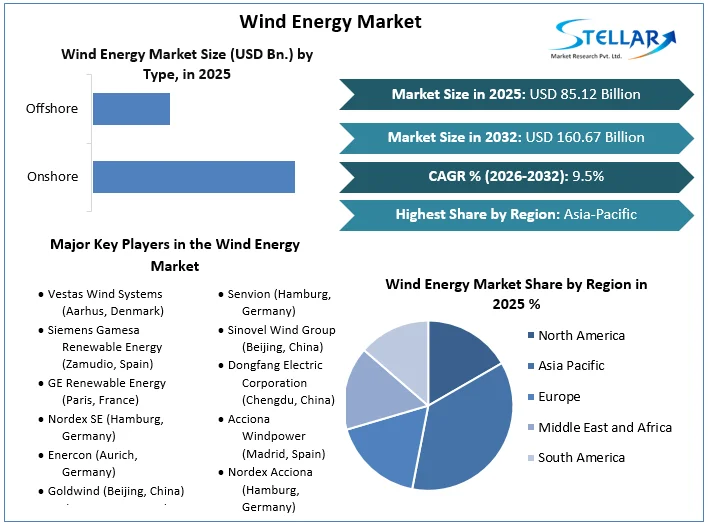
The Wind Energy Market size was valued at USD 85.12 Bn. in 2025 and the total Wind Energy revenue is expected to grow at a CAGR of 9.5% from 2026 to 2032, reaching nearly USD 160.67 Bn. by 2032.
Growing Demand for Clean and Renewable Energy
One of the primary factors driving the wind energy market is the global commitment to reducing carbon emissions. Nations across Europe, North America, and Asia-Pacific have established ambitious renewable energy targets under international climate agreements, creating favorable conditions for wind energy investments.
Rapid industrialization and urbanization have significantly increased electricity consumption worldwide. Wind power offers a reliable, cost-effective, and environmentally friendly solution for meeting rising energy demand while reducing dependence on coal, oil, and natural gas.
Corporate sustainability initiatives are also contributing to market growth. Many multinational companies are investing in renewable energy procurement through long-term power purchase agreements (PPAs), further stimulating demand for large-scale wind projects.
Technological Innovations Are Transforming the Industry
Continuous technological advancements are reshaping the wind energy sector. Modern wind turbines feature larger rotor diameters, taller towers, and advanced blade designs that improve electricity generation even under low wind conditions. These innovations significantly enhance energy output while reducing the levelized cost of electricity.
Digital technologies such as artificial intelligence (AI), machine learning, predictive maintenance, and Internet of Things (IoT) sensors are improving operational efficiency. Real-time monitoring systems enable operators to optimize turbine performance, minimize downtime, and reduce maintenance costs through predictive analytics.
Offshore wind technology has also advanced considerably. Floating wind turbine platforms are expanding project opportunities in deeper waters where stronger and more consistent wind resources are available, unlocking significant untapped renewable energy potential.
Offshore Wind Emerges as a Major Growth Opportunity
While onshore wind installations continue to dominate global capacity, offshore wind is becoming one of the fastest-growing segments within the renewable energy industry. Offshore projects benefit from stronger wind speeds, higher energy production, and fewer land-use constraints.
Countries including the United Kingdom, Germany, China, Denmark, the Netherlands, South Korea, and the United States are making significant investments in offshore wind infrastructure. Governments are supporting these developments through auctions, tax incentives, and long-term renewable energy policies.
The emergence of floating offshore wind farms is expected to create new investment opportunities by enabling power generation in previously inaccessible marine environments.
Government Policies Supporting Market Expansion
Government initiatives remain one of the strongest growth drivers for the wind energy market. Many countries have introduced renewable portfolio standards, clean energy incentives, feed-in tariffs, production tax credits, and competitive auction systems to encourage renewable energy development.
Financial support from multilateral development banks and green financing institutions is accelerating project deployment, particularly in emerging economies. Carbon pricing mechanisms and stricter environmental regulations continue to strengthen the business case for wind energy investments.
National energy transition strategies increasingly recognize wind power as a critical component for achieving long-term energy independence and climate resilience.
Challenges Facing the Wind Energy Market
Despite strong growth prospects, the wind energy market faces several operational and economic challenges.
High initial capital investment remains a barrier, particularly for offshore projects requiring specialized installation vessels, subsea transmission infrastructure, and complex engineering. Financing large-scale wind farms often requires long-term investment commitments and supportive regulatory environments.
Grid integration presents another challenge. As renewable energy penetration increases, electricity networks must be modernized to manage variable power generation efficiently. Investments in smart grids, battery energy storage systems, and transmission infrastructure are becoming essential to ensure reliable electricity supply.
Additionally, supply chain disruptions, rising raw material prices, and permitting delays can affect project timelines and overall development costs.
Regional Outlook
Europe continues to lead the global wind energy market due to its mature renewable energy infrastructure, supportive regulations, and ambitious climate goals. Countries such as Germany, the United Kingdom, Spain, Denmark, and the Netherlands have established strong wind energy ecosystems supported by experienced manufacturers and developers.
Asia-Pacific represents the fastest-growing regional market, driven primarily by China and India. China remains the world’s largest installer of wind power capacity, supported by extensive government investments and domestic manufacturing capabilities. India is expanding its renewable energy portfolio through large-scale onshore and offshore wind projects aimed at improving energy security.
North America also maintains strong market momentum, with the United States and Canada investing heavily in utility-scale wind farms to diversify electricity generation and reduce carbon emissions.
Latin America, the Middle East, and Africa are emerging as promising markets due to abundant wind resources, increasing renewable energy investments, and improving regulatory frameworks.
𝐃𝐨𝐰𝐧𝐥𝐨𝐚𝐝 𝐅𝐫𝐞𝐞 𝐏𝐃𝐅 𝐁𝐫𝐨𝐜𝐡𝐮𝐫𝐞: https://www.stellarmr.com/report/req_sample/Wind-Energy-Market/2141
Competitive Landscape
- Vestas Wind Systems (Aarhus, Denmark)
- Siemens Gamesa Renewable Energy (Zamudio, Spain)
- GE Renewable Energy (Paris, France)
- Nordex SE (Hamburg, Germany)
- Enercon (Aurich, Germany)
- Goldwind (Beijing, China)
- Suzlon Energy Limited (Pune, India)
- MingYang Smart Energy (Zhongshan, China)
- Envision Energy (Shanghai, China)
- Senvion (Hamburg, Germany)
Future Outlook
The future of the wind energy market remains highly promising as renewable energy becomes central to global economic development and climate strategies. Continued advancements in turbine technology, digital asset management, offshore wind engineering, and energy storage systems will further improve the competitiveness of wind power.
Increasing investments in green hydrogen production powered by renewable electricity are expected to create additional demand for wind-generated power. Growing corporate commitments to net-zero emissions and expanding renewable electricity procurement will continue to support long-term market growth.
As governments strengthen clean energy policies and investors prioritize sustainable infrastructure, the wind energy market is well-positioned to play a pivotal role in achieving global decarbonization goals. With innovation, supportive regulation, and expanding renewable energy demand driving industry transformation, wind energy will remain one of the most important pillars of the world’s sustainable energy future.
