AV Cables for Residential Market: How Smart Homes and Premium Entertainment Are Driving Future Demand
The AV Cables for Residential Market is witnessing steady growth as modern households continue to invest in advanced home entertainment systems, gaming consoles, smart televisions, and connected home devices. Although wireless technologies have become increasingly common, wired audio-visual (AV) connections remain indispensable for consumers seeking superior signal quality, low latency, stable connectivity, and high-definition audio and video transmission. As a result, the market continues to evolve alongside innovations in display technology, home automation, and digital content consumption.
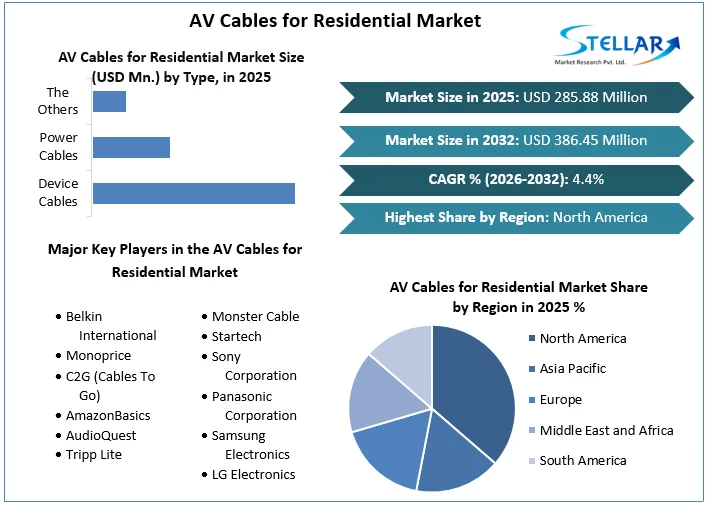
According to recent market insights, the global AV Cables for Residential Market was valued at USD 285.88 million in 2025 and is expected to reach approximately USD 386.45 million by 2032, expanding at a compound annual growth rate (CAGR) of 4.4% during the forecast period. This growth reflects the increasing preference for high-performance home entertainment solutions and the ongoing digital transformation of residential spaces.
𝐃𝐨𝐰𝐧𝐥𝐨𝐚𝐝 𝐅𝐫𝐞𝐞 𝐏𝐃𝐅 𝐁𝐫𝐨𝐜𝐡𝐮𝐫𝐞: https://www.stellarmr.com/report/req_sample/AV-Cables-for-Residential-Market/1554
Growing Demand for High-Definition Home Entertainment
One of the primary factors fueling market growth is the widespread adoption of high-definition televisions, 4K and 8K displays, projectors, gaming systems, and soundbars. Consumers are increasingly prioritizing premium viewing experiences that deliver exceptional picture quality and immersive sound.
Unlike wireless connections, AV cables such as HDMI, optical audio cables, coaxial cables, and DisplayPort cables provide stable data transmission with minimal interference. This makes them particularly valuable for applications requiring high bandwidth, including ultra-high-definition video streaming, competitive gaming, and home theater systems.
The growing popularity of streaming platforms, live sports broadcasting, and high-resolution digital content has further strengthened demand for reliable wired connectivity. As households upgrade their entertainment systems, compatible AV cables remain an essential component of every installation.
Smart Homes Are Creating New Growth Opportunities
The rapid expansion of smart home ecosystems has significantly influenced the AV cables market. Today’s connected homes integrate smart televisions, intelligent speakers, security cameras, home assistants, gaming devices, and networked entertainment systems into a single digital environment.
Many of these devices require dependable wired connections for optimal performance, especially where uninterrupted audio and video transmission is critical. Home automation systems often combine wireless communication with wired infrastructure to improve reliability and reduce signal interruptions.
As consumers invest in comprehensive smart home installations, demand for premium-quality AV cables capable of supporting high-speed data transmission continues to rise. Manufacturers are responding by introducing cables with improved shielding, higher bandwidth capabilities, and enhanced durability.
Gaming Industry Boosts Residential Cable Demand
Gaming has become one of the strongest contributors to residential AV cable demand. The introduction of next-generation gaming consoles has increased requirements for HDMI 2.1 cables capable of supporting features such as 4K gaming at 120Hz, Variable Refresh Rate (VRR), Auto Low Latency Mode (ALLM), and enhanced audio return channels.
Professional gamers and enthusiasts prefer wired connections because they minimize latency while ensuring consistent visual and audio performance. Gaming accessories, monitors, VR headsets, and home entertainment systems all rely on high-quality AV cables for seamless operation.
As esports, cloud gaming, and immersive gaming experiences continue expanding worldwide, the demand for advanced residential AV connectivity solutions is expected to remain strong.
Technology Advancements Are Improving Product Performance
Continuous technological innovation is reshaping the AV cables market. Manufacturers are developing products that support increasing bandwidth requirements generated by modern display technologies and high-speed digital content.
Today’s premium AV cables feature:
Higher data transfer speeds
Improved electromagnetic shielding
Gold-plated connectors for better conductivity
Enhanced durability and flexibility
Support for HDR, Dolby Vision, Dolby Atmos, and 8K resolution
Backward compatibility with older devices
These innovations improve user experience while extending product life cycles. As home electronics become more sophisticated, cable manufacturers are focusing on future-ready products capable of supporting evolving technology standards.
E-Commerce Is Expanding Market Accessibility
Online retail platforms have transformed the purchasing behavior of residential consumers. Buyers can now compare technical specifications, customer reviews, prices, and compatibility information before selecting AV cables for specific applications.
E-commerce channels have also enabled manufacturers to reach broader customer bases while reducing dependence on traditional retail networks. Digital marketplaces offer a wide variety of products, ranging from budget-friendly cables for everyday use to premium professional-grade solutions for home theaters and gaming setups.
Meanwhile, offline electronics retailers continue to play an important role by providing expert guidance, installation services, and product demonstrations that help consumers make informed purchasing decisions.
Challenges Limiting Market Growth
Despite positive market prospects, several factors continue to restrain industry expansion.
The growing adoption of wireless technologies such as Wi-Fi streaming, Bluetooth audio, wireless HDMI, and screen mirroring reduces dependence on physical cables for certain applications. Many consumers now prefer cable-free entertainment setups that simplify installation and reduce visible wiring.
Price sensitivity also remains a challenge. Budget-conscious buyers often opt for low-cost generic cables rather than premium branded products, intensifying competition and limiting profit margins for manufacturers.
Compatibility issues between legacy devices and newer display standards can further complicate purchasing decisions. Consumers may require adapters or upgraded equipment, increasing overall ownership costs and occasionally delaying replacement purchases.
North America Leads While Asia-Pacific Emerges as a High-Growth Region
North America continues to dominate the global AV Cables for Residential Market due to high household spending on consumer electronics, widespread smart home adoption, advanced broadband infrastructure, and strong demand for premium entertainment systems.
The United States represents one of the largest residential electronics markets, supported by frequent technology upgrades and early adoption of advanced gaming and home theater equipment. Consumers in the region consistently invest in high-performance accessories that complement their entertainment systems.
Meanwhile, the Asia-Pacific region is expected to experience substantial growth throughout the forecast period. Rising disposable incomes, rapid urbanization, expanding middle-class populations, and increasing smartphone and smart TV penetration are driving demand across countries such as China, India, Japan, and South Korea.
Government initiatives supporting digital infrastructure, combined with growing internet accessibility and expanding e-commerce platforms, further contribute to regional market expansion.
Competitive Landscape Focuses on Innovation and Quality
- Belkin International
- Monoprice
- C2G (Cables To Go)
- AmazonBasics
- AudioQuest
- Tripp Lite
- Monster Cable
- Startech
- Sony Corporation
- Panasonic Corporation
𝐃𝐨𝐰𝐧𝐥𝐨𝐚𝐝 𝐅𝐫𝐞𝐞 𝐏𝐃𝐅 𝐁𝐫𝐨𝐜𝐡𝐮𝐫𝐞: https://www.stellarmr.com/report/req_sample/AV-Cables-for-Residential-Market/1554
Future Outlook
The future of the AV Cables for Residential Market remains positive despite the increasing popularity of wireless connectivity. As display resolutions continue advancing, gaming technologies become more sophisticated, and smart homes become mainstream, reliable wired connections will remain essential for delivering superior performance.
Consumers increasingly expect seamless integration across televisions, projectors, gaming consoles, sound systems, streaming devices, and home automation platforms. This demand will encourage manufacturers to develop more advanced, durable, and future-ready cable solutions capable of supporting next-generation entertainment technologies.
Growing investments in residential digital infrastructure, combined with rising consumer awareness of high-quality audiovisual performance, are expected to sustain steady market growth over the coming years. While wireless technologies will continue expanding, premium wired AV solutions are likely to remain indispensable wherever maximum speed, stability, and signal quality are required.
As innovation accelerates and households continue upgrading their entertainment ecosystems, the AV Cables for Residential Market is well positioned to capitalize on evolving consumer preferences and the global shift toward connected, technology-enabled living spaces.
