Key Highlights
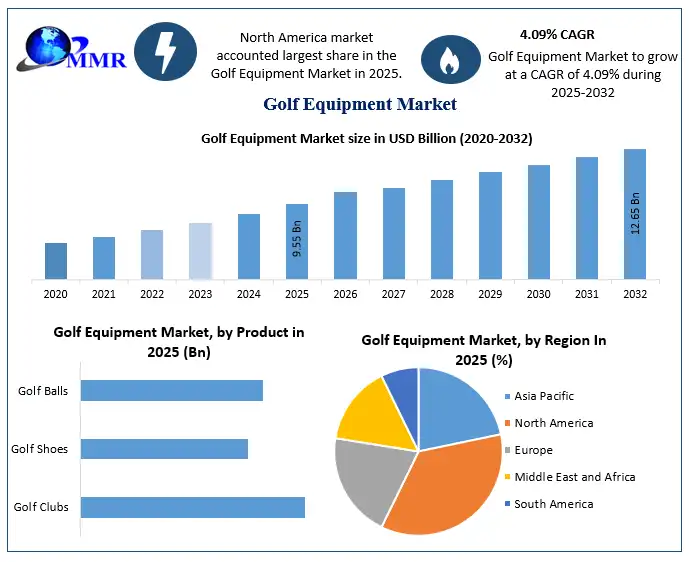
Market Capitalization: The global golf equipment market achieved a valuation of USD 9.55 billion in 2025 and is on track to reach USD 12.65 billion by 2032.
Expansion Velocity: The category is progressing at a steady compound annual growth rate (CAGR) of 4.09% across the 2026 to 2032 forecast window.
Geographic Leadership: The Asia Pacific region leads the global landscape with approximately 45% of total market revenue, followed by the Americas at over 40%.
Demographic Pivot: Female player participation experienced an 8% increase, marking the most significant five-year uptick for the segment.
Rounds Played: Global playing metrics indicate an increase in individual engagement, with the average number of rounds played per golfer rising to 20.2.
Why This Matters Now
A dramatic influx of newer, more diverse player demographics has shattered the traditional consumer profile of the global golf industry. Sporting goods brand executives and premium lifestyle retail managers can no longer rely on rigid, off-the-rack equipment lines without losing market share to agile, technology-driven competitors.
What changed? The purchase pathway has evolved from a generic retail transaction into a technical consultation where data from launch monitors, custom swing analytics, and personalized club configurations dictate buyer choices. Why now? A surge in golf tourism alongside a massive 43% spike in US equipment sales indicates immediate consumer willingness to invest in high-margin, professional-grade equipment. Who benefits? Original equipment manufacturers (OEMs), specialized pro shops, and retail chains that elevate their in-store advisory frameworks will capture long-term loyalty and higher average order values from active players.
What happens next? Leading equipment fabricators will restructure production cycles to support longer, highly localized custom-fitting pipelines. This manufacturing adjustment allows brands to capture predictable premium revenues from both older, highly active enthusiasts and fast-growing new demographic segments like female golfers.
Market Overview
The global Golf equipment market Size operates as a high-value sector within the broader premium sports apparel and consumer goods landscape. Valued at USD 9.55 billion in 2025, the market is on a path to reach USD 12.65 billion by 2032, representing a 4.09% CAGR. This upward path is supported by an expansive global footprint consisting of over 66 million active players completing more than 900 million rounds annually across approximately 38,000 courses worldwide.
This consistent commercial baseline is heavily influenced by continuous product engineering across clubs, balls, shoes, and specialized accessories. Because players are increasingly looking to optimize their performance metrics, equipment choices have shifted from generic sporting goods to highly technical investments. Driven by this structural change in consumer behavior, manufacturing systems are moving away from mass-produced inventories toward flexible, lower-volume production cycles that prioritize custom shaft alignments, grip materials, and head aerodynamics.
Key Trends Driving Growth
The most influential catalyst reshaping the equipment landscape is the global expansion of the golf tourism sector. High-income travelers are increasingly choosing vacation destinations centered around premium course access, driving immediate retail demand for high-end travel bags, versatile golf shoes, and matching club sets. This tourism boom provides local resort pro shops and luxury golf facilities with high-margin retail traffic, converting standard travel leisure into a primary sales driver for top-tier equipment brands.
Simultaneously, a sharp rise in female participation is expanding the available consumer audience. The number of female players grew by 8%, marking the largest single uptick in five years and forcing a major change in product development strategies. Brands are moving away from superficial cosmetic modifications to engineer equipment tailored specifically to the swing speeds, flex requirements, and ergonomic preferences of female players.
Furthermore, premium manufacturers are allocating significant marketing budgets toward experiential retail formats. Brands are training in-store associates to act as technical advisors, utilizing advanced simulator bays and ball-flight tracking technology to guide consumer purchases. This educational service model justifies premium product pricing while building long-term customer relationships that help shield brick-and-mortar retailers from pure e-commerce price competition.
Segment Insights
Product Classification: Comprises specialized categories including high-performance golf clubs, aerodynamically optimized golf balls, specialized golf shoes, and secondary accessories.
Distribution Channels: Segmented into traditional offline channels—including on-course pro shops and specialty sporting goods stores—and fast-growing online e-commerce platforms.
End-Use Distribution: Divided between highly technical professional players who require tour-grade specifications and a massive amateur player base focused on game improvement.
Dominant and Fastest-Growing Segments: Not explicitly isolated with separate comparative numerical metrics in the supplied MMR report data, though capital flow heavily favors custom-fitted club lines and technical in-store advisory channels.
Regional Growth Story
The regional footprint of the golf equipment industry shows a strong concentration of revenue within established, high-income sporting economies. The Asia Pacific region commands the largest portion of global revenue at approximately 45%, driven by high corporate participation, premium club memberships, and expanding course developments across Japan, South Korea, Greater China, Australia, and Southeast Asian nations like Thailand, Singapore, and Malaysia. In these markets, consumer purchasing patterns are highly brand-conscious, with buyers showing a clear preference for premium imports and tour-validated gear.
At the same time, the Americas maintain an essential market position, accounting for over 40% of the global equipment footprint. The United States serves as the core financial anchor of this region, home to 23.8 million active players who generate nearly USD 70 billion in direct and indirect annual industry revenues. This massive concentration of regular players supports a highly competitive retail market, where sudden demand spikes require manufacturers to maintain highly efficient, responsive logistics operations across Canada, Mexico, and major European markets like the United Kingdom, Germany, Sweden, and France.
Competitive Landscape
The global golf equipment market is led by an established group of prominent original equipment manufacturers and sports conglomerates. Key market participants include Acushnet Holding Corp., TaylorMade Golf Company, Inc., Dixon Golf, Inc., Roger Cleveland Golf Company, Inc., True Temper, Mizuno USA, Wilson, and Miura Golf Inc. The competitive dynamic between these organizations is defined by material innovation and product performance claims rather than basic retail price cutting.
To secure premium positioning, dominant manufacturers are shifting their business strategies away from rigid mass production toward flexible, customized options. Major brands are investing heavily in field marketing campaigns, tournament sponsorships, and mobile custom-fitting vans to engage consumers directly on the course. This focus on validation from professional tours ensures that high-margin consumer products, such as multi-layer urethane balls and composite-face drivers, are backed by clear, data-driven performance metrics that appeal to serious amateur players.
Recent Developments
Retail Service Upgrades: Major equipment brands expanded their technical fitting networks, installing advanced launch monitors and radar tracking software across certified retail points.
Production Cycle Adjustments: Original equipment manufacturers adjusted factory workflows to allow for the efficient assembly and rapid delivery of individualized, custom-fit club configurations.
Targeted Product Redesigns: Engineering teams launched high-performance club lines featuring specialized shaft profiles and optimized weight distributions tailored for female players.
Logistics Network Expansions: Logistics managers upgraded distribution hubs across North America and Europe to better manage sudden seasonal demand spikes and secure steady inventory levels for on-course pro shops.
Strategic Implications
For sporting goods executives, brand directors, and retail inventory managers, the changing dynamics of the golf market highlight a clear operational priority: product versatility must be supported by technical retail services. Continuing to push unadjusted, mass-market club sets through traditional retail channels leads to inventory build-ups and lower profit margins. Retail operators must modernize their physical store layouts, adding high-tech simulator bays and certified fitting professionals to convert standard shelf space into a premium service hub.
Furthermore, as golf tourism continues to drive international equipment sales, establishing strong partnerships with premium resorts and destination courses is vital. Brands must ensure that on-course pro shops are fully stocked with high-demand balls, footwear, and accessory lines to capture high-margin impulse purchases from traveling players. Equipment suppliers that combine responsive logistics with experiential in-store marketing will protect their retail margins, while slower-moving brands risk losing floor space to technical, service-oriented competitors.
Future Outlook
The global golf equipment market will maintain its upward path as expanding tourism networks and growing participation from female and younger players diversify the global player base. As advanced swing diagnostics, custom-fitted configurations, and premium performance materials establish themselves as standard requirements for players of all skill levels, the market’s high-value segments will expand consistently. Equipment brands that systematically integrate data-driven fitting services and optimize their multi-channel distribution networks will secure dominant retail positions and high customer retention, whereas slower-moving brands will face intense price competition, outdated inventory challenges, and declining market relevance.
Analyst Perspective
“The global golf equipment market has shifted from a traditional product-selling model to a highly personalized retail environment where custom fitting drives premium value,” says Siddhi Dole, Lead Analyst at Maximize Market Research.
About Maximize Market Research
Maximize Market Research Pvt. Ltd. (MMR) is a global market research and consulting firm known for delivering accurate, actionable, and data-driven insights. Our expertise spans diverse industries — including medical devices, pharmaceuticals, technology, automotive, electronics, chemicals, personal care, and consumer goods. We provide services such as market-validated forecasts, competitive intelligence, strategic consulting, and industry impact analysis, helping businesses navigate market complexities and achieve sustainable growth.
2nd Floor, Navale IT Park Phase 3
Pune Banglore Highway, Narhe
Pune, Maharashtra 411041, India
+91 9607365656
sales@maximizemarketresearch.com
