Key Highlights
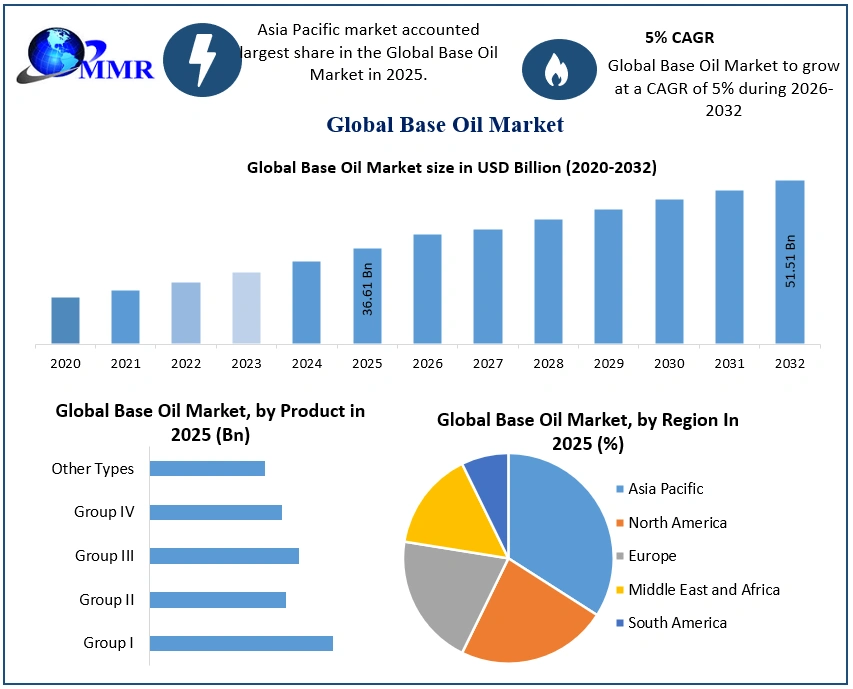
Global Base Oil Market valued at USD 36.61 Billion in 2025, forecast to reach USD 51.51 Billion by 2032 at 5% CAGR, signaling a decisive shift toward performance‑driven industrial lubrication strategies.
Group I remains the dominant product segment with 51.7% volume share, but tightening quality and emissions standards are accelerating the migration to cleaner, higher‑grade base oils.
Asia Pacific holds the majority of global demand, anchored by heavy equipment, power, and metalworking industries, even as automotive production volatility reshapes lubricant planning.
BRIC countries emerge as high‑potential lubricant markets as industrial expansion and infrastructure investment scale up machinery fleets and maintenance requirements.
Major oil and energy companies, including Chevron, Exxon Mobil, Shell, SK innovation, Aramco, Sinopec, and PetroChina, are central to capacity, pricing, and technology direction in base oil supply.
Why This Matters Now
Factories, fleets, and heavy equipment platforms are entering a period of higher mechanical stress, tighter emissions rules, and longer asset life expectations. In that environment, the quality and stability of base oils inside engine oils, gear oils, and industrial lubricants become productivity variables rather than commodity inputs.
Base oils account for 70–97% of lubricant formulations, and engine oils alone typically comprise 70–90% base oil with 10–30% additives. That composition means every change in base oil quality, viscosity, and contamination profile directly affects equipment uptime, energy efficiency, and maintenance costs for industrial operators.
Market Overview
The Base Oil Market size was valued at USD 36.61 Billion in 2025 and is projected to reach nearly USD 51.51 Billion by 2032, growing at a 5% CAGR from 2026 to 2032. Demand is tightly linked to oils used in the automobile industry, environmental legislation, and expanding industrial activity across heavy equipment, power, and metalworking sectors.
Base oils are refined petroleum or synthetic materials produced to defined lubricant base stock specifications, and the refining route or production method fundamentally shapes lubricant performance. As industrial operations push machinery to higher speeds and temperatures, the choice of base oil increasingly determines whether plants meet throughput, reliability, and emissions targets.
Key Trends Driving Growth
The rise of advanced engine technologies with fast‑moving parts and high‑temperature operating windows is driving strong demand for high‑grade engine oils, and in turn, higher‑quality base oils. Diesel trucks, passenger cars, light‑duty trucks, and stationary engines all require engine oils capable of resisting harsh conditions, making base oil performance a frontline factor in fleet productivity and downtime risk.
At the same time, environmental regulations are pushing the market away from high‑sulphur, contaminant‑rich Group I products toward cleaner base oils that can meet mid‑SAPS criteria and support lighter viscosity grades. As industrial buyers and OEMs seek lubricants that align with emissions rules and tighter specifications, base oil producers face pressure to upgrade refining processes and portfolios.
Request a Free Sample Copy or View Report Summary: https://www.maximizemarketresearch.com/request-sample/105579/
Segment Insights
Dominant Segment – Product: Group I Base Oil
Group I leads the market in volume with a 51.7% share, driven by low pricing and wide availability from solvent refining processes that remain simple and cost‑effective. However, sulphur, nitrogen, olefins, and aromatic contaminants make Group I less suitable for high‑performance and low‑emission applications, pushing industrial operators to reassess long‑term reliance on these products.Fastest‑Shifting Segment – Cleaner, Higher‑Grade Base Oils (Group II/III)
While the report highlights Group I as the current volume leader, it also notes a growing preference for cleaner, higher‑quality base oils, especially in Europe and North America. This indicates faster demand momentum toward Group II and Group III stocks that offer higher saturation and better antioxidation performance in modern engines and environmental regimes.Application Mix – Engine Oils, Gear Oils, and Metalworking Fluids
The market is segmented by type into Pick & Place, Palletizing & De‑palletizing, Transportation, Engine Oils, Gear Oils, and Metalworking Fluids. Engine oils dominate lubricant demand in automotive and industrial engines, while gear oils, greases, and metalworking fluids support heavy equipment, power generation, and precision metalworking, tying base oil consumption directly to machinery utilization.Demand Drivers – Automotive and Industrial Oils
High‑grade engine oils for automotive fleets and industrial engines are a primary demand driver, with base oils constituting the majority of every blend. As vehicle and equipment populations expand in emerging markets and maintenance standards tighten in mature markets, base oil consumption maps closely to capital investment in machinery and transport.
Regional Growth Story
Asia Pacific holds the majority of global base oil demand, supported by multinational investment, growing industrial sectors, and strong need for gear oil, grease, and other lubricants in heavy equipment, power, and metalworking industries. China, as the world’s largest automaker, impacts regional lubricant demand through swings in vehicle production, while construction and industrial projects sustain underlying base oil consumption.
BRIC countries are expected to be particularly attractive lubricant markets due to their large populations and government focus on industrial growth. As foreign and domestic investment rises and financial infrastructure improves, these economies are likely to add machinery capacity, vehicle fleets, and engineering equipment, expanding the installed base of assets requiring regular lubrication.
North America dominated the global Base Oil Market in 2025. This dominance reflects mature automotive and industrial ecosystems, established refining capacity, and strong demand for higher‑grade lubricants that align with performance and emissions standards.
Competitive Landscape
Key players in the Base Oil Market include Chevron Corporation, Exxon Mobil Corporation, S‑OIL, Motiva Enterprises, SK innovation, Royal Dutch Shell, Neste, AVISTA OIL, Nynas, Repsol, Ergon, Calumet, H&R Group, Sinopec, PetroChina, Aramco, and Abu Dhabi National Oil Company. These companies control major refining assets, base oil production lines, and regional supply, giving them leverage over pricing, quality availability, and product innovation.
As demand tilts toward cleaner and higher‑performance base oils, global producers face strategic decisions about upgrading refining technologies, shifting product portfolios, and aligning with regulatory trajectories. Companies that accelerate investment in hydroprocessing, quality enhancement, and application‑specific formulations will be better positioned to capture emerging demand in advanced engines and environmentally constrained markets.
Recent Developments
Increased emphasis on high‑grade engine oils compatible with fast‑moving parts and high temperatures, raising technical requirements for base oil performance and stability.
Noticeable decline in Group I base oil demand expected in Europe and North America due to contamination levels and compliance challenges with mid‑SAPS and lighter viscosity grades.
Strong forecast that BRIC countries will experience rapid lubricant demand growth, supported by industrial expansion, infrastructure investment, and rising vehicle populations.
Persistent crude oil price volatility, with historical Brent and WTI spikes, continues to impact margins and pricing structures for mineral‑based base oils derived from crude.
Strategic Implications
For manufacturers and fleet operators, base oil selection has moved from a procurement afterthought to an operational strategy lever. Choosing higher‑quality base oils can support longer drain intervals, improved engine and equipment protection, and lower unplanned downtime, with direct implications for productivity targets and cost per unit output.
For refiners and base oil suppliers, the shift away from contaminant‑heavy Group I products in key markets signals the need to modernize capacity and build differentiated, cleaner product lines. Aligning with automotive and industrial OEM specifications, emissions rules, and maintenance regimes becomes central to competitive positioning in the next growth phase.
Investors and industrial buyers should track base oil quality trends alongside industrial automation and equipment modernization cycles in Asia Pacific and BRIC economies. As these regions upgrade machinery fleets and expand industrial footprints, demand will favor suppliers able to deliver consistent, application‑specific base oils at scale.
Future Outlook
From 2026 to 2032, the Base Oil Market’s 5% CAGR reflects a gradual but structural transition from commodity supply toward performance‑centric lubricant strategies. Crude price volatility and tightening pollution standards remain risk factors, but also create an opportunity for suppliers that improve operational efficiency and align with OEM requirements.
As industrial and automotive systems evolve, future demand growth will concentrate in segments and regions where machinery complexity, environmental constraints, and uptime expectations are highest. The decisive line between future leaders and laggards will be drawn by those industrial and energy players that treat base oil quality as a core element of equipment strategy, not just as a bulk fluid purchase.
Related Reports
Global Cultivator and Tiller Machinery Market https://www.maximizemarketresearch.com/market-report/global-cultivator-and-tiller-machinery-market/22787/
Global Unmanned Marine Vehicles Market https://www.maximizemarketresearch.com/market-report/global-unmanned-marine-vehicles-market/34021/
Global Dual Clutch Transmission Market https://www.maximizemarketresearch.com/market-report/global-dual-clutch-transmission-market/21564/
Analyst Perspective
“As global industries expand and modernize machinery, base oil quality and application fit will increasingly influence reliability, emissions compliance, and cost competitiveness across fleets and factories,”-Gaurav Deshmukh
About Maximize Market Research
Maximize Market Research Pvt. Ltd. (MMR) is a global market research and consulting company that provides reliable, data-focused, and practical business insights. The firm serves a wide range of industries, including healthcare, pharmaceuticals, technology, automotive, electronics, chemicals, personal care, and consumer goods. Through market forecasts, competitive analysis, strategic consulting, and industry impact assessments, MMR helps organizations understand changing market conditions, identify growth opportunities, and make informed business decisions for long-term success.
2nd Floor, Navale IT Park Phase 3
Pune Banglore Highway, Narhe
Pune, Maharashtra 411041, India
+91 9607365656
sales@maximizemarketresearch.com
