Key Highlights
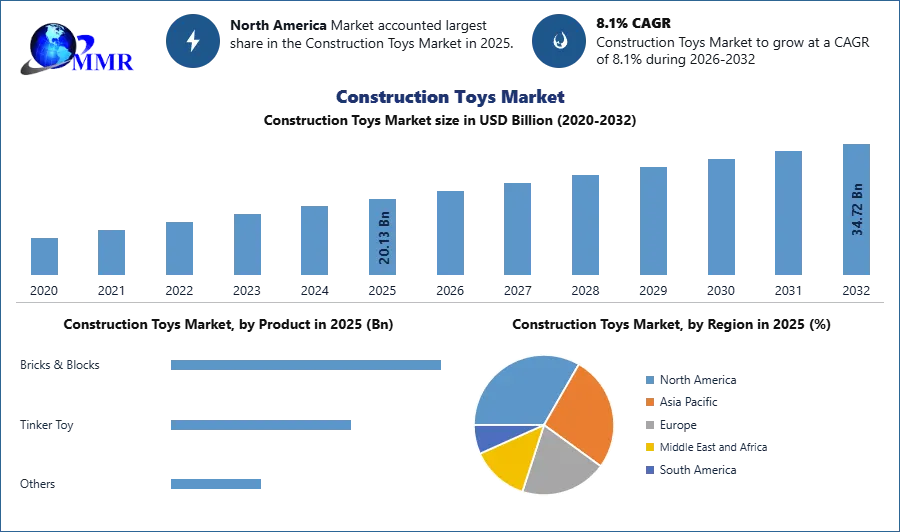
Market Capitalization: The global construction toys market achieved a valuation of USD 20.13 billion in 2025 and is projected to scale to USD 34.72 billion by 2032.
Expansion Velocity: The sector is advancing at a compound annual growth rate (CAGR) of 8.10% over the 2025 to 2032 industrial planning timeline.
Category Dominance: Bricks and blocks captured over 55% of total market revenue in 2025, maintaining structural command of global toy aisles.
Geographic Anchor: North America holds structural leadership of the global market, accounting for a revenue stake exceeding 30% in 2025.
Alternative Growth: Wooden construction sets are establishing a separate high-value track, registering a projected 11.1% CAGR as regulatory pressure on virgin polymers mounts.
Why This Matters Now
Toy manufacturers and consumer goods executives are facing an immediate survival crunch as traditional physical play models clash directly with high-engagement digital screens. Brands that fail to rapidly integrate physical-digital hybrid technology into traditional building blocks will lose entire cohorts of early-stage consumers to automated digital ecosystems before those children ever enter a brick-and-mortar retail store.
What changed? The baseline consumer requirement has fundamentally evolved from simple passive amusement to active, structured cognitive development driven by a global surge in STEM education priorities. Why now? The rapid entry of dual-income households into the consumer pool has unlocked higher discretionary capital, converting the purchase of construction sets from a seasonal holiday transaction into a year-round educational investment. Who benefits? Original equipment manufacturers (OEMs), institutional preschool suppliers, and retail category leaders who aggressively replace standard petroleum plastics with certified green materials will capture non-negotiable shelf placements from corporate compliance officers and premium space from increasingly risk-averse parents.
What happens next? Leading manufacturing groups will shift capital allocations to support highly technical, localized manufacturing pipelines capable of outputting custom biodegradable polymers. This industrial pivot allows corporate leaders to isolate their supply chains from fluctuating petrochemical pricing while securing a defensive barrier against low-margin, unbranded copycats entering the regional market.
Market Overview
The global Construction toys market Size operates as a high-margin anchor within the international consumer goods, sports entertainment, and educational supply sectors. Valued at USD 20.13 billion in 2025, the market is on a direct track to reach USD 34.72 billion by 2032, expanding at a validated CAGR of 8.10%. This upward path is sustained by a worldwide network of institutional early-childhood learning centers, specialized toy retailers, and massive e-commerce distribution infrastructure.
This commercial trajectory is heavily impacted by strict state-level safety regulations governing chemical formulations in children’s products. Because regulatory agencies worldwide are tightening restriction thresholds on synthetic compounds, raw material procurement has become a critical strategic battleground for corporate boards. Consequently, manufacturing facilities are converting high-volume extrusion lines to process bio-derived alternatives, balancing mechanical interlocking tolerances with non-toxic product formulations.
Key Trends Driving Growth
The most critical catalyst forcing a transformation of the manufacturing sector is the rapid rise of the “kidult” demographic and high-complexity building enthusiasts. Mature consumers are purchasing advanced architectural kits, motorized mechanical systems, and complex engineering replicas to use as collectible display pieces, which directly increases the average transaction value across global retail networks. This structural demographic expansion allows legacy toy manufacturers to command premium price points well above traditional toy margins, fundamentally altering historical volume-to-profit ratios.
Simultaneously, the widespread institutional adoption of building sets in early-childhood curricula is expanding the permanent commercial procurement pipeline. Educational institutions are integrating modular construction kits into daily preschool routines to teach fundamental physical mechanics, structural engineering, and cooperative problem-solving frameworks. This institutional validation provides a highly predictable B2B sales foundation for suppliers, insulating commercial revenue from the standard cyclical volatility associated with winter holiday retail patterns.
Furthermore, leading fabrication brands are utilizing advanced machine learning and computer vision to build physical-digital hybrid products. By pairing physical interlocking blocks with interactive software applications, manufacturers are effectively extending the play life of their standard products and capturing valuable consumer usage data. This digital integration creates a multi-layered ecosystem that helps shield physical retail products from losing relevance to pure mobile application entertainment.
Segment Insights
Product Classification: Comprises specialized categories including standard interlocking bricks and blocks, classic tinker toys, motorized mechanical assemblies, and high-complexity engineering kits.
Raw Material Composition: Divided into high-impact traditional polymers, certified sustainable wood, lightweight metals, and advanced biodegradable structural composites.
Distribution Networks: Structured across high-volume physical distribution operations, including hypermarkets and specialty toy stores, alongside fast-scaling direct-to-consumer (DTC) digital storefronts.
End-User Segments: Distributed between residential household consumers focused on developmental play and commercial educational institutions purchasing high-volume learning supplies.
Dominant Segment: Bricks and blocks lines represent the absolute dominant product segment, commanding over 55% of global market revenue due to their unmatched cross-age design flexibility.
Fastest-Growing Segment: Automated digital-physical hybrid lines and certified sustainable wooden toys represent the fastest-growing material tracks, advancing at an 11.1% velocity as market demand shifts toward circular consumer products.
Regional Growth Story
The global distribution of construction toy revenue demonstrates a deep concentration of purchasing power within highly developed, education-focused regional economies. North America maintains the leading position in the global market, accounting for a commanding revenue stake of over 30% in 2025. Within this region, the United States acts as the primary financial driver, backed by high consumer disposable income and an extensive network of specialized preschool programs that utilize modular building blocks as core learning tools. This massive regional demand requires manufacturers to run highly responsive, automated supply chains to prevent costly stockouts at major retail portals.
Concurrently, the Asia Pacific region is recording the fastest operational expansion rate across the global landscape. Accelerated urbanization, rising middle-class disposable incomes, and deep cultural investments in early STEM education across China, India, Japan, and South Korea are driving immediate retail consumption of premium international toy brands. This regional shift is forcing major western manufacturers to build localized manufacturing centers and specialized distribution networks throughout Asia to counter the rising flow of lower-cost, unbranded domestic alternatives.
Competitive Landscape
The global construction toys market is dominated by a core group of deeply entrenched multi-national brands and specialized engineering toy producers. Elite industry participants include the LEGO Group, Mattel, Inc. (Mega Bloks), Hasbro, Inc. (KRE-O), Bandai Co., Ltd., KNEX (Basic Fun, Inc.), Ravensburger AG, and Spin Master. The competitive friction between these market leaders is characterized by aggressive patent protection for interlocking mechanisms and high-stakes bidding wars for popular entertainment property licenses.
To protect their long-term market shares, dominant manufacturers are shifting from simple volume-based distribution toward targeted technology partnerships and corporate acquisitions. Industry giants are buying up specialized early-childhood brands and embedding machine learning applications into their core product lines to build defensible product ecosystems. This focus on proprietary technological features ensures that high-margin product launches remain difficult for low-cost competitors to copy, helping protect premium brand equity and factory floor utilization rates.
Recent Developments
AI System Deployments: Mattel launched an advanced AI-integrated Mega Construx series that uses computer vision to guide children through complex engineering builds (05 February 2026).
Motorized Line Expansions: Ravensburger launched the GraviTrax “Power” Expansion, featuring motorized components that allow for automated, perpetual motion in marble run systems (10 January 2025).
Circular Material Conversions: Elite toy manufacturers successfully transformed multiple production lines to process sustainable sugarcane-derived bioplastics and recycled ocean polymers, setting a new environmental benchmark for factory compliance.
Strategic Corporate Consolidation: Spin Master finalized its corporate acquisition of premium early-childhood specialist Melissa & Doug, immediately increasing its control over the high-value sustainable wooden toy segment.
Strategic Implications
For consumer goods executives, supply chain directors, and retail category managers, the ongoing evolution of the construction toy market requires an immediate reassessment of raw material pipelines and digital product capabilities. Maintaining single-source procurement strategies based entirely on standard fossil-fuel polymers introduces significant compliance risks as international carbon regulations tighten. Operations managers must quickly diversify their supplier networks to secure stable access to high-grade bioplastics and certified sustainable wood stocks before competitor pre-purchases drive up market prices.
Additionally, as direct-to-consumer digital channels continue to outpace traditional retail growth, brand managers must reallocate marketing capital toward interactive online marketing and digital platform optimization. Ensuring that physical products are backed by strong digital application ecosystems is essential for maintaining space on modern retail shelves. Manufacturers that pair clean-label, non-toxic production standards with automated physical-digital play styles will protect their wholesale margins, while slower-moving brands will face decreasing retail shelf space and heavy inventory markdowns.
Future Outlook
The global construction toys market will maintain its upward growth trajectory as expanding middle-class populations and institutional investments in early-childhood STEM programs drive steady baseline demand. As computer-vision guidance, automated robotic assemblies, and certified circular biomaterials transform from premium novelties into baseline consumer expectations, the market’s high-value tiers will continue to scale. Agile toy manufacturers that systematically embed machine learning systems and transition their supply chains to certified sustainable materials will capture dominant retail positions and high customer lifetime value, whereas legacy brands tied to standard petroleum plastics and non-interactive designs will face intense price erosion, severe retail floor space reductions, and declining brand relevance.
Analyst Perspective
“The global construction toys market has entered a critical period where material sustainability and digital integration are no longer optional additions, but fundamental requirements for market survival,” states Siddhi Dole, Lead Analyst at Maximize Market Research.
About Maximize Market Research
Maximize Market Research Pvt. Ltd. (MMR) is a global market research and consulting firm known for delivering accurate, actionable, and data-driven insights. Our expertise spans diverse industries — including medical devices, pharmaceuticals, technology, automotive, electronics, chemicals, personal care, and consumer goods. We provide services such as market-validated forecasts, competitive intelligence, strategic consulting, and industry impact analysis, helping businesses navigate market complexities and achieve sustainable growth.
2nd Floor, Navale IT Park Phase 3
Pune Banglore Highway, Narhe
Pune, Maharashtra 411041, India
+91 9607365656
sales@maximizemarketresearch.com
