Key Highlights
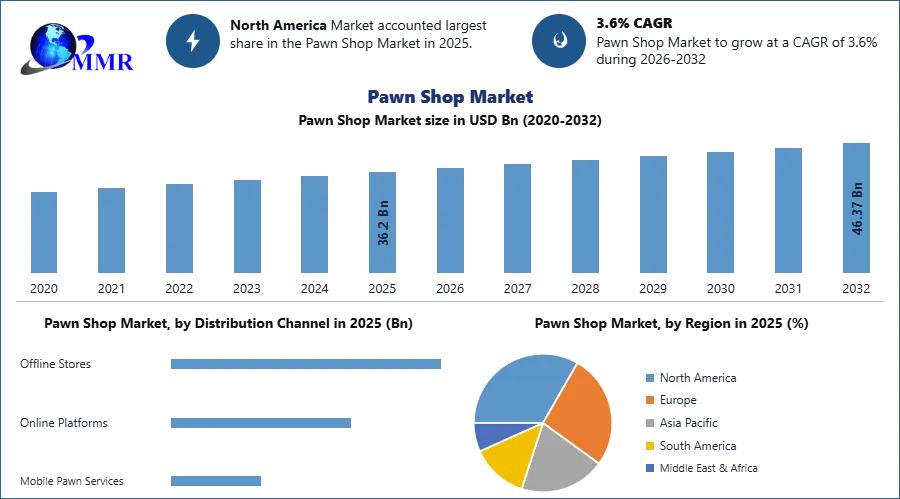
Market Capitalization: The global pawn shop market achieved a valuation of USD 36.20 billion in 2025 and is on track to reach USD 46.37 billion by 2032.
Expansion Velocity: The category is progressing at a compound annual growth rate (CAGR) of 3.6% across the 2025 to 2032 industrial planning timeline.
Core Consumer Engine: Generation Y, or Millennials born between the early 1980s and mid-1990s, represents a primary demographic driving transaction volumes.
Digital Adoption: Over 4,500 pawn shop operators globally have deployed integrated digital platforms to manage remote loan tracking and secondary marketplace listings.
Regional Anchor: The Asia Pacific region leads global market growth, sustained by rapid urbanization and rising underbanked populations in key developing economies.
Why This Matters Now
Mainstream financial institutions continue to restrict access to traditional consumer credit lines, creating an immediate liquidity squeeze for millions of credit-constrained individuals. Alternative financial services operators who fail to transition beyond rigid, legacy brick-and-mortar storefronts will lose active transactional volume to agile, digital-first online lending competitors.
What changed? The collateral-backed lending path has shifted from an isolated, physical-only transaction into an omnichannel ecosystem where mobile applications and remote digital valuations determine loan structures. Why now? Systemic macroeconomic volatility and unexpected income mismatches have normalized secondary market sourcing, converting pawn shops from secondary emergency outposts into regular liquidity management hubs. Who benefits? National corporate chains and tech-enabled independent pawnbrokers who invest in automated online appraisal mechanisms will capture higher customer retention and insulated operating margins.
What happens next? Leading retail pawn networks will redesign their front-end interfaces to support secure, virtual consultations. This technical alignment allows companies to attract younger, tech-savvy consumer cohorts while lowering the traditional overhead costs associated with physical estate management.
Market Overview
The global Pawn shop market Size operates as a critical segment within the broader alternative financial services and specialty retail distribution landscapes. Valued at USD 36.20 billion in 2025, the market is on a path to reach USD 46.37 billion by 2032, advancing at a compound annual growth rate (CAGR) of 3.6%. The model provides a mutually advantageous ecosystem where consumers quickly secure non-recourse cash loans against personal assets, while buyers gain immediate access to a diverse pool of pre-owned commodities.
This operational baseline is highly resilient during broader macroeconomic shifts. Because traditional banking compliance and strict credit check procedures systematically lock out underbanked populations, collateral-based lending provides immediate access to short-term working capital. Driven by this structural demand, the pawn framework has evolved into a formalized retail category that balances financial liquidity management with sustainable, circular used-goods retailing.
Key Trends Driving Growth
The most critical catalyst forcing an operational shift in the industry is the rapid integration of digital platforms and e-commerce functionalities. Operators are utilizing mobile applications to facilitate remote pawn appraisals, off-site loan renewals, and digital item redemptions, exponentially expanding their geographical market reach. This structural shift towards digital transformation allows businesses to eliminate historical localized constraints, drawing in tech-conscious buyers who value automated convenience over physical negotiations.
Simultaneously, changing consumer behavior regarding secondhand shopping is opening a separate, high-value retail avenue. Cost-conscious and environmentally aware consumer groups are actively targeting pawn shop inventories to source affordable, sustainable luxury items, consumer electronics, and high-value jewelry. This retail trend provides local stores with high-margin sales opportunities, changing the public image of pawn inventories from distressed liquidations into curated vintage and refurbished product catalogs.
Furthermore, economic shifts within emerging markets are introducing a wave of newly urbanized consumers into the alternative credit ecosystem. A growing middle class across developing nations faces unique cash flow mismatches, driving baseline demand for immediate, unsecured corporate lending or collateralized personal lending solutions. This demographic expansion ensures steady transaction velocity, allowing corporate pawn networks to deploy scalable lending systems across high-density urban corridors.
Segment Insights
Service Offerings: Comprises short-term consumer lending secured by personal property, direct used goods retailing, and certified item appraisal services for purchase or pawn.
Deployment Architecture: Categorized across traditional localized brick-and-mortar establishments and fast-growing online pawn platforms.
Target Consumer Demographics: Distributed across clear generational cohorts, with Generation Y (Millennials) acting as a highly active transacting segment.
Application Frameworks: Divided between individual consumers managing personal expenses and commercial entities utilizing asset-backed lending for rapid inventory sourcing.
Dominant Segment: Traditional on-site consumer lending represents the structural foundation of the market, generating the largest recurring revenue share due to the ongoing demand for instant liquidity without credit verifications.
Fastest-Growing Segment: Online pawn services and digital e-commerce retail networks represent the fastest-growing operational deployment modes, expanding customer acquisition beyond historical physical catchments.
Regional Growth Story
The global performance of the pawn industry illustrates a strong connection between market expansion and regional financial frameworks. The Asia Pacific region stands as a dominant force in the global market, propelled by rapid urbanization, growing economies, and an expanding middle class across China and India. In these territories, a massive unbanked or underbanked population uses personal valuables, such as gold jewelry and consumer gadgets, to bridge short-term financing gaps, driving rapid corporate chain expansion and high physical outlet density.
Concurrently, the North American market maintains a highly consolidated and advanced operational position. The region features established, multi-state corporate pawn shop networks that operate with standardized corporate compliance policies and integrated retail technologies. This corporate consolidation provides a highly stable revenue base, where automated inventory management systems allow operators to balance local loan-to-value ratios against the real-time resale pricing of unredeemed collateral across secondary e-commerce networks.
Competitive Landscape
The global pawn shop market is characterized by a mix of large corporate operators, franchise networks, and highly fragmented independent pawnbrokers. Prominent industry participants focus on expanding their market footprints through targeted physical acquisitions and comprehensive digital system rollouts. The competitive environment is defined by underwriting accuracy and the speed of digital appraisal tools rather than standard retail discount wars.
To defend their long-term market positions, leading corporate entities are moving away from passive storage models toward active e-commerce cross-listing. Major chains are connecting their localized point-of-sale systems directly to international secondary marketplaces, ensuring that unredeemed assets are instantly listed for global resale. This high-efficiency inventory model keeps corporate capital liquid, reduces the storage burden on retail floors, and protects operating margins from the localized devaluation of pledged goods.
Recent Developments
Omnichannel System Rollouts: Elite pawn networks successfully deployed centralized mobile applications that allow consumers to review loan balances, upload asset images for preliminary appraisal, and execute remote interest payments.
Point-of-Sale Upgrades: Corporate operators installed real-time data analytics tools across physical store networks to dynamically align local loan offers with international market values for precious metals and consumer electronics.
Regulatory Compliance Investments: Compliance departments modernized their tracking frameworks to adapt to complex, localized changes regarding interest rate caps and specific regional licensing mandates.
Secondary Market Expansions: Leading brands built dedicated digital storefronts to capture the growing consumer demand for verified, authenticated luxury goods and refurbished technology products.
Strategic Implications
For alternative finance executives, retail brand managers, and investment groups, the transformation of the pawn market requires an immediate upgrade of technical capabilities and customer experience. Relying exclusively on physical walk-in traffic exposes businesses to regional economic shifts and changes in local foot traffic patterns. Operations managers must invest in high-security digital asset authentication tools and secure remote payment processing networks to maintain operational relevance.
Furthermore, managing the financial risk of loan defaults requires careful attention to asset devaluation. If a borrower defaults, recovering the loan amount depends entirely on the quick resale of the pledged collateral. Businesses must ensure their retail channels are fully integrated across both physical and digital marketplaces to minimize asset holding times and protect overall revenue stability throughout the year.
Future Outlook
The global pawn shop market will maintain its steady upward path as expanding digital appraisal networks, mobile loan management tools, and growing acceptance of secondhand retail options diversify the customer base. As secure virtual consultations and omnichannel e-commerce retail networks establish themselves as standard operational expectations, the market’s high-margin tiers will continue to expand. Pawn shop networks that successfully combine digital remote service models with accurate, data-driven asset valuation systems will secure dominant retail positions and highly predictable cash flows, whereas slow-moving, single-location storefronts will face increasing compliance costs, declining foot traffic, and rapid market obsolescence.
Analyst Perspective
“The global pawn shop market has entered a transformative phase where digital integration is breaking down traditional brick-and-mortar boundaries,” states Siddhi Dole, Lead Analyst at Maximize Market Research.
About Maximize Market Research
Maximize Market Research Pvt. Ltd. (MMR) is a global market research and consulting firm known for delivering accurate, actionable, and data-driven insights. Our expertise spans diverse industries — including medical devices, pharmaceuticals, technology, automotive, electronics, chemicals, personal care, and consumer goods. We provide services such as market-validated forecasts, competitive intelligence, strategic consulting, and industry impact analysis, helping businesses navigate market complexities and achieve sustainable growth.
2nd Floor, Navale IT Park Phase 3
Pune Banglore Highway, Narhe
Pune, Maharashtra 411041, India
+91 9607365656
sales@maximizemarketresearch.com
