Next-Generation Industrial Metrology and Inspection Market: Transforming Precision Manufacturing Through Smart Quality Control
The Next-Generation Industrial Metrology and Inspection Market is becoming a cornerstone of modern manufacturing as industries increasingly prioritize precision, automation, and quality assurance. From automotive and aerospace to electronics, medical devices, and semiconductor manufacturing, organizations are adopting advanced metrology and inspection technologies to improve production efficiency, reduce defects, and meet stringent quality standards.
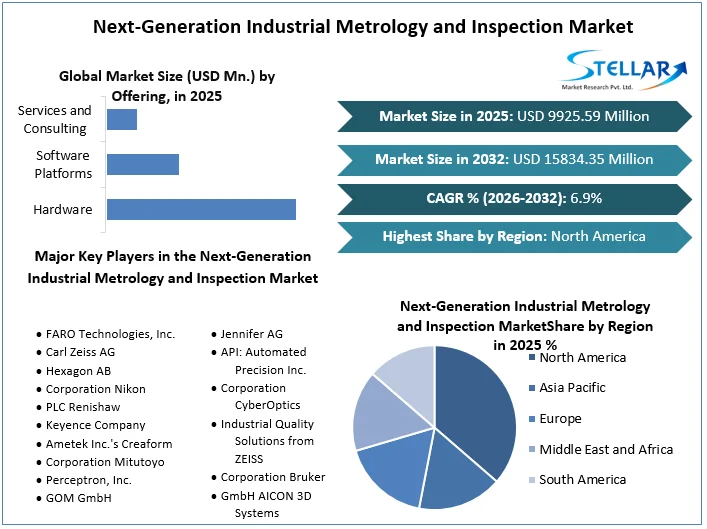
According to recent market insights, the Next-Generation Industrial Metrology and Inspection Market was valued at USD 9,925.59 million in 2025 and is projected to reach approximately USD 15,834.35 million by 2032, registering a compound annual growth rate (CAGR) of 6.9% during the forecast period. The market’s growth reflects the increasing adoption of Industry 4.0 technologies, artificial intelligence (AI), robotics, and digital manufacturing across industrial sectors worldwide.
𝐃𝐨𝐰𝐧𝐥𝐨𝐚𝐝 𝐅𝐫𝐞𝐞 𝐏𝐃𝐅 𝐁𝐫𝐨𝐜𝐡𝐮𝐫𝐞: https://www.stellarmr.com/report/req_sample/Next-Generation-Industrial-Metrology-and-Inspection-Market/1561
The Growing Need for Precision in Modern Manufacturing
Manufacturing industries today face increasing pressure to produce complex products with exceptional accuracy while minimizing production costs and material waste. As products become smaller, lighter, and more technologically sophisticated, traditional inspection methods are no longer sufficient to ensure consistent quality.
Next-generation industrial metrology combines advanced measurement systems, automated inspection equipment, high-resolution imaging, and digital analytics to provide manufacturers with highly accurate dimensional measurements and defect detection capabilities. These technologies help companies identify production issues early, reducing costly recalls, rework, and downtime.
The demand for precision manufacturing is particularly strong in industries such as aerospace, automotive, and medical devices, where even minor measurement errors can affect product performance and safety.
Industry 4.0 Is Accelerating Market Growth
The global shift toward Industry 4.0 has significantly accelerated the adoption of intelligent metrology and inspection systems. Smart factories increasingly rely on interconnected sensors, industrial Internet of Things (IIoT) devices, cloud computing, and AI-powered software to monitor manufacturing processes in real time.
Unlike conventional inspection methods that often detect problems after production, modern metrology systems enable continuous quality monitoring throughout the manufacturing cycle. This real-time visibility allows manufacturers to make immediate adjustments, reducing defects and improving overall equipment effectiveness.
Integration with Manufacturing Execution Systems (MES) and Enterprise Resource Planning (ERP) platforms further enables organizations to optimize production workflows while maintaining comprehensive quality documentation.
Artificial Intelligence Is Revolutionizing Inspection Processes
Artificial intelligence has emerged as one of the most transformative technologies in industrial inspection. AI-powered vision systems analyze thousands of images within seconds, identifying surface defects, dimensional inconsistencies, assembly errors, and material imperfections with exceptional accuracy.
Machine learning algorithms continuously improve inspection performance by learning from historical production data, reducing false positives and increasing detection reliability over time.
AI also supports predictive maintenance by identifying equipment wear before failures occur, helping manufacturers minimize unexpected downtime and improve operational efficiency.
As AI technologies continue advancing, manufacturers are expected to invest heavily in intelligent inspection platforms capable of autonomous decision-making and adaptive quality control.
3D Metrology and Laser Scanning Expand Industrial Applications
Three-dimensional measurement technologies are becoming increasingly important as manufacturers produce more intricate components for electric vehicles, aircraft, consumer electronics, and medical equipment.
Advanced 3D scanners, laser trackers, structured light systems, and coordinate measuring machines (CMMs) provide highly detailed digital representations of manufactured parts. These systems enable engineers to verify complex geometries with micron-level precision while significantly reducing inspection time.
In industries such as aerospace and automotive, where lightweight materials and complex component designs are common, 3D metrology has become indispensable for maintaining strict dimensional tolerances.
The growing adoption of additive manufacturing also creates additional opportunities for advanced inspection technologies capable of validating highly customized and geometrically complex products.
Automation Improves Manufacturing Efficiency
Automation continues to reshape industrial quality assurance by eliminating manual inspection bottlenecks. Automated inspection cells equipped with robotics, machine vision, and intelligent sensors operate continuously with consistent accuracy, improving productivity while reducing labor costs.
Manufacturers increasingly deploy collaborative robots (cobots) integrated with inspection systems to perform repetitive measurement tasks safely alongside human workers.
Automated quality control also accelerates production cycles, allowing manufacturers to meet increasing customer demand without compromising product quality.
As global manufacturing faces skilled labor shortages, automation offers a practical solution for maintaining operational excellence and production consistency.
Key Industries Driving Market Demand
Several industries are contributing significantly to the growth of the Next-Generation Industrial Metrology and Inspection Market.
The automotive industry remains one of the largest adopters due to increasing electric vehicle production, lightweight component manufacturing, and autonomous vehicle development.
The aerospace and defense sector relies on advanced inspection systems to maintain stringent safety standards while verifying complex engine components, turbine blades, and structural assemblies.
In the electronics and semiconductor industry, manufacturers require ultra-precise measurement solutions capable of inspecting miniature integrated circuits and high-density electronic assemblies.
The medical device sector also depends on advanced metrology to ensure compliance with strict regulatory requirements while producing highly accurate implants, surgical instruments, and diagnostic equipment.
Regional Market Trends
North America continues to lead the market due to its advanced manufacturing infrastructure, high adoption of Industry 4.0 technologies, and significant investments in aerospace, automotive, and semiconductor production.
The United States remains a major innovation hub, with manufacturers increasingly integrating AI-driven inspection systems into smart factories to improve production efficiency and quality assurance.
Europe also represents a strong market supported by advanced automotive manufacturing, industrial automation, and stringent product quality regulations. Germany, France, and the United Kingdom continue investing heavily in digital manufacturing technologies.
Meanwhile, the Asia-Pacific region is expected to witness the fastest growth throughout the forecast period. China, Japan, South Korea, and India are rapidly expanding manufacturing capacity while adopting advanced quality inspection technologies to remain globally competitive.
Government initiatives promoting smart manufacturing and industrial digitalization further strengthen regional market growth.
Competitive Landscape
- FARO Technologies, Inc.
- Carl Zeiss AG
- Hexagon AB
- Corporation Nikon
- PLC Renishaw
- Keyence Company
- Ametek Inc.’s Creaform
- Corporation Mitutoyo
- Perceptron, Inc.
- GOM GmbH
Challenges Facing the Industry
Despite strong growth prospects, several challenges remain.
High initial investment costs associated with advanced metrology equipment can discourage adoption among small and medium-sized manufacturers. Integrating sophisticated inspection systems into existing production environments also requires specialized expertise and employee training.
Data management has become another growing challenge as AI-powered inspection systems generate massive volumes of production information requiring secure storage, processing, and analysis.
Additionally, rapid technological advancement means manufacturers must regularly upgrade software and hardware to maintain competitive capabilities.
𝐃𝐨𝐰𝐧𝐥𝐨𝐚𝐝 𝐅𝐫𝐞𝐞 𝐏𝐃𝐅 𝐁𝐫𝐨𝐜𝐡𝐮𝐫𝐞: https://www.stellarmr.com/report/req_sample/Next-Generation-Industrial-Metrology-and-Inspection-Market/1561
Future Outlook
The future of the Next-Generation Industrial Metrology and Inspection Market appears highly promising as manufacturers continue prioritizing quality, automation, and operational efficiency. Emerging technologies such as AI, digital twins, cloud computing, edge analytics, and autonomous robotics will further transform industrial inspection capabilities.
Increasing production of electric vehicles, semiconductor devices, renewable energy components, and advanced medical technologies will create sustained demand for precision measurement solutions. Manufacturers will increasingly adopt integrated quality management platforms capable of combining inspection, analytics, and predictive maintenance into unified digital ecosystems.
As Industry 4.0 matures and smart factories become the global manufacturing standard, next-generation metrology and inspection technologies will play an even greater role in ensuring product quality, regulatory compliance, and production efficiency. Companies investing in intelligent inspection systems today will be better positioned to improve competitiveness, reduce manufacturing costs, and meet the evolving quality expectations of customers across diverse industrial sectors.
