Smoke Ingredients for Food Market: Meeting Consumer Demand for Authentic Flavor and Clean-Label Innovation
The Smoke Ingredients for Food Market is experiencing steady growth as food manufacturers seek innovative ways to deliver authentic smoky flavors while improving production efficiency and meeting evolving consumer preferences. Smoke ingredients have become an essential component in processed foods, meat products, seafood, dairy, snacks, sauces, and plant-based alternatives, offering the distinctive taste and aroma of traditional smoking without the complexities of conventional smoking methods.
According to recent market insights, the growing demand for convenience foods, premium flavor experiences, and clean-label ingredients is driving the adoption of smoke ingredients across the global food industry. Manufacturers are investing in advanced smoke flavor technologies that deliver consistent quality, enhanced food safety, and improved shelf life while reducing processing time and environmental impact.
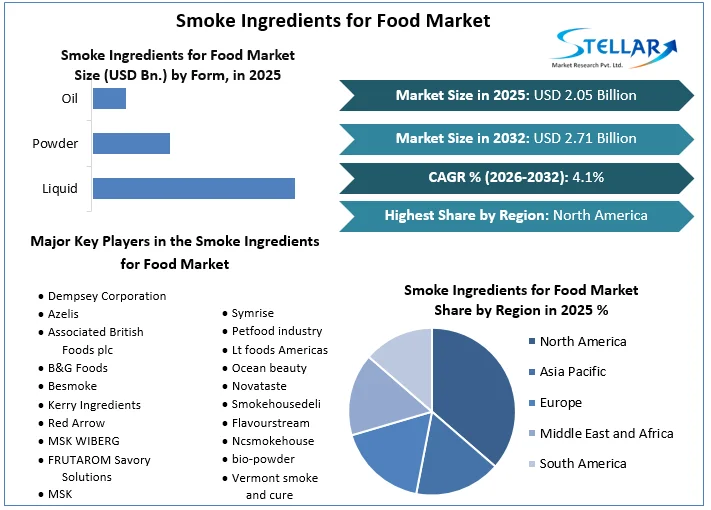
Smoke Ingredients for Food Market size was valued at USD 2.05 Bn. in 2025 and the total Global Smoke Ingredients for food revenue is expected to grow at a CAGR of 4.10% from 2026 to 2032, reaching nearly USD 2.71 Bn. by 2032.
Understanding Smoke Ingredients in Food Processing
Smoke ingredients are flavoring agents produced by capturing and refining smoke generated from the controlled combustion of hardwoods such as hickory, oak, beech, maple, and mesquite. Unlike traditional smoking, which exposes food directly to smoke, these ingredients are purified to remove unwanted compounds while retaining the desirable smoky aroma and taste.
Smoke ingredients are available in several forms, including:
Liquid smoke
Smoke powders
Smoke oils
Smoke emulsions
Smoke condensates
These ingredients can be applied through dipping, spraying, marinating, injection, or direct incorporation into food formulations, making them highly versatile for industrial food production.
Rising Demand for Processed and Convenience Foods
One of the primary drivers of the Smoke Ingredients for Food Market is the increasing global consumption of processed and ready-to-eat foods. Urbanization, changing lifestyles, and busy work schedules have encouraged consumers to choose convenient meal options that offer restaurant-quality flavors with minimal preparation.
Manufacturers are incorporating smoke ingredients into processed meats, frozen foods, sauces, seasonings, cheeses, snacks, and packaged meals to enhance taste while maintaining consistent product quality.
As convenience food consumption continues to rise across developed and emerging economies, demand for reliable smoke flavor solutions is expected to increase significantly.
Clean-Label Trends Are Reshaping Product Development
Modern consumers increasingly scrutinize ingredient labels, preferring products made with recognizable and naturally derived ingredients. This shift has encouraged food manufacturers to develop smoke ingredients produced through natural wood-smoking processes rather than artificial flavoring methods.
Natural smoke flavors allow manufacturers to meet clean-label requirements while delivering authentic taste profiles that consumers associate with traditional wood-fired cooking.
Ingredient transparency has become particularly important in premium food categories, where consumers are willing to pay higher prices for products perceived as healthier and minimally processed.
Manufacturers continue investing in purification technologies that remove undesirable compounds while preserving the complex flavor characteristics of natural smoke.
Plant-Based Foods Create New Growth Opportunities
The rapid expansion of plant-based meat alternatives has emerged as a significant opportunity for smoke ingredient manufacturers. Consumers increasingly expect plant-based burgers, sausages, bacon alternatives, and seafood substitutes to replicate the flavor experience of traditional animal-based products.
Smoke ingredients play a critical role in delivering authentic barbecue, grilled, and roasted flavor profiles without requiring actual smoking processes.
As the global plant-based food market continues expanding, food developers are using advanced smoke flavor systems to improve taste, consumer acceptance, and product differentiation.
This trend has opened new revenue opportunities beyond traditional meat processing applications.
Technology Is Improving Smoke Ingredient Production
Advancements in food processing technology are enabling manufacturers to produce cleaner, safer, and more consistent smoke ingredients.
Modern production systems utilize controlled pyrolysis, filtration, and fractionation techniques to remove harmful substances such as polycyclic aromatic hydrocarbons (PAHs) while preserving desirable flavor compounds.
Recent innovations also include customized smoke profiles tailored to specific food applications, allowing manufacturers to create distinctive flavor experiences for regional cuisines and premium product lines.
Automation and digital quality monitoring further enhance production consistency, helping food companies maintain regulatory compliance and customer satisfaction.
Sustainability Becomes a Competitive Advantage
Sustainability has become an increasingly important consideration across the global food industry. Traditional smoking methods often consume significant amounts of energy and generate emissions during production.
Smoke ingredients offer a more sustainable alternative by reducing processing time, improving resource efficiency, and minimizing waste generation. Many manufacturers are also sourcing wood from sustainably managed forests and adopting environmentally responsible production practices.
These sustainability initiatives support corporate environmental goals while appealing to environmentally conscious consumers seeking responsibly produced food products.
Regional Market Dynamics
North America remains one of the leading markets for smoke ingredients due to its strong processed meat industry, growing demand for barbecue-flavored foods, and high consumption of convenience products.
The United States continues to drive innovation in premium smoke flavor development, supported by advanced food processing infrastructure and increasing demand for natural food ingredients.
Europe also represents a significant market, particularly as food manufacturers focus on clean-label formulations and compliance with stringent food safety regulations. Countries such as Germany, France, Italy, and the United Kingdom continue investing in premium food innovation and sustainable ingredient sourcing.
Meanwhile, the Asia-Pacific region is expected to experience the fastest growth during the forecast period. Rising disposable incomes, expanding urban populations, increasing consumption of processed foods, and rapid growth of quick-service restaurants are driving demand across China, India, Japan, South Korea, and Southeast Asia.
Growing interest in Western-style cuisine and premium packaged foods further supports regional market expansion.
Challenges Facing the Market
Despite positive growth prospects, the Smoke Ingredients for Food Market faces several challenges.
Stringent food safety regulations require manufacturers to maintain high product purity while complying with evolving international standards governing smoke flavor production and usage.
Raw material availability also affects production costs. Variations in hardwood supply due to environmental factors or forestry regulations may influence pricing and manufacturing capacity.
Additionally, increasing competition from alternative natural flavoring solutions encourages manufacturers to continuously innovate and differentiate their product portfolios.
Maintaining flavor consistency across diverse food applications also requires ongoing research and development investments.
Competitive Landscape
- Dempsey Corporation
- Azelis
- Associated British Foods plc
- B&G Foods
- Besmoke
- Kerry Ingredients
- Red Arrow
- MSK WIBERG
- FRUTAROM Savory Solutions
- MSK
𝐃𝐨𝐰𝐧𝐥𝐨𝐚𝐝 𝐅𝐫𝐞𝐞 𝐏𝐃𝐅 𝐁𝐫𝐨𝐜𝐡𝐮𝐫𝐞: https://www.stellarmr.com/report/req_sample/Smoke-Ingredients-for-Food-Market/1703
Future Outlook
The future of the Smoke Ingredients for Food Market remains highly promising as consumer demand for authentic flavors, convenience foods, and clean-label products continues to grow. Technological advancements in smoke production, increasing adoption of plant-based foods, and greater emphasis on sustainability are expected to reshape the competitive landscape over the coming years.
Manufacturers that invest in natural smoke ingredients, advanced purification technologies, and customized flavor solutions will be well positioned to capitalize on emerging opportunities across global food markets.
As the food industry continues balancing taste, safety, sustainability, and operational efficiency, smoke ingredients will remain an indispensable component of modern food manufacturing. Their ability to deliver consistent smoky flavors while supporting clean-label formulations and environmentally responsible production practices ensures continued market expansion throughout the forecast period.
