Starch-based Bioplastics Market: Driving the Transition Toward Sustainable Packaging and Circular Economy
The Starch-based Bioplastics Market is emerging as one of the fastest-growing segments within the sustainable materials industry as governments, businesses, and consumers increasingly seek environmentally friendly alternatives to conventional petroleum-based plastics. Derived primarily from renewable resources such as corn, potato, cassava, wheat, and other starch-rich crops, starch-based bioplastics offer biodegradable and compostable solutions that help reduce plastic pollution while supporting global sustainability goals.
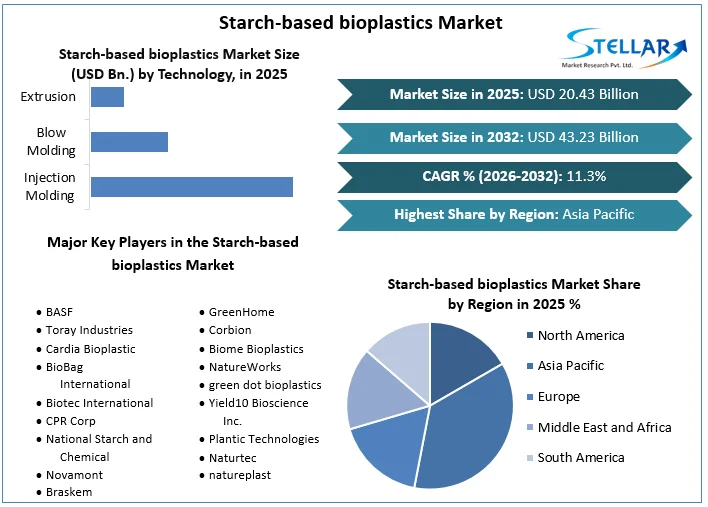
According to recent market insights, the Starch-based Bioplastics Market was valued at USD 20.43 billion in 2025 and is projected to reach approximately USD 43.23 billion by 2032, expanding at a compound annual growth rate (CAGR) of 11.3% during the forecast period. This remarkable growth is driven by increasing environmental awareness, supportive government regulations, rapid technological advancements, and expanding applications across multiple industries.
𝐃𝐨𝐰𝐧𝐥𝐨𝐚𝐝 𝐅𝐫𝐞𝐞 𝐏𝐃𝐅 𝐁𝐫𝐨𝐜𝐡𝐮𝐫𝐞: https://www.stellarmr.com/report/req_sample/Starch-based-Bioplastics-Market/1706
Rising Environmental Concerns Are Accelerating Market Growth
Plastic waste has become one of the world’s most pressing environmental challenges. Millions of tons of plastic enter landfills and oceans every year, creating long-term ecological damage and raising concerns among governments, environmental organizations, and consumers.
In response, industries are actively replacing traditional plastics with biodegradable alternatives that minimize environmental impact. Starch-based bioplastics naturally decompose under composting conditions, significantly reducing long-term waste accumulation compared to conventional plastics.
As sustainability becomes a core business priority, manufacturers across packaging, food service, agriculture, and consumer goods industries are increasingly investing in starch-based materials to support circular economy initiatives and improve environmental performance.
Packaging Industry Leads Demand
Packaging represents the largest application segment for starch-based bioplastics due to growing restrictions on single-use plastics and increasing consumer demand for eco-friendly packaging solutions.
Food packaging, shopping bags, disposable cutlery, compostable films, trays, and takeaway containers increasingly utilize starch-based polymers to reduce plastic waste while maintaining product functionality.
Major retailers and consumer goods companies are introducing sustainable packaging commitments aimed at reducing virgin plastic consumption. These initiatives continue to create substantial opportunities for starch-based bioplastic manufacturers.
Flexible packaging manufacturers are also adopting starch blends to develop compostable packaging materials suitable for food products, beverages, fresh produce, and e-commerce shipments.
Government Regulations Continue to Support Adoption
Regulatory support remains one of the strongest drivers of the Starch-based Bioplastics Market.
Many countries have implemented bans or restrictions on single-use plastics while introducing policies encouraging biodegradable alternatives. Extended Producer Responsibility (EPR) regulations, plastic taxes, and mandatory recycled content requirements further motivate businesses to adopt sustainable materials.
Governments are also investing in bioeconomy initiatives that promote renewable raw materials and environmentally responsible manufacturing practices.
These supportive policies provide long-term market stability while encouraging innovation throughout the biodegradable plastics value chain.
Technological Innovation Improves Material Performance
Historically, starch-based bioplastics faced challenges related to moisture sensitivity, limited mechanical strength, and relatively short shelf life. However, continuous technological advancements are significantly improving product performance.
Manufacturers now combine starch with biodegradable polymers such as PLA (Polylactic Acid), PBAT (Polybutylene Adipate Terephthalate), and PHA (Polyhydroxyalkanoates) to create composite materials with enhanced flexibility, durability, and heat resistance.
Research institutions and industrial manufacturers are also developing advanced formulations capable of meeting demanding performance requirements across automotive, electronics, agriculture, and healthcare applications.
These innovations continue expanding the commercial viability of starch-based bioplastics beyond traditional packaging markets.
Food and Beverage Industry Creates Significant Opportunities
The food and beverage sector remains one of the largest consumers of biodegradable packaging materials.
Restaurants, cafes, supermarkets, and food delivery platforms increasingly utilize compostable packaging to meet sustainability targets while addressing growing consumer expectations.
Disposable cups, plates, straws, food trays, produce bags, and takeaway containers manufactured from starch-based bioplastics help reduce dependence on conventional plastics without compromising product quality.
The rapid growth of online food delivery services further increases demand for sustainable packaging solutions capable of maintaining food safety while minimizing environmental impact.
Agriculture Expands New Applications
Agriculture has become another promising application area for starch-based bioplastics.
Biodegradable mulch films, seed coatings, nursery pots, compost bags, and controlled-release fertilizer coatings help farmers reduce plastic waste while improving soil health.
Unlike conventional agricultural plastics, biodegradable materials naturally decompose after use, eliminating the need for costly collection and disposal operations.
Growing emphasis on sustainable farming practices continues to support adoption across developed and emerging agricultural markets.
Regional Market Trends
Europe currently represents one of the leading markets for starch-based bioplastics due to strict environmental regulations, ambitious climate targets, and widespread consumer awareness regarding sustainable products.
The European Union’s initiatives to reduce plastic waste and promote circular economy principles have significantly accelerated biodegradable packaging adoption across multiple industries.
North America also demonstrates strong market growth driven by corporate sustainability commitments, technological innovation, and increasing investments in renewable materials.
Meanwhile, the Asia-Pacific region is expected to experience the fastest growth throughout the forecast period. Countries such as China, India, Japan, South Korea, and Thailand are expanding bioplastic production capacity while implementing policies aimed at reducing plastic pollution.
Abundant agricultural resources and increasing manufacturing capabilities further strengthen the region’s long-term market potential.
Challenges Facing the Market
Despite impressive growth prospects, several challenges continue to influence market development.
Production costs remain higher than conventional petroleum-based plastics, making widespread adoption difficult in highly price-sensitive markets.
Raw material availability and fluctuations in agricultural commodity prices can also affect manufacturing costs and supply chain stability.
Additionally, composting infrastructure remains limited in many regions, reducing the environmental benefits of biodegradable materials where proper disposal systems are unavailable.
Manufacturers must also continue improving product performance to match the durability and versatility of traditional plastics across demanding industrial applications.
Competitive Landscape
- BASF
- Toray Industries
- Cardia Bioplastic
- BioBag International
- Biotec International
- CPR Corp
- National Starch and Chemical
- Novamont
- Braskem
- GreenHome
𝐃𝐨𝐰𝐧𝐥𝐨𝐚𝐝 𝐅𝐫𝐞𝐞 𝐏𝐃𝐅 𝐁𝐫𝐨𝐜𝐡𝐮𝐫𝐞: https://www.stellarmr.com/report/req_sample/Starch-based-Bioplastics-Market/1706
Future Outlook
The future of the Starch-based Bioplastics Market appears exceptionally promising as sustainability continues to reshape global manufacturing and consumer purchasing decisions. Increasing regulatory support, rising environmental awareness, and ongoing technological innovation will remain the primary growth drivers throughout the forecast period.
As industries transition toward circular economy models, demand for biodegradable materials is expected to expand well beyond packaging into automotive, agriculture, healthcare, textiles, electronics, and consumer products.
Manufacturers that invest in advanced material science, scalable production technologies, and strategic partnerships will be well positioned to capitalize on this rapidly growing market. With governments and businesses worldwide accelerating efforts to reduce plastic waste and carbon emissions, starch-based bioplastics are poised to play a vital role in building a more sustainable and resource-efficient global economy.
