Chocolate, Cocoa Beans, Lecithin, Sugar and Vanilla Market: Shaping the Future of the Global Confectionery Industry
The Chocolate, Cocoa Beans, Lecithin, Sugar and Vanilla Market plays a crucial role in the global food and beverage industry by supplying the essential ingredients that define the taste, texture, aroma, and quality of chocolate products. As consumer preferences evolve toward premium, organic, and ethically sourced confectionery products, manufacturers are investing in innovative ingredient solutions, sustainable sourcing practices, and advanced processing technologies to meet rising demand.
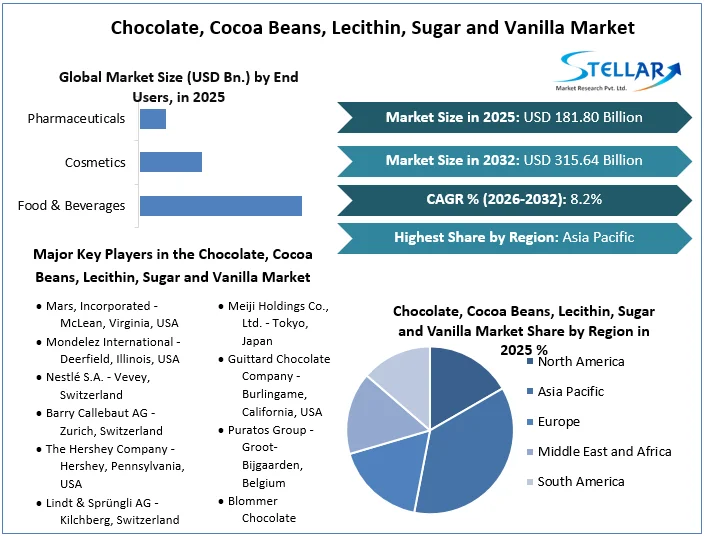
According to recent market insights, the Chocolate, Cocoa Beans, Lecithin, Sugar and Vanilla Market was valued at USD 181.80 billion in 2025 and is projected to reach approximately USD 315.64 billion by 2032, growing at a compound annual growth rate (CAGR) of 8.2% during the forecast period. Rising disposable incomes, increasing chocolate consumption, product innovation, and expanding premium confectionery segments are expected to support sustained market growth worldwide.
𝐃𝐨𝐰𝐧𝐥𝐨𝐚𝐝 𝐅𝐫𝐞𝐞 𝐏𝐃𝐅 𝐁𝐫𝐨𝐜𝐡𝐮𝐫𝐞: https://www.stellarmr.com/report/req_sample/Chocolate-Cocoa-Beans-Lecithin-Sugar-and-Vanilla-Market/1722
Growing Consumer Demand for Premium Chocolate
One of the most significant trends driving the market is the increasing popularity of premium and artisanal chocolate products. Consumers are no longer purchasing chocolate solely as an affordable treat; they are seeking high-quality products made with carefully selected cocoa beans, natural vanilla, premium sweeteners, and specialty ingredients.
Dark chocolate, single-origin cocoa, handcrafted chocolates, and gourmet confectionery have witnessed strong demand as consumers become more interested in flavor complexity, authenticity, and premium experiences.
Manufacturers are responding by introducing products with higher cocoa content, unique flavor combinations, and ethically sourced ingredients that appeal to health-conscious and environmentally aware buyers.
Cocoa Beans Remain the Foundation of Market Growth
Cocoa beans remain the most important raw material in chocolate manufacturing. Countries in West Africa, particularly Côte d’Ivoire and Ghana, continue to dominate global cocoa production, supplying a substantial share of the world’s cocoa requirements.
However, the cocoa supply chain faces increasing challenges, including climate change, unpredictable weather conditions, crop diseases, and labor shortages. These factors contribute to fluctuations in cocoa prices and create uncertainty for manufacturers.
To reduce supply risks, chocolate producers are investing in sustainable cocoa farming programs, farmer training initiatives, and long-term sourcing partnerships that improve productivity while promoting environmental conservation and fair trade practices.
Lecithin Enhances Product Performance
Lecithin plays a vital role in chocolate manufacturing by improving texture, viscosity, and processing efficiency. It enables manufacturers to reduce cocoa butter usage while maintaining smooth consistency and desirable mouthfeel.
Soy lecithin remains widely used due to its effectiveness and affordability. However, sunflower lecithin has gained popularity among manufacturers seeking allergen-friendly and non-GMO alternatives.
Growing consumer demand for clean-label products is encouraging ingredient suppliers to develop naturally sourced emulsifiers that meet evolving food labeling requirements without compromising product quality.
Sugar Innovation Supports Health-Conscious Consumers
Although sugar remains a key ingredient in chocolate production, changing dietary preferences have encouraged manufacturers to reduce sugar content while maintaining taste and texture.
Consumers increasingly seek reduced-sugar, low-calorie, and diabetic-friendly chocolate products. In response, manufacturers are incorporating alternative sweeteners, natural sugar substitutes, and innovative sugar reduction technologies into new product formulations.
Balancing sweetness with flavor authenticity has become a major focus for research and development teams throughout the confectionery industry.
As health awareness continues to grow globally, sugar innovation is expected to remain a critical area of investment.
Vanilla Continues to Add Premium Value
Vanilla remains one of the world’s most valuable natural flavoring ingredients. Its distinctive aroma enhances chocolate products while contributing to premium product positioning.
Natural vanilla demand continues to rise despite ongoing supply challenges caused by weather conditions, limited cultivation areas, and fluctuating production volumes.
Manufacturers increasingly combine natural vanilla with advanced flavor technologies to achieve consistent quality while managing ingredient costs. Sustainable vanilla sourcing initiatives also support long-term supply chain stability and improved livelihoods for farming communities.
Sustainability Becomes a Competitive Advantage
Sustainability has become a defining trend across the chocolate ingredient market. Consumers increasingly expect manufacturers to demonstrate environmental responsibility, ethical sourcing, and transparent supply chains.
Leading chocolate companies are investing in sustainable cocoa farming, regenerative agriculture, deforestation prevention, water conservation, and carbon footprint reduction initiatives.
Certification programs supporting fair trade, organic farming, and responsible sourcing continue gaining importance among retailers and consumers alike.
Packaging innovation also contributes to sustainability efforts, with manufacturers adopting recyclable, biodegradable, and compostable packaging materials that align with circular economy objectives.
Technological Innovation Is Improving Manufacturing
Advanced manufacturing technologies continue transforming chocolate production through improved automation, precision processing, and digital quality control.
Artificial intelligence helps optimize ingredient blending, monitor production quality, and improve demand forecasting. Automated manufacturing systems enhance consistency while reducing production costs and minimizing ingredient waste.
Digital supply chain technologies also improve traceability, enabling manufacturers to verify ingredient origins and strengthen consumer confidence regarding product authenticity.
Continuous investment in research and development allows companies to create innovative chocolate formulations that address changing consumer preferences while improving operational efficiency.
Regional Market Trends
Europe remains one of the largest markets for chocolate and premium confectionery due to its long-standing chocolate manufacturing heritage and strong consumer demand for high-quality products. Countries including Switzerland, Belgium, Germany, France, and Italy continue driving innovation in premium chocolate production.
North America also represents a major market supported by increasing demand for organic chocolate, seasonal gifting, and healthier confectionery options.
Meanwhile, the Asia-Pacific region is expected to witness the fastest growth during the forecast period. Rising disposable incomes, expanding middle-class populations, increasing urbanization, and growing Western dietary influences are encouraging higher chocolate consumption across China, India, Japan, South Korea, and Southeast Asia.
Rapid growth in e-commerce platforms and modern retail channels further supports regional market expansion by improving product accessibility.
Challenges Facing the Industry
Despite strong growth prospects, the market faces several ongoing challenges.
Volatile cocoa prices remain one of the industry’s biggest concerns, significantly affecting manufacturing costs and profit margins. Climate-related production disruptions continue increasing uncertainty within global cocoa supply chains.
Health concerns surrounding excessive sugar consumption also encourage manufacturers to reformulate products while balancing taste and affordability.
In addition, sustainable sourcing requirements require substantial investments in certification, farmer support programs, and supply chain transparency.
Manufacturers must carefully manage these challenges while continuing to meet consumer expectations for quality, innovation, and sustainability.
𝐃𝐨𝐰𝐧𝐥𝐨𝐚𝐝 𝐅𝐫𝐞𝐞 𝐏𝐃𝐅 𝐁𝐫𝐨𝐜𝐡𝐮𝐫𝐞: https://www.stellarmr.com/report/req_sample/Chocolate-Cocoa-Beans-Lecithin-Sugar-and-Vanilla-Market/1722
Competitive Landscape
- Mars, Incorporated – McLean, Virginia, USA
- Mondelez International – Deerfield, Illinois, USA
- Nestlé S.A. – Vevey, Switzerland
- Barry Callebaut AG – Zurich, Switzerland
- The Hershey Company – Hershey, Pennsylvania, USA
- Lindt & Sprüngli AG – Kilchberg, Switzerland
- Ferrero Group – Alba, Italy
- Cargill, Incorporated – Wayzata, Minnesota, USA
- Meiji Holdings Co., Ltd. – Tokyo, Japan
- Guittard Chocolate Company – Burlingame, California, USA
Future Outlook
The future of the Chocolate, Cocoa Beans, Lecithin, Sugar and Vanilla Market appears highly promising as premiumization, sustainability, and product innovation reshape the global confectionery landscape. Consumers increasingly seek indulgent yet responsibly produced chocolate products featuring high-quality ingredients, natural flavors, and transparent sourcing practices.
Technological advancements in ingredient processing, sugar reduction, digital manufacturing, and supply chain management will continue supporting industry growth. Meanwhile, expanding middle-class populations in emerging markets and increasing demand for premium chocolate products will create significant long-term opportunities.
Companies that invest in sustainable cocoa sourcing, innovative formulations, clean-label ingredients, and environmentally responsible production will be best positioned to succeed in this competitive and rapidly evolving market. As global consumers continue embracing premium confectionery experiences, the Chocolate, Cocoa Beans, Lecithin, Sugar and Vanilla Market is expected to remain a dynamic and essential segment of the worldwide food and beverage industry.
