Key Highlights
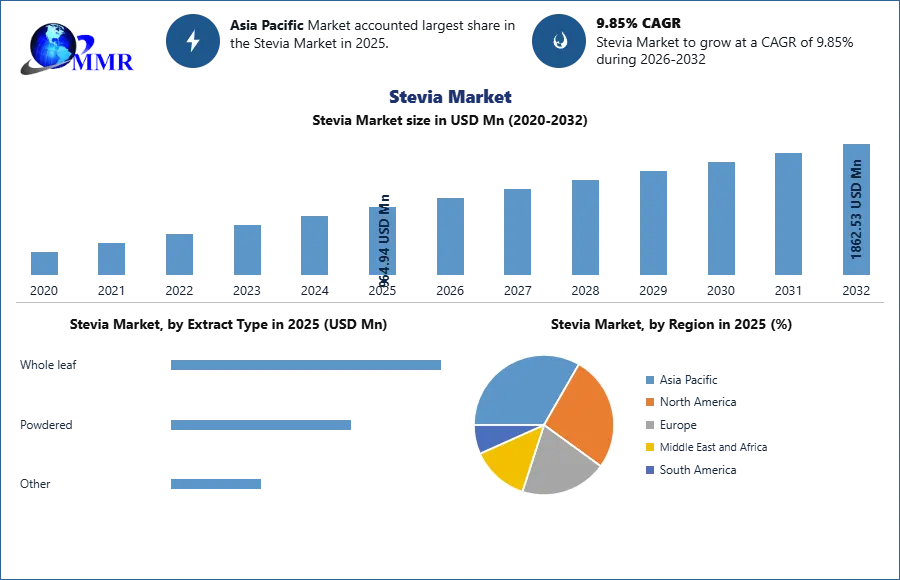
Stevia Market size was valued at USD 964.94 Million in 2025 and is expected to reach nearly USD 1862.53 Million by 2032 at a 9.85% CAGR, signaling a structural shift toward natural, low-calorie sweeteners in global FMCG portfolios.
The market is driven by growing consumer awareness of lifestyle diseases and demand for sugar-reduced products that maintain taste, supporting long-cycle reformulation in food and beverages.
Stevia’s plant origin and low-calorie profile make it a central ingredient in clean-label strategies across beverages, bakery, confectionery, and functional foods.
Regulatory and health pressures on traditional sugar and synthetic sweeteners are pushing manufacturers to accelerate stevia adoption.
FMCG players and ingredient companies compete on formulation expertise, taste optimization, and regional penetration, opening emerging opportunities in developing markets.
Why This Matters Now
Global FMCG leaders face dual pressure: regulators demand sugar reduction, and consumers demand transparency and natural ingredients. Stevia, as a plant-derived, low-calorie sweetener, directly addresses both forces and is becoming a strategic lever rather than a niche additive.
With the Stevia Market projected to grow from USD 964.94 Million in 2025 to nearly USD 1862.53 Million by 2032 at 9.85% CAGR, sugar replacement is no longer a limited campaign—it is a long-cycle portfolio redesign. Every percentage point of growth represents more SKUs reformulated, more categories touched, and deeper dependence on reliable stevia supply and expertise.
Market Overview
The Stevia Market size is on a strong growth trajectory, driven by health-conscious consumers, rising obesity and diabetes rates, and a clear pivot away from traditional sugar in mainstream food and beverage products. As manufacturers embed sugar reduction and natural positioning into core brand strategies, stevia becomes a critical ingredient in keeping taste while meeting health targets.
Stevia, derived from the Stevia rebaudiana plant, offers intense sweetness with negligible calories, enabling significant sugar reduction without a corresponding loss of sweetness. This capability supports reformulation across carbonated soft drinks, flavored waters, juices, dairy, bakery, confectionery, and functional foods, where taste remains non-negotiable.
Key Trends Driving Growth
The most important growth driver is the global shift toward natural, plant-based sweeteners as consumers question the long-term safety and image of synthetic alternatives. Stevia’s botanical origin and “natural” positioning align directly with clean-label expectations, allowing brands to remove artificial sweeteners while still delivering sweetness.
A second driver is the rising incidence of obesity and diabetes, pushing consumers and regulators to confront dietary sugar. As front-of-pack labelling, sugar taxes, and health campaigns intensify, FMCG brands increasingly use stevia to lower sugar content while preserving flavour and indulgence cues.
Third, the expansion of functional and health-oriented foods amplifies demand. Products marketed for weight management, blood sugar control, or general wellness can use stevia to support low-calorie claims and position themselves as part of a healthier lifestyle, expanding stevia’s role beyond basic sweetening.
Request a Free Sample Copy or View Report Summary: https://www.maximizemarketresearch.com/request-sample/27578/
Segment Insights
Dominant Segment – Food & Beverage Applications
Food and beverage applications account for the bulk of stevia demand, as manufacturers reformulate mainstream categories such as soft drinks, juices, yogurt, bakery goods and confectionery. These applications leverage stevia’s sweetness and low-calorie profile to align everyday products with health and wellness expectations without breaking the taste experience.Fastest-Growing Segment – Health-Focused and Functional Product Lines
Stevia is expanding fastest in health-focused and functional segments, including diet beverages, sugar-free snacks, and specialized nutrition products. These lines use stevia not only to cut calories but also to anchor brand identity around wellness, creating premium pricing opportunities and long-term loyalty among health-conscious consumers.Consumer Behaviour – Clean Label and Natural Preference
Consumers increasingly scrutinize ingredient lists and favour products free from artificial additives, pushing demand for clean-label formulations where stevia replaces synthetic sweeteners. As natural origin becomes a purchase criterion, stevia’s plant-based story turns into a competitive advantage across multiple FMCG categories.E-Commerce and Retail – Wider Access and Niche Brands
While detailed channel data is not provided, the broader sugar-reduction trend and natural sweetener narrative support growth in online and modern retail formats, where health-focused, niche and premium brands often lead innovation. This opens space for stevia-forward SKUs to gain visibility and scale faster than in traditional retail alone.
Regional Growth Story
The Stevia Market is global, with demand across developed and emerging regions driven by similar health and sugar-reduction concerns, although intensity and regulation vary. Mature markets typically adopt stevia quickly due to high obesity and diabetes awareness and strong clean-label movements.
In emerging markets, growing middle-class incomes, urbanization, and increasing exposure to global health narratives create fertile ground for stevia-sweetened beverages and foods. As local manufacturers modernize portfolios and international brands expand presence, stevia becomes a standard sweetener option rather than a specialty ingredient.
Regions with aggressive sugar policies, such as sugar taxes or reformulation targets, are likely to see faster integration of stevia across mainstream categories. For FMCG and ingredient players, aligning regional strategies with health regulation trajectories is central to capturing stevia-related growth.
Competitive Landscape
The Stevia Market features a mix of global ingredient companies, sweetener specialists, and FMCG brands using stevia across their product lines. Competition revolves around access to high-quality stevia extracts, taste optimization (including masking bitterness), and application support for tricky categories like dairy and certain beverages.
Manufacturers that can deliver stevia solutions with improved taste, stability, and blend performance gain an edge as reformulation projects scale. FMCG brands that lock in strategic partnerships with reliable stevia suppliers and invest in R&D to refine flavour profiles will be better positioned than rivals that treat stevia as a plug-in commodity.
Recent Developments
Growing use of stevia in mainstream soft drinks, juices, teas and flavoured waters as manufacturers respond to sugar taxes and consumer pressure.
Acceleration of reformulation projects in bakery and confectionery, where stevia helps maintain sweetness while lowering sugar content.
Increased investment in taste-improvement technologies and blends that combine stevia with other natural sweeteners to enhance consumer acceptance.
Stevia’s integration into functional and lifestyle products aimed at weight management and blood sugar support, widening its reach beyond traditional FMCG categories.
Strategic Implications
For FMCG boardrooms, stevia is no longer optional. It is a strategic ingredient for sugar reduction, brand repositioning, and regulatory compliance across major categories. Companies that embed stevia in their long-term innovation roadmaps can design portfolios that meet health targets without sacrificing core taste equity.
Ingredient suppliers must move beyond simple supply to become formulation partners, offering technical support for taste optimization and category-specific stevia solutions. As reformulation volumes grow, securing reliable, high-quality stevia supply and building joint development programs with brand owners will determine competitive advantage.
Investors should view stevia adoption as a proxy for how seriously FMCG players treat health and regulatory risk. Firms aggressively integrating stevia and other natural sweeteners signal readiness for a lower-sugar future; laggards risk margin compression and reputational damage as policies tighten.
Future Outlook
With the Stevia Market set to grow from USD 964.94 Million in 2025 to nearly USD 1862.53 Million by 2032 at 9.85% CAGR, the next seven years will define which companies turn sugar reduction into strategic advantage. As product pipelines fill with stevia-sweetened SKUs, consumer expectations for low-sugar, naturally sweetened options will harden into a new baseline.
Taste science, supply security and regulatory alignment will separate leaders from followers. The winners will be those that treat stevia as a cornerstone of health-centric portfolio redesign and invest in making it indistinguishable from sugar in consumer experience, while losers will cling to legacy sugar-heavy formulas until regulation and consumer choice force abrupt, costly change.
Related Reports
Global Fanfold Labels Market https://www.maximizemarketresearch.com/market-report/global-fanfold-labels-market/86921/
Global Profilometer Market https://www.maximizemarketresearch.com/market-report/global-profilometer-market/22226/
PLA Cup Market https://www.maximizemarketresearch.com/market-report/pla-cup-market/146528/
Analyst Perspective
“As health pressures rise and sugar becomes a strategic risk, companies that make stevia central to their reformulation roadmaps will gain durable advantage in taste, trust and regulatory resilience,” Siddhi Dole
About Maximize Market Research
Maximize Market Research Pvt. Ltd. (MMR) is a global market research and consulting company that provides reliable, data-focused, and practical business insights. The firm serves a wide range of industries, including healthcare, pharmaceuticals, technology, automotive, electronics, chemicals, personal care, and consumer goods. Through market forecasts, competitive analysis, strategic consulting, and industry impact assessments, MMR helps organizations understand changing market conditions, identify growth opportunities, and make informed business decisions for long-term success.
2nd Floor, Navale IT Park Phase 3
Pune Banglore Highway, Narhe
Pune, Maharashtra 411041, India
+91 9607365656
sales@maximizemarketresearch.com
