Military Simulation and Virtual Training Market Advances as Defense Forces Accelerate Digital Readiness
Modern defense organizations are increasingly replacing conventional training methods with immersive digital environments to improve operational readiness while reducing costs and safety risks. Technologies such as virtual reality (VR), augmented reality (AR), mixed reality (MR), digital twins, and AI-powered simulation platforms are transforming how military personnel prepare for complex combat scenarios. As governments invest in defense modernization and multi-domain operations, the Military Simulation and Virtual Training Market is emerging as a strategic enabler of next-generation military preparedness.
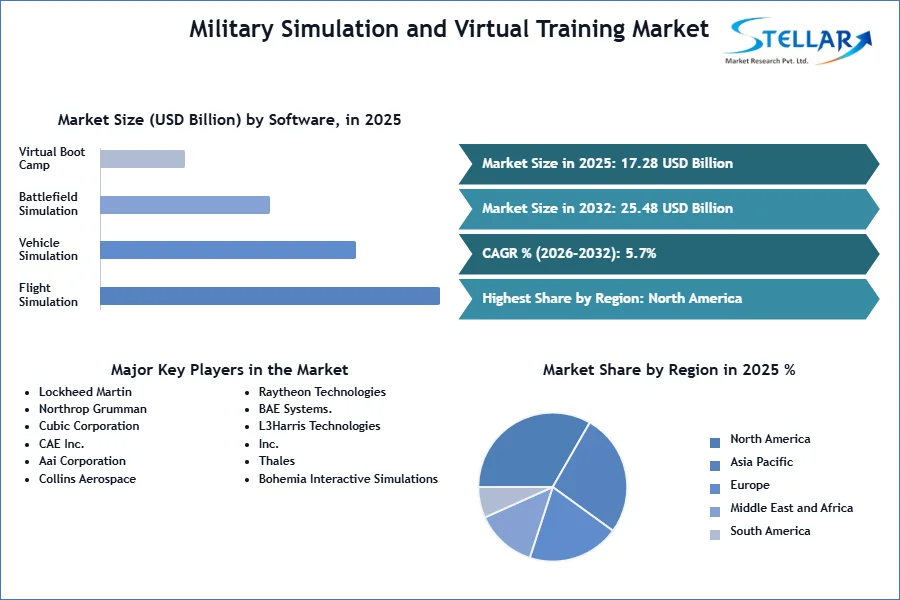
According to Stellar Market Research, the global Military Simulation and Virtual Training Market was valued at USD 17.28 billion in 2025 and is projected to reach USD 25.48 billion by 2032, growing at a CAGR of 5.7% during the forecast period. The market is being driven by increasing defense budgets, demand for realistic yet cost-effective training, and rapid adoption of immersive simulation technologies.
Defense Modernization Is Driving Demand for Virtual Training
Military organizations worldwide are prioritizing advanced simulation systems to prepare personnel for increasingly sophisticated operational environments. Traditional live training exercises involve significant costs related to fuel, equipment maintenance, ammunition, logistics, and safety. Virtual training environments provide a realistic alternative, allowing soldiers, pilots, and naval personnel to repeatedly practice mission-critical scenarios without exposing personnel or assets to unnecessary risks.
Governments are also integrating simulation-based learning into broader military modernization programs to improve mission readiness while optimizing defense spending. The growing emphasis on joint operations, cyber warfare, and autonomous defense systems is further accelerating the adoption of advanced virtual training platforms.
𝐃𝐨𝐰𝐧𝐥𝐨𝐚𝐝 𝐅𝐫𝐞𝐞 𝐏𝐃𝐅 𝐁𝐫𝐨𝐜𝐡𝐮𝐫𝐞: https://www.stellarmr.com/report/req_sample/military-simulation-and-virtual-training-market/2400
Flight Simulation Continues to Lead Platform Adoption
Among various platform types, flight simulation remains the dominant segment due to the complexity and high operating costs associated with pilot training. Modern fighter aircraft require extensive simulation before live operations, making advanced flight simulators essential for pilot proficiency and mission planning.
Vehicle simulation and battlefield simulation are also witnessing strong demand as armed forces seek realistic training for armored vehicles, tactical operations, and multi-domain combat exercises. Virtual boot camps are gaining popularity for basic military training, enabling recruits to develop operational skills within controlled digital environments.
Immersive Technologies Are Reshaping Military Training
Artificial intelligence, virtual reality, augmented reality, mixed reality, and digital twin technologies are significantly improving the realism and effectiveness of military simulations. AI-powered systems can dynamically adjust battlefield scenarios based on trainee performance, while VR and MR platforms create immersive environments that closely replicate real-world combat conditions.
Digital twins are also emerging as valuable tools for replicating military equipment and operational systems, enabling predictive maintenance training and mission rehearsal. Cloud computing and advanced networking technologies further support distributed training, allowing geographically dispersed military units to participate in coordinated virtual exercises.
Air Applications Continue to Dominate
The air segment accounts for the largest share of the military simulation and virtual training market due to the increasing complexity of modern aircraft operations and the high cost of live flight exercises. Flight simulators allow pilots to practice emergency procedures, combat missions, and equipment handling under realistic conditions while minimizing operational expenses.
Ground and naval applications are also expanding steadily as defense organizations adopt integrated simulation systems for armored vehicles, naval vessels, amphibious operations, and multi-domain warfare. Simulation-based training enables military personnel to improve decision-making, tactical coordination, and operational efficiency before deployment.
Regional Market Outlook
North America remains the largest regional market, supported by substantial defense budgets, advanced military infrastructure, and continuous investments in simulation technologies. The United States leads global adoption through ongoing modernization programs and strong participation from major defense contractors.
Europe continues to expand its simulation capabilities through collaborative defense initiatives, NATO training programs, and investments in digital battlefield technologies. Countries including the United Kingdom, Germany, and France are increasing procurement of advanced military training systems.
Asia-Pacific is expected to register the fastest growth during the forecast period as countries such as China, India, Japan, South Korea, and Australia continue modernizing their armed forces. Rising geopolitical tensions, expanding defense budgets, and increased focus on indigenous defense capabilities are driving regional demand for advanced simulation platforms.
Challenges Affecting Market Growth
Despite strong growth prospects, several challenges remain. Advanced military simulation platforms require significant upfront investments in hardware, software integration, and system maintenance. Cybersecurity has also become a critical concern as connected training environments face growing risks from cyber threats and unauthorized data access.
Integration with legacy military systems and interoperability across multiple defense platforms can further complicate implementation, requiring continuous software updates and specialized technical expertise.
𝐃𝐨𝐰𝐧𝐥𝐨𝐚𝐝 𝐅𝐫𝐞𝐞 𝐏𝐃𝐅 𝐁𝐫𝐨𝐜𝐡𝐮𝐫𝐞: https://www.stellarmr.com/report/req_sample/military-simulation-and-virtual-training-market/2400
Competitive Landscape
The military simulation and virtual training market is highly competitive, with leading defense technology companies investing heavily in immersive training solutions, AI integration, and digital transformation. Strategic partnerships, defense contracts, product innovation, and research investments remain central to competitive positioning.
Key market participants include Lockheed Martin, Northrop Grumman, Cubic Corporation, CAE Inc., Collins Aerospace, Raytheon Technologies, BAE Systems, L3Harris Technologies, Thales, and Bohemia Interactive Simulations. These companies continue expanding their simulation portfolios to address evolving defense requirements across air, land, and naval operations.
Future Outlook
The future of the military simulation and virtual training market will be shaped by continued advances in immersive technologies, artificial intelligence, cloud computing, and digital twin applications. Defense organizations are expected to increasingly adopt simulation-first training strategies to improve operational efficiency, reduce costs, and strengthen combat readiness.
Growing investments in autonomous systems, cyber defense, and multi-domain warfare will further expand demand for intelligent virtual training platforms. As military operations become more technologically sophisticated, simulation-based learning will remain a critical component of defense preparedness worldwide.
Conclusion
The global Military Simulation and Virtual Training Market is poised for sustained growth as defense organizations embrace digital transformation to improve readiness, safety, and operational effectiveness. With the market projected to expand from USD 17.28 billion in 2025 to USD 25.48 billion by 2032, investments in AI-driven simulations, immersive training environments, and advanced digital technologies are expected to redefine military training for the next generation of defense forces.
