Key Highlights
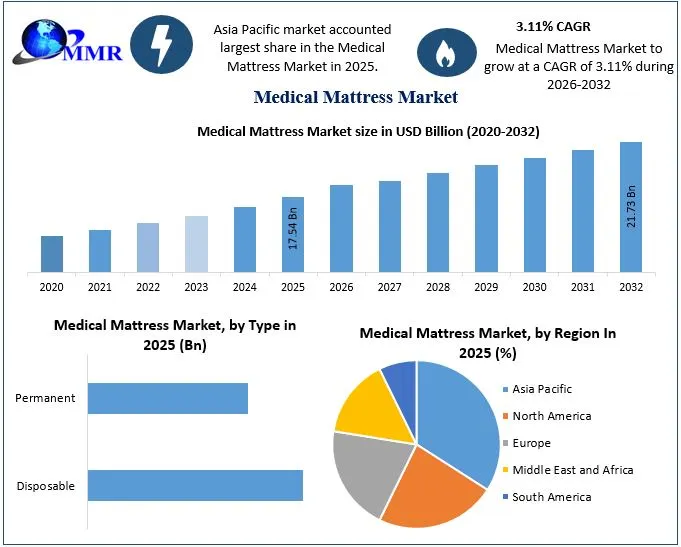
Market Capitalization: The global medical mattress market achieved a valuation of USD 17.54 billion in 2025 and is projected to expand to USD 21.73 billion by 2032.
Expansion Velocity: The category is growing at a compound annual growth rate (CAGR) of 3.11% across the 2026 to 2032 industrial planning timeline.
Geographic Leadership: The Asia Pacific region holds the dominant market position, driven by expanding healthcare networks and a massive senior demographic pool.
Product Utility: Specialized fowler mattresses are seeing high demand due to their advanced structural flexibility and patient body relaxation capabilities.
Corporate Activity: Strategic institutional capital investments and regulatory compliance measures are altering competitive boundaries for global medical suppliers.
Why This Matters Now
Hospital procurement directors and healthcare facility executives are facing an immediate resource squeeze as rising patient volumes clash with outdated long-term care assets. Medical institutions that fail to upgrade their basic support surfaces will see an increase in extended patient stay times, leading to lower bed turnover rates and reduced clinical efficiency.
What changed? The clinical bedding market has evolved from a simple hospital supply purchase into a critical piece of preventive patient care equipment that helps manage complex health complications during recovery. Why now? A simultaneous rise in chronic diseases, sports-related injuries, and hospitalizations has increased bed occupancy rates, putting extra pressure on institutional supply chains. Who benefits? Original equipment manufacturers (OEMs), clinical procurement groups, and specialized healthcare distributors who supply durable, high-rigidity permanent mattresses will capture multi-year institutional supply contracts from major private and public nursing groups.
What happens next? Leading medical product fabricators will modify their manufacturing setups to support higher output levels for customized clinical dimensions. This operational pivot allows production facilities to insulate their revenue streams against changing healthcare spending patterns while establishing strong barriers against lower-tier competitors.
Market Overview
The global Medical mattress market Size operates as a high-stakes, specialized segment within the international medical equipment and clinical care supply sectors. Valued at USD 17.54 billion in 2025, the market is on a direct track to reach USD 21.73 billion by 2032, advancing at a steady CAGR of 3.11%. This commercial path is sustained by rapid physical expansions of public health facilities, new private nursing homes, and growing international home care distribution networks.
This market trajectory is highly sensitive to overnight patient stay frequencies and the total volume of operational hospital beds globally. Because care facilities require specialized pressure-relief setups to prevent secondary patient injuries, procurement standards have become increasingly technical. Driven by these structural demands, the manufacturing landscape is moving toward durable core materials that offer dependable full-body rigidity and help maintain calm patient recovery states.
Key Trends Driving Growth
The most critical catalyst transforming the procurement sector is the aggressive expansion of private hospital networks and government-backed nursing homes worldwide. Medical operators are continuously building new treatment centers to handle expanding patient volumes, which creates immediate, large-volume demand for matching bed configurations and medical mattresses. This rapid facility development provides equipment manufacturers with large, predictable institutional orders, converting standard infrastructure upgrades into a primary sales engine for top-tier brands.
Simultaneously, a sharp increase in sports-related injuries and orthopedic conditions is expanding the home treatment consumer segment. Recovering individuals are choosing to manage their long-term rehabilitation from home, which drives immediate direct-to-consumer sales for high-rigidity therapeutic mattresses. This trend allows specialized manufacturers to build secondary retail revenue pipelines outside traditional hospital tenders, helping insulate overall corporate margins from institutional price caps.
Furthermore, leading engineering brands are focusing heavily on fowler mattress lines to capture high-value specialty care segments. These mattresses are engineered with specific flexible joints to fit modern adjustable hospital beds, matching standard sizing metrics like 1980L x 900W x 600H millimeters. This technical focus ensures optimal performance in high-intensity clinical spaces, allowing brands to justify premium price points while meeting strict hospital utility requirements.
Segment Insights
Product Classifications: Comprises high-rigidity fowler mattresses, specialized pressure-relief surfaces, and traditional multi-layered clinical support blocks.
Type Formulations: Segmented into high-turnover disposable medical mattress options and highly durable permanent clinical bedding systems.
Distribution Networks: Structured across high-volume direct institutional B2B procurement, specialized medical supply distributors, and growing home care direct-to-consumer sales platforms.
Dominant Segment: Permanent medical bedding systems represent the dominant product category by type, commanding the largest portion of global market revenue due to their multi-year durability and widespread use in standard hospital wards.
Fastest-Growing Segment: Flexible fowler mattresses and advanced therapeutic pressure-relief lines represent the fastest-growing design categories, moving quickly because of the rapid modernization of adjustable medical bed systems globally.
Regional Growth Story
The global performance of the medical mattress sector shows a strong concentration of revenue within rapidly growing healthcare economies. The Asia Pacific region commands the leading position in the global market, a dominant status it will maintain through the entire forecast window. This regional strength is driven by a massive population base, an aging demographic requiring specialized care, and a substantial middle-class expansion across China, India, Japan, South Korea, and Southeast Asian nations. These structural market fundamentals encourage local health authorities to rapidly increase total hospital bed counts, ensuring a steady stream of equipment orders.
At the same time, the North American and European markets maintain highly advanced, quality-driven positions within the global supply network. The United States and key European countries operate under strict medical hygiene standards and patient safety rules, forcing manufacturers to focus on product quality and brand recognition. This regulatory framework ensures regular replacement cycles for existing hospital assets, requiring logistics managers to run efficient, on-time distribution setups to support regular facility refreshes.
Competitive Landscape
The global medical mattress market features intense competition among a highly specialized group of medical device manufacturers and healthcare conglomerates. Leading industry participants include Stryker Corporation, Hill-ROM Holdings, Inc., Invacare Corp., Arjo A.B., Linet Group S.E., Joerns Healthcare LLC, Blue Chip Medical Products, and Casco Manufacturing Solutions. The competitive dynamic between these organizations centers on material innovation, strict safety compliance, and multi-year corporate supply relationships.
To secure long-term market dominance, top manufacturers are shifting their business strategies away from simple price competition toward targeted corporate consolidations and structural service upgrades. Industry leaders are using asset acquisitions and international regulatory clearances to block smaller regional competitors from securing key institutional tenders. This consolidation strategy allows top-tier brands to bundle their medical mattress lines with larger, high-margin adjustable bed system sales, protecting factory floor utilization and securing long-term brand loyalty across major hospital networks.
Recent Developments
Stryker Supply Expansions: Stryker Corporation executed major product line enhancements, expanding its clinical bedding portfolio to match newly deployed high-intensity patient care beds (23 May 2025).
Rhône Capital Realignments: Rhône Capital LLC adjusted its healthcare investment focus, driving strategic capital toward specialized manufacturing plants to scale the output of pressure-relief therapeutic surfaces (06 July 2025).
European Regulatory Approvals: The European Commission updated its healthcare equipment standards, forcing medical mattress fabricators to modify product safety profiles to maintain active continental distribution rights (08 December 2025).
DHCare Distribution Upgrades: DHCare completed a major integration of its logistics framework, speeding up shipping times for specialized fowler mattresses directed toward private nursing networks (30 January 2026).
Strategic Implications
For medical equipment executives, supply chain managers, and clinical procurement directors, the continuous growth of the medical mattress market requires an immediate focus on long-term institutional relationships and strict product validation. Relying on basic, low-margin product lines without distinct therapeutic or orthopedic benefits exposes manufacturers to intense price competition from unbranded suppliers. Engineering teams must ensure that product dimensions match adjustable fowler systems perfectly, shielding their portfolios from changing hospital bed formats.
Furthermore, navigating international healthcare safety updates demands highly flexible manufacturing systems. If regulatory bodies adjust hygiene or materials compliance baselines unexpectedly, factory profitability depends entirely on how quickly lines can adapt without increasing scrap rates. Corporate operators who combine automated production with certified non-toxic raw material inputs will protect their long-term tender wins, while slower-moving fabricators face declining brand trust and the loss of major hospital supply contracts.
Future Outlook
The global medical mattress market will maintain its upward growth trajectory as expanding hospital networks and an aging global population drive a steady demand for specialized healthcare bedding. As custom fowler designs, pressure-relief technologies, and multi-year product durability become standard baseline requirements for healthcare procurement officers globally, the market’s high-value tiers will continue to scale. Medical manufacturing groups that systematically tie their product lines to adjustable bed tech and optimize their institutional distribution networks will secure leading positions and recurring corporate revenue, whereas legacy suppliers tied to non-adjustable, low-durability designs will face intense margin compression, lost hospital tenders, and rapid market obsolescence.
Analyst Perspective
“The global medical mattress market has transformed from a secondary hospital utility item into an essential component of professional patient recovery and pressure management,” states Siddhi Dole, Lead Analyst at Maximize Market Research.
About Maximize Market Research
Maximize Market Research Pvt. Ltd. (MMR) is a global market research and consulting firm known for delivering accurate, actionable, and data-driven insights. Our expertise spans diverse industries — including medical devices, pharmaceuticals, technology, automotive, electronics, chemicals, personal care, and consumer goods. We provide services such as market-validated forecasts, competitive intelligence, strategic consulting, and industry impact analysis, helping businesses navigate market complexities and achieve sustainable growth.
2nd Floor, Navale IT Park Phase 3
Pune Banglore Highway, Narhe
Pune, Maharashtra 411041, India
+91 9607365656
sales@maximizemarketresearch.com
