Fire Sprinkler Systems Market Expands as Smart Building Safety and Fire Regulations Drive Global Demand
The growing emphasis on life safety, infrastructure resilience, and stricter building regulations is accelerating the adoption of advanced fire protection technologies worldwide. The Fire Sprinkler Systems Market is witnessing robust growth as governments mandate enhanced fire safety standards across residential, commercial, and industrial buildings. Integration of IoT-enabled monitoring, predictive maintenance, and smart building management systems is further transforming traditional fire sprinkler installations into intelligent fire protection solutions.
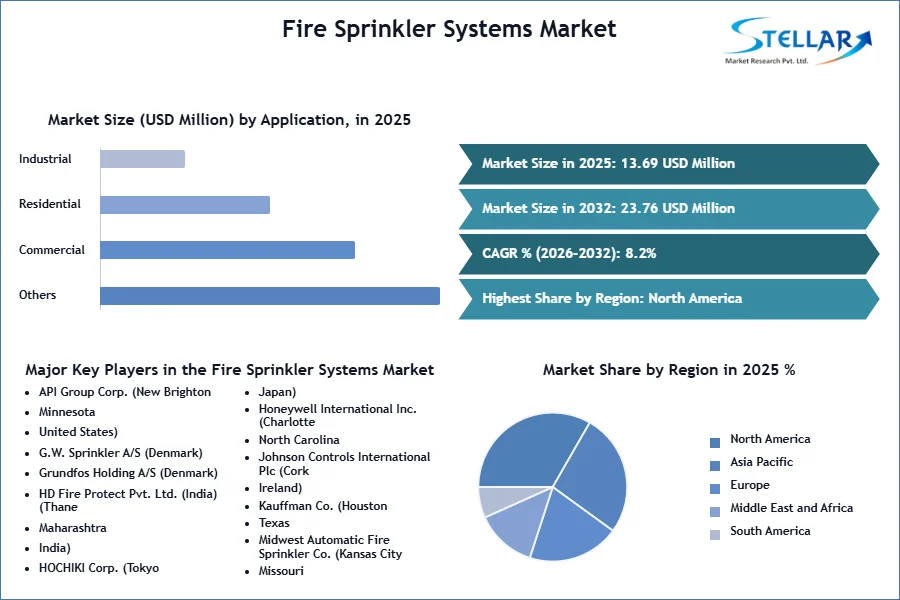
According to Stellar Market Research, the global Fire Sprinkler Systems Market was valued at USD 13.69 billion in 2025 and is projected to reach USD 23.76 billion by 2032, expanding at a CAGR of 8.20% during the forecast period. Rapid urbanization, infrastructure development, insurance incentives, and stringent fire safety regulations continue to create significant opportunities for manufacturers and system integrators.
Urbanization and Infrastructure Development Fuel Market Growth
The rapid expansion of urban infrastructure, commercial complexes, industrial facilities, hospitals, educational institutions, and residential high-rise buildings has significantly increased demand for automatic fire protection systems. As cities continue to expand vertically, fire safety has become a critical component of modern construction projects.
Building owners are increasingly investing in fire sprinkler systems to minimize property damage, improve occupant safety, and comply with national and international fire safety standards. Insurance providers also encourage sprinkler installations by offering reduced premiums for buildings equipped with certified fire protection systems, further supporting market growth.
𝐃𝐨𝐰𝐧𝐥𝐨𝐚𝐝 𝐅𝐫𝐞𝐞 𝐏𝐃𝐅 𝐁𝐫𝐨𝐜𝐡𝐮𝐫𝐞: https://www.stellarmr.com/report/req_sample/Fire-Sprinkler-Systems-Market/2617
Smart Fire Protection Technologies Are Transforming the Industry
Modern fire sprinkler systems are evolving beyond traditional water-based suppression systems through the integration of Internet of Things (IoT), cloud connectivity, and intelligent monitoring technologies. Smart sprinkler systems continuously monitor pressure levels, valve performance, and water flow while providing real-time alerts for maintenance requirements and potential system failures.
Artificial intelligence and predictive maintenance technologies are helping facility managers reduce downtime, improve operational reliability, and ensure compliance with evolving fire safety regulations. Integration with building management systems enables centralized monitoring of fire protection infrastructure across commercial and industrial facilities.
Commercial Buildings Continue to Lead Market Demand
Commercial buildings remain the largest application segment due to stringent fire safety requirements for offices, shopping centers, hotels, healthcare facilities, airports, educational institutions, and public infrastructure. Fire sprinkler systems play a critical role in protecting occupants while reducing fire-related damage and business interruption.
Industrial facilities are also increasing investments in advanced sprinkler technologies to safeguard manufacturing plants, warehouses, logistics centers, oil and gas facilities, and data centers where fire risks can result in substantial financial losses. The residential segment is expected to witness strong growth as governments strengthen building safety regulations for multi-family housing and high-rise developments.
Wet Pipe Systems Remain the Preferred Solution
Among product categories, wet pipe sprinkler systems continue to dominate the market due to their simple design, cost-effectiveness, and reliable operation. These systems remain the preferred choice for heated commercial and residential buildings where immediate water discharge is essential during fire emergencies.
Dry pipe, pre-action, and deluge sprinkler systems are increasingly being deployed in specialized environments such as cold storage facilities, industrial plants, aviation infrastructure, and mission-critical facilities where specific fire protection requirements demand customized suppression solutions.
North America Leads While Asia-Pacific Emerges as a High-Growth Region
North America continues to dominate the global fire sprinkler systems market, supported by comprehensive fire safety regulations, mature construction industries, and widespread adoption of advanced fire protection technologies. Organizations such as the National Fire Protection Association (NFPA) continue to strengthen building codes, driving installation across commercial, industrial, and residential sectors.
Asia-Pacific is expected to register the fastest growth during the forecast period due to rapid urbanization, industrialization, expanding smart city initiatives, and increasing investments in commercial infrastructure. Countries including China, India, Japan, and Southeast Asian nations are strengthening fire safety regulations while accelerating construction of high-rise buildings, manufacturing facilities, and transportation infrastructure.
Regulatory Compliance and Sustainability Shape Future Development
Governments worldwide continue updating fire safety regulations to improve occupant protection and reduce fire-related economic losses. Compliance with standards such as NFPA codes, International Code Council (ICC) regulations, and local building safety requirements is becoming increasingly important for property developers and facility managers.
Manufacturers are also introducing environmentally friendly products featuring lead-free piping components, recyclable materials, and water-efficient sprinkler technologies to support sustainable construction practices and green building certifications.
Market Challenges
Despite strong market prospects, high installation costs, maintenance requirements, and regulatory compliance complexities remain key challenges. Retrofitting older buildings with modern sprinkler systems often requires substantial infrastructure modifications and capital investment.
In addition, periodic inspection, testing, and maintenance are essential to ensure reliable system performance, creating ongoing operational costs for building owners and facility operators.
Competitive Landscape
The global fire sprinkler systems market remains highly competitive, with manufacturers focusing on smart technologies, product innovation, strategic acquisitions, and global expansion. Companies are investing in IoT-enabled monitoring solutions, integrated fire safety platforms, and sustainable product development to strengthen their competitive position.
Major market participants include Johnson Controls (Tyco Fire Protection Products), Minimax Viking Group, Honeywell, Siemens, Potter Electric Signal Company, Victaulic, Reliable Automatic Sprinkler, Rapidrop Global, and HD Fire Protect. Strategic mergers, digital innovation, and expansion of service capabilities continue shaping the competitive landscape.
𝐃𝐨𝐰𝐧𝐥𝐨𝐚𝐝 𝐅𝐫𝐞𝐞 𝐏𝐃𝐅 𝐁𝐫𝐨𝐜𝐡𝐮𝐫𝐞: https://www.stellarmr.com/report/req_sample/Fire-Sprinkler-Systems-Market/2617
Future Outlook
The fire sprinkler systems market is expected to maintain strong momentum through 2032 as governments strengthen fire safety legislation and smart building technologies become increasingly mainstream. Rising investments in commercial infrastructure, industrial automation, logistics facilities, healthcare institutions, and data centers will continue driving demand for advanced fire suppression solutions.
The growing adoption of IoT, artificial intelligence, cloud-based monitoring, and predictive maintenance will further improve operational efficiency while supporting compliance with evolving safety regulations. As urban development accelerates worldwide, intelligent fire sprinkler systems will remain a critical component of next-generation building safety infrastructure.
Conclusion
The global Fire Sprinkler Systems Market is entering a period of sustained expansion, driven by stricter fire safety regulations, rapid urbanization, and technological innovation. With the market projected to grow from USD 13.69 billion in 2025 to USD 23.76 billion by 2032 at a CAGR of 8.20%, continued investments in smart fire protection technologies, sustainable building practices, and intelligent monitoring systems will reshape the future of fire safety across residential, commercial, and industrial infrastructure.
