Key Highlights
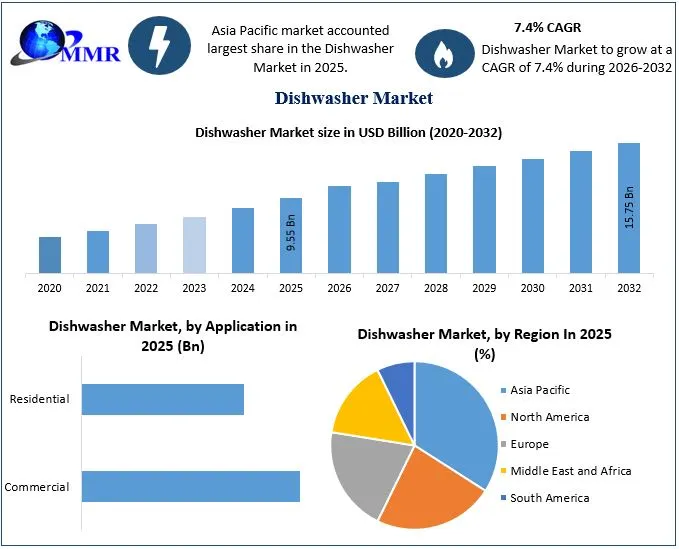
Market Capitalization: The global dishwasher market reached a valuation of USD 9.55 billion in 2025 and is on track to hit USD 15.75 billion by 2032.
Expansion Velocity: The overall sector is growing at a stable compound annual growth rate (CAGR) of 7.4% across the 2026 to 2032 industry projection window.
Product Capitalization: Freestanding units held the largest baseline share of the market in 2025, commanding 58.83% of global revenue.
Geographic Anchor: The Asia Pacific region acts as the primary global volume driver, capturing a dominant 34.7% of total market revenue in 2025.
Channel Migration: Traditional brick-and-mortar retail stores managed 71.4% of product transactions in 2025, while digital online procurement lines are accelerating at a 9.2% CAGR.
Why This Matters Now
Commercial restaurant groups and residential kitchen appliance manufacturers face an immediate labor and operational crisis as rising utility costs and staff shortages squeeze hospitality margins worldwide. Companies that view dishwashing as a low-priority household chore or a minor kitchen expense are missing a critical shift toward full mechanical automation and sanitization infrastructure.
The traditional kitchen workflow has transformed from manual labor into a highly structured, machine-driven process focused on water conservation and strict health compliance. Rapid urbanization and fast-paced modern lifestyles have dramatically reduced the time available for basic household maintenance, turning automated cleaning systems into an essential appliance. Original equipment manufacturers (OEMs), commercial foodservice groups, and global appliance distributors that secure exclusive manufacturing agreements for high-efficiency, smart-connected hardware will protect their operational margins and capture premium market share from changing modern consumer habits.
Major appliance networks are rapidly updating their factory production lines to manufacture advanced built-in and smart-enabled machines. This engineering change allows brand managers to shield their product catalogs from changing building designs while winning high-ticket commercial supply deals across the booming global hospitality sector.
Market Overview
The global Dishwasher market Size stands as a highly resilient, high-value asset class within the broader commercial food equipment, premium home appliance, and retail consumer goods industries. Valued at USD 9.55 billion in 2025, the market is positioned to expand to USD 15.75 billion by 2032, advancing at a steady 7.4% CAGR. This market expansion is supported by growing construction volumes in multi-family apartments, a major post-pandemic focus on high-temperature sanitization, and the rapid expansion of digital direct-to-consumer lifestyle channels.
This business path is highly insulated against temporary economic shifts. Automated dishwashers clean cookware by spraying high-pressure jets of heated water, typically between 45°C and 75°C, ensuring complete sterilization that manual washing cannot achieve. Because these advanced machines use significantly less water and electricity than hand washing, they directly support global green building initiatives and corporate carbon reductions. This structural efficiency keeps global replacement demand strong across both premium domestic kitchens and high-volume commercial food establishments.
Key Trends Driving Growth
The most critical driver shifting the kitchen appliance sector is the rapid consumer adoption of fully connected smart home ecosystems. Modern property buyers are systematically choosing high-end residential spaces equipped with smart, Wi-Fi-enabled hardware that supports remote application monitoring, custom cleaning cycles, and automated diagnostic reports. This technology focus allows tier-one manufacturers to achieve premium pricing, boosting corporate profits while introducing advanced features like load-sensing water optimization and automatic detergent dispensers.
Simultaneously, the global food service and hospitality industries are turning dishwashing into an infrastructure-level productivity decision. Restaurants, hotels, corporate catering hubs, bars, and pubs require repeatable sanitation cycles and fast plate turnover to maintain fast kitchen workflows. Commercial operators are installing heavy-duty, high-capacity dishwashing systems to lower their reliance on local kitchen staff, reduce glassware breakage rates, and comply with strict national health inspections.
Furthermore, changing architectural preferences are altering the setup of modern urban living spaces. The global move toward modular kitchen layouts requires built-in appliances that fit smoothly into custom cabinets without wasting valuable kitchen space. Real estate developers are adding factory-installed dishwashers directly to their standard apartment plans, providing appliance brands with high-volume wholesale supply agreements across major metropolitan markets.
Segment Insights
Product Categories: Divided into flexible freestanding units and integrated built-in appliances designed for custom cabinetry.
Application Sectors: Comprises heavy-duty commercial establishments, including restaurants and corporate offices, alongside private residential households.
Distribution Channels: Separated between traditional offline retail showrooms, hypermarkets, and automated online e-commerce platforms.
Dominant Segment: Freestanding appliances represent the Dominant Product Segment, capturing 58.83% of market revenue in 2025 due to low setup costs, easy physical relocation, and flexible placement benefits for renters. Commercial applications represent the Dominant Application Segment with a 60% market share, driven by rapid hospitality expansion.
Fastest-Growing Segment: Online distribution represents the Fastest-Growing Channel Segment, expanding at a 9.2% CAGR as major digital players like Amazon, Alibaba, and Flipkart speed up appliance shipping pipelines. Built-in dishwashers are the fastest-growing product type, expanding at a 7.6% CAGR.
Regional Growth Story
The global division of dishwasher market revenue highlights a major concentration of consumer demand and smart technology adoption in the Asia Pacific region. This geographic territory holds a dominant 34.7% of the total market share as of 2025, driven by rapid urbanization and rising middle-class disposable incomes across India and China. Leading manufacturers are localizing their product lines to match regional cooking habits, creating specialized cycles designed to clean heavy residues from traditional cookware. This targeted engineering approach has driven massive sales volumes, with major electronic brands reporting tens of thousands of units sold annually across major Asian metro areas.
At the same time, Europe is emerging as the fastest-growing region, holding an approximate 28% market share. European growth is backed by major investments from top industry players like Robert Bosch GmbH and Fagor Electrodomesticos, who are focusing on high-efficiency, water-saving appliance platforms. Meanwhile, North America maintains strong market volumes, supported by busy consumer lifestyles, high consumer technology adoption, and strict government water-use mandates that force rapid building upgrades.
Competitive Landscape
The global dishwasher market features intense competition between multi-national engineering groups and regional appliance specialists. Prominent industry leaders include Robert Bosch GmbH, Whirlpool Corporation, Beko, Blomberg, Dacor, Fisher and Paykel, GE Profile, IKEA, Bertazzoni, Kucht, Jenn-Air, Kenmore Elite, KitchenAid, and LG Electronics. Competition among these international brands focuses heavily on software innovation, energy efficiency ratings, and noise reduction capabilities rather than basic wholesale price cuts.
To protect their long-term market share, elite manufacturers are moving away from basic mechanical machines toward AI-enabled appliances. Brands like Bosch and Whirlpool are spending heavily on smart sensors that check water clarity during the wash cycle, automatically adjusting energy and water use based on soil levels. This focus on premium technology allows major brands to win high-value corporate deals with master developers and international hotel chains, blocking entry-level suppliers from lucrative commercial projects.
Recent Developments
AI Smart Diagnostics: Major appliance brands updated their product lines with AI systems that monitor part wear and schedule preventative maintenance through consumer smartphone apps.
Tall-Tub Engineering: Manufacturing lines expanded the assembly of premium tall-tub models, giving residential buyers more interior loading space without changing standard exterior appliance dimensions.
Water Filtration Innovations: R&D groups introduced multi-stage water filtration systems that lower total water use per wash cycle, meeting strict European ecological standards.
Ultra-Quiet Core Systems: Brands launched advanced brushless motors and sound-absorbing insulation packages, reducing operating noise levels for open-concept home designs.
Strategic Implications
For retail appliance executives, inventory managers, and commercial procurement directors, the steady growth of the global dishwasher market requires a fast upgrade of existing sales and distribution networks. Relying entirely on traditional brick-and-mortar showrooms exposes brands to sudden sales drops as online appliance sales accelerate at a 9.2% CAGR. Marketing teams must build interactive digital storefronts that feature accurate dimension guides, live installation support videos, and transparent customer reviews to win tech-savvy online buyers.
Furthermore, product development teams must focus on localized engineering to successfully capture emerging market segments. Appliance configurations must be customized to handle regional water hardness variations and specific food residues without requiring excessive pre-rinsing by the end user. Manufacturers that combine efficient, smart-connected hardware with reliable, widespread after-sales service networks will protect their wholesale margins, while slower brands face heavy price competition from entry-level consumer lines.
Future Outlook
The global dishwasher market will maintain its strong growth path as expanding global hospitality networks, smart home developments, and strict water conservation rules drive baseline demand. As automated water optimization, integrated modular styling, and high-temperature sanitization move from premium upgrades to standard consumer requirements, the market’s high-tech segments will continue to scale up. Appliance groups that secure strong components supply chains and invest heavily in eco-certified digital platforms will win dominant retail space and long-term customer loyalty, whereas legacy manufacturers tied to loud, high-consumption hardware will face falling profit margins, canceled commercial vendor contracts, and rapid brand obsolescence.
Analyst Perspective
“The global dishwasher market is undergoing a major technological shift, moving from a luxury household convenience to a critical infrastructure asset for modern, high-efficiency kitchens,” states Siddhi Dole, Lead Analyst at Maximize Market Research.
About Maximize Market Research
Maximize Market Research Pvt. Ltd. (MMR) is a global market research and consulting firm known for delivering accurate, actionable, and data-driven insights. Our expertise spans diverse industries — including medical devices, pharmaceuticals, technology, automotive, electronics, chemicals, personal care, and consumer goods. We provide services such as market-validated forecasts, competitive intelligence, strategic consulting, and industry impact analysis, helping businesses navigate market complexities and achieve sustainable growth.
2nd Floor, Navale IT Park Phase 3
Pune Banglore Highway, Narhe
Pune, Maharashtra 411041, India
+91 9607365656
sales@maximizemarketresearch.com
