Key Highlights
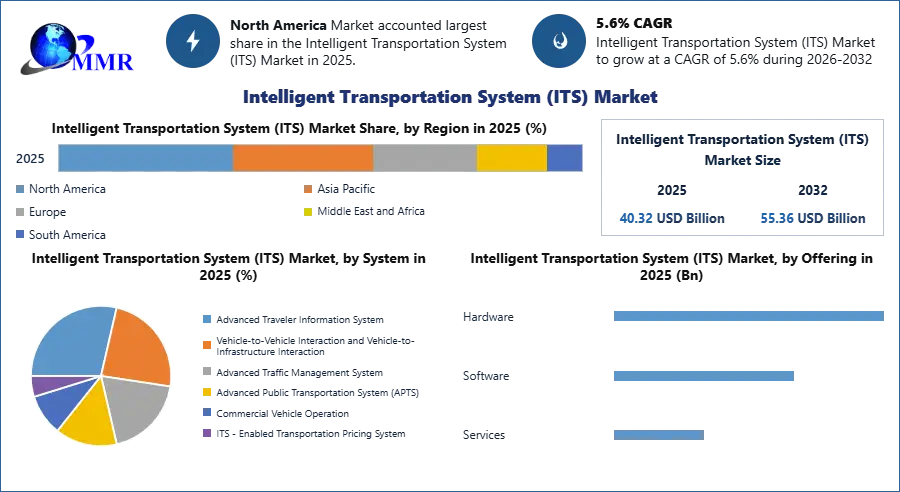
Intelligent Transportation System Market size is expected to reach USD 55.36 Billion by 2032, growing at a 5.6% CAGR from 2026 to 2032, signalling sustained infrastructure and software investment rather than a short-term project cycle.
Advanced Traffic Management, traveller information, public transit and freight logistics systems form the backbone of ITS deployments, anchored in AI, sensors, connectivity and analytics.
The market sits directly on top of telecom and cloud infrastructure, driving demand for 5G, edge computing, secure data centres and API-driven integration.
Governments and operators in the US, Europe, China, Japan, India and South Korea treat ITS as a strategic lever for congestion reduction, emissions control, safety and productivity.
System integrators, network vendors and software platforms compete to offer end-to-end solutions that combine hardware, connectivity, analytics and applications.
Why This Matters Now
Executives responsible for networks, clouds and urban infrastructure are facing a convergence of pressure: congestion, emissions targets, road safety and citizen expectations. Intelligent transportation systems convert road networks into continuous data streams, turning traffic lights, vehicles and sensors into endpoints on a digital platform.
A market growing to USD 55.36 Billion by 2032 at 5.6% CAGR means ITS is no longer a pilot topic for smart city conferences; it has become a discrete capital program line tied to AI, edge, telecom modernization and cloud migration. For CIOs, CTOs, telcos and cloud providers, ignoring ITS now means missing a long-cycle, infrastructure-led revenue opportunity.
Market Overview
Intelligent transportation systems size combine communication technologies, sensors, controllers, software and analytics to manage traffic, inform travellers, coordinate public transit and optimize freight flows. They ingest data from cameras, loop detectors, GPS probes, connected vehicles and mobile devices, then feed decisions back into signals, signs and digital services.
The expected size of USD 55.36 Billion by 2032 at a 5.6% CAGR frames ITS as a steady, infrastructure-heavy market rather than a speculative tech sector. Deployment cycles are long; contracts span years; and systems must integrate with legacy roads, vehicles and control rooms. This creates recurring demand for network maintenance, software upgrades and cloud services once ITS platforms are in place.
Key Trends Driving Growth
What changed is the shift from standalone traffic controllers to AI-driven, cloud-connected platforms. Cities and highway agencies are moving from siloed intersections to network-wide optimisation using machine learning, real-time data and centralized control dashboards.
Why now? Urbanization, rising vehicle ownership and political pressure on emissions and safety are forcing governments to invest in smarter systems instead of simply building more roads. ITS promises better throughput and safer journeys without proportionate new concrete.
Telecom and IT trends are equally important. 5G and advanced LTE networks support low-latency V2X communication, while edge computing allows local processing of video and sensor data near the roadway. Cloud platforms provide scalable analytics and storage, opening opportunities for subscription-based software and data services layered on top of public infrastructure.
Request a Free Sample Copy or View Report Summary: https://www.maximizemarketresearch.com/request-sample/31299/
Segment Insights
Dominant Segment – Advanced Traffic Management Systems (ATMS)
ATMS typically emerges as the dominant system segment, covering centralized signal control, incident detection, ramp metering and network-wide optimisation. This segment benefits operators directly by improving travel times, reducing congestion and supporting safety interventions driven by real-time data.Fastest-Growing Segment – Connected and Integrated Traveller Information & V2X Platforms
Traveller information systems, in-vehicle services and V2X communication platforms are among the fastest-growing areas, as drivers and fleets demand real-time route, hazard and parking information via apps and dashboards. These systems depend heavily on telecom networks, APIs and mobile front-ends.Cloud and Edge Infrastructure
Cloud-hosted ITS software and edge nodes positioned at intersections or roadside cabinets are increasingly standard. This architecture gives cities flexibility to roll out analytics upgrades, security patches and new apps without replacing hardware wholesale, and creates long-term demand for data centre capacity and managed services.Enterprise Software and Integration Demand
Transport agencies and operators require integration with ERP, asset management, ticketing, freight platforms and public safety systems. This drives enterprise software demand for middleware, APIs and microservice-based ITS applications that can evolve with broader digital transformation programs.
Regional Growth Story
The United States invests heavily in ITS as part of federal and state highway modernization and Vision Zero safety initiatives. ITS deployments connect freeways, arterials and public transit networks, often using regional data centers and public–private partnerships with telcos and integrators.
China and India face high urbanization and congestion pressure. Both markets are scaling ITS to manage megacity traffic, bus rapid transit, tolling and freight corridors. China leverages strong domestic telecom and equipment manufacturers, while India blends imported technology with local implementation and policy-led smart city programs.
Japan and South Korea focus on precision mobility and vehicle technology integration. Their ITS initiatives tie into advanced driver assistance, autonomous vehicle pilots and telematics-rich public transit, leveraging high-density 5G networks and robust sensor ecosystems.
Germany, the UK and broader Europe anchor their ITS strategies in emissions reduction, multimodal transport and EU regulatory frameworks for interoperability and safety. Pan-European standards and funding mechanisms favour vendors and operators who can deliver compliant, cross-border solutions.
Competitive Landscape
The competitive arena includes global system integrators, telecom operators, network and sensor vendors, and software providers. Some players focus on hardware and field deployments; others build software-only control platforms; many pursue integrated offerings that blend both.
Each major contract for ATMS, tolling, transit ITS or freight corridor management signals not just revenue, but influence over future data flows and platform standards. Vendors that secure multi-city or multi-country deployments gain leverage to define APIs, security protocols and data formats, reinforcing their position in subsequent projects.
AI and analytics capabilities are emerging as key differentiators. Providers able to show measurable gains in travel time reliability, incident response, emissions and safety from their algorithms will secure premium positioning, while commodity hardware providers will face pricing pressure.
Recent Developments
Expansion of AI-powered traffic signal optimisation projects, using real-time data to adjust cycles dynamically rather than fixed-time plans.
Increasing integration of ITS control centres with public safety, emergency services and environmental monitoring, driven by unified data and dashboards.
Telecom-led initiatives to deploy 5G and edge infrastructure along highways and in cities, explicitly marketed as enablers of connected mobility and ITS.
Growth of SaaS-based ITS management platforms, where agencies subscribe to software and analytics rather than owning monolithic on-premises systems.
Strategic Implications
For CIOs and CTOs in public agencies, ITS is a flagship digital transformation program that forces decisions on cloud strategy, cybersecurity, data governance and vendor ecosystems. Choosing modular, standards-based platforms now will determine how easily future innovations—such as autonomous shuttles or dynamic congestion pricing—can be layered in.
Telecom operators can treat ITS as an anchor tenant for 5G and edge networks, justifying investments with long-term, public-sector contracts and spillover benefits to consumer and enterprise applications. Network modernization aligned with ITS projects strengthens competitiveness in broader connectivity markets.
Cloud providers and software vendors see ITS as a testbed for high-throughput, low-latency analytics and API ecosystems. Success here can demonstrate capability in other real-time verticals, from manufacturing to energy, reinforcing platform economics across industries.
Future Outlook
With the Intelligent Transportation System Market expected to reach USD 55.36 Billion by 2032 at 5.6% CAGR, the next decade will be defined less by pilot deployments and more by full-scale integration of AI, 5G, edge and cloud into road and transit networks. Once ITS platforms become standard critical infrastructure, they will shape data flows for autonomous vehicles, urban logistics, and citizen mobility apps.
The decisive divide will be between digital leaders that treat ITS as a strategic network and AI platform—investing in interoperable, secure, cloud-native systems—and laggards that stick to fragmented, hardware-only projects and lose control of data, innovation speed and mobility outcomes to more ambitious peers.
Related Reports
Smart Agriculture Market https://www.maximizemarketresearch.com/market-report/smart-agriculture-market/1871/
Global Cloud GIS Market https://www.maximizemarketresearch.com/market-report/global-cloud-gis-market/25382/
Global Rapid Application Development Market https://www.maximizemarketresearch.com/market-report/global-rapid-application-development-market/28403/
Analyst Perspective
“As AI, 5G and cloud move from buzzwords to deployed assets on our roads, agencies, telcos and platform providers that build intelligent transportation as a full-stack digital system will own the future of mobility economics and service quality.” Yash Ghosalkar
About Maximize Market Research
Maximize Market Research Pvt. Ltd. (MMR) is a global market research and consulting company that provides reliable, data-focused, and practical business insights. The firm serves a wide range of industries, including healthcare, pharmaceuticals, technology, automotive, electronics, chemicals, personal care, and consumer goods. Through market forecasts, competitive analysis, strategic consulting, and industry impact assessments, MMR helps organizations understand changing market conditions, identify growth opportunities, and make informed business decisions for long-term success.
2nd Floor, Navale IT Park Phase 3
Pune Banglore Highway, Narhe
Pune, Maharashtra 411041, India
+91 9607365656
sales@maximizemarketresearch.com
