Key Highlights
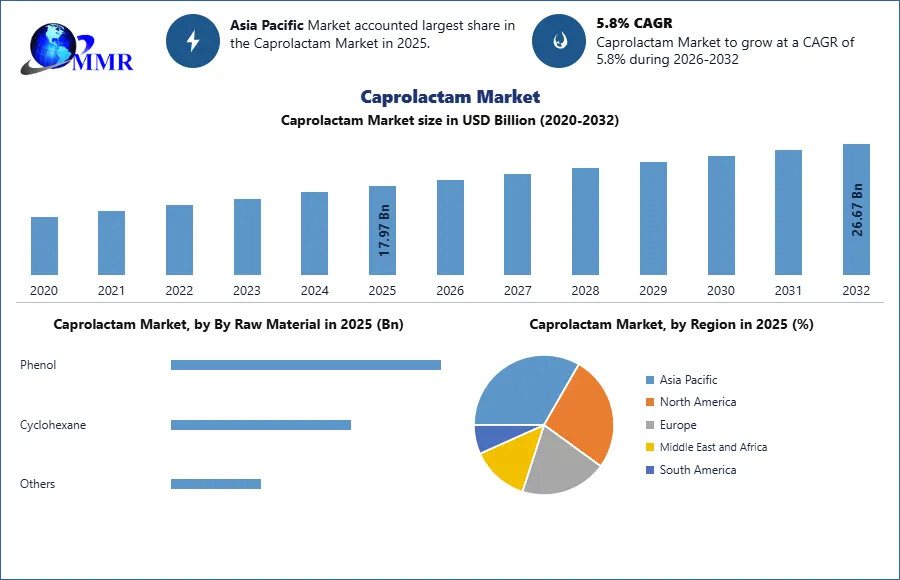
Caprolactam Market size was valued at USD 17.97 Billion in 2025 and is expected to reach nearly USD 26.67 Billion by 2032, growing at a CAGR of 5.8% from 2026 to 2032, signalling durable demand tied to nylon 6 value chains.
Nylon 6 fibers and resins remain the primary outlet for caprolactam, keeping the material central to textiles, automotive components, industrial yarns and engineered plastics.
Asia, particularly China and other regional hubs, dominates caprolactam production and consumption, shaping global trade flows and pricing benchmarks.
Energy, feedstock costs and environmental regulation increasingly influence capacity deployment, plant economics and investment decisions.
Producers are exploring efficiency upgrades, integration moves and sustainability initiatives to preserve competitiveness as demand grows under tighter regulatory scrutiny.
Why This Matters Now
Chemical manufacturers, nylon producers and procurement leaders face a structurally important decision: how to position themselves in a caprolactam market that is already large—USD 17.97 Billion in 2025—and on track to reach USD 26.67 Billion by 2032 at 5.8% CAGR. This growth is not speculative; it is anchored in nylon 6 demand for fibers and engineered plastics where substitution is neither easy nor cheap.
For boardrooms and investors, these numbers translate into multi‑year feedstock exposure. Any disruption in caprolactam supply or pricing directly hits margin structures in textiles, automotive components, industrial packaging and more. For procurement leaders, caprolactam becomes a strategic category requiring long‑term contracts, diversified sourcing and sustainability narratives.
Market Overview
Caprolactam size is the critical precursor to nylon 6, converted through polymerization into fibers and resins used in textiles, carpets, industrial yarns, engineering plastics and film. It sits upstream of a large, diversified downstream network, making its market size of USD 17.97 Billion in 2025 and forecast of USD 26.67 Billion by 2032 highly consequential across manufacturing sectors.
The 5.8% CAGR from 2026 to 2032 reflects steady expansion rather than a boom‑and‑bust cycle. Increased demand for durable, lightweight and chemically resistant materials in automotive, electronics and industrial applications keeps nylon 6 relevant, and by extension, supports caprolactam consumption.
What has changed is the backdrop: energy markets are more volatile, environmental regulation is more stringent, and buyers are more sensitive to carbon footprints and recycling options. Caprolactam strategies now must address these factors alongside pure volume growth.
Key Trends Driving Growth
Downstream nylon 6 demand in textiles and engineering plastics remains the primary growth engine. As global populations urbanize and middle‑class consumption of apparel, carpets and durable goods increases, nylon 6 retains a strong position in mixed-material products where performance and cost balance matter.
Industrial uses—such as automotive parts, electrical housings and industrial films—reinforce caprolactam’s role. Lightweight, strong and heat‑resistant components support vehicle efficiency and equipment durability, making nylon 6 difficult to fully replace in many designs.
On the supply side, large‑scale plants in Asia, and particularly China, sharpen competition through scale and integration. These facilities often tie caprolactam directly to downstream nylon 6 capacity, enhancing feedstock security and allowing producers to manage margins across the chain.
Sustainability and regulation add pressure. Producers face tighter emissions rules, stricter effluent and waste standards, and rising expectations for energy efficiency, pushing more emphasis on process optimization, cleaner feedstocks and potential circular models tied to nylon recycling.
Request a Free Sample Copy or View Report Summary: https://www.maximizemarketresearch.com/request-sample/24437/
Segment Insights
Dominant Segment – Nylon 6 Fibers and Resins
The dominant segment for caprolactam is nylon 6 fibers and resins, used in textiles, carpets, industrial yarns and engineering plastics. This dominance means caprolactam demand tracks construction, automotive, consumer goods and infrastructure trends through nylon applications, rather than isolated chemical use.Fastest-Growing Segment – Engineering Plastics and Industrial Applications
The fastest‑growing demand comes from engineering plastics and industrial uses, where nylon 6 replaces metals and lower‑performance polymers in structural parts, housings and films. This shift supports higher value per ton of caprolactam and encourages investment in grades and quality suitable for demanding applications.Feedstock Trends
Caprolactam production relies on petrochemical feedstocks and energy‑intensive processes, making feedstock pricing and energy costs critical to margins. Integrated producers with upstream access and energy management capabilities are better positioned to absorb volatility and maintain reliable supply.Supply‑Demand Dynamics
Supply‑demand is driven by plant capacity, utilization rates and regional investment. Asia’s capacity expansions and debottlenecking projects influence global availability and pricing, while demand from textiles and plastics sectors keeps utilization high enough to discourage prolonged oversupply.
Regional Growth Story
Asia‑Pacific, led by China, dominates caprolactam production and consumption. Strong industrial bases, large textile sectors and growing plastics demand anchor the region’s influence, and integrated nylon chains give local players significant control over regional pricing and trade flows.
In Europe, Germany and other EU producers operate under strict regulatory regimes and high energy costs. This environment pushes European players toward efficiency, specialty grades and sustainability‑driven differentiation rather than pure volume competition.
The United States retains important capacity and downstream demand in automotive, industrial and consumer applications, but faces global price competition from Asian producers. Strategic focus for US players centers on reliability, quality, and integration with downstream manufacturing networks that value supply security.
Japan and South Korea, with tradition in advanced materials and precision manufacturing, support high‑spec nylon uses in automotive, electronics and industrial sectors. Here, caprolactam value arises from quality and consistency, not just scale, reinforcing the importance of process control and technology.
India’s appetite grows as its textiles and industrial sectors expand. Demand for nylon 6 yarns, fabrics and components offers long‑term potential, but local capacity, imports and regulatory frameworks will determine how caprolactam supply strategies evolve.
Competitive Landscape
The global Caprolactam Market features integrated chemical majors and regional producers with varying levels of upstream and downstream integration. Players with captive nylon 6 manufacturing enjoy more control over margins and utilization, turning caprolactam into part of a broader portfolio rather than a standalone commodity.
Capacity expansions and debottlenecking projects signal confidence in long‑term nylon demand and a desire to capture regional growth. When a producer boosts caprolactam capacity alongside nylon plant investments, it indicates a strategy to control feedstock, stabilize internal pricing and reduce reliance on external supply.
Acquisitions and partnerships in the chain—whether upstream feedstocks or downstream nylon converters—show moves to consolidate supply chains and strengthen pricing power. These actions reshape market structure, potentially concentrating capacity in fewer hands and raising the strategic importance of long‑term contracts for buyers.
Recent Developments
Capacity additions and process upgrades in key production regions, aimed at supporting forecast growth from USD 17.97 Billion in 2025 to USD 26.67 Billion by 2032 at 5.8% CAGR.
Portfolio adjustments as producers evaluate specialty caprolactam and nylon grades for higher‑margin engineering and industrial applications.
Increased focus on energy efficiency and emissions control in caprolactam plants to meet stricter regulatory and sustainability expectations.
Trade and logistics optimization in response to shifting regional demand and price patterns, especially between Asia, Europe and North America.
Strategic Implications
For chemical producers, caprolactam’s growth trajectory and link to nylon chains require clear choices on integration, geography and technology. Investing in upstream feedstocks, efficient processes and downstream nylon capacity can stabilize margins, while neglecting these levers may leave producers exposed to price swings and regulatory costs.
Procurement leaders in textiles and engineering plastics must treat caprolactam as a strategic category. Diversified sourcing, long‑term offtake agreements and close monitoring of regulatory developments can reduce supply risk and support more predictable pricing for nylon‑based products.
Investors should see caprolactam as an embedded part of broader value chains rather than a standalone commodity. Returns depend on how well companies link caprolactam to higher‑value nylon uses, manage sustainability pressures and navigate regional competition and trade flows.
Future Outlook
With the Caprolactam Market expected to grow from USD 17.97 Billion in 2025 to nearly USD 26.67 Billion by 2032 at 5.8% CAGR, strategic advantage will hinge on how players manage feedstocks, energy, regulation and downstream integration. Capacity without efficiency or sustainability will become a liability, not an asset.
The decisive edge will belong to producers and industrial buyers that treat caprolactam as a core lever in integrated, low‑risk nylon strategies—while those that rely on undifferentiated volume and short‑term buying will find themselves squeezed by tighter regulation, price volatility and competitors with stronger supply‑chain control.
Related Reports
Global EndofLine Packaging Market https://www.maximizemarketresearch.com/market-report/global-end-of-line-packaging-market/31622/
Metamaterials Market https://www.maximizemarketresearch.com/market-report/global-metamaterials-market/24404/
Global Powder Metallurgy Components Market https://www.maximizemarketresearch.com/market-report/global-powder-metallurgy-components-market/25524/
Analyst Perspective
“As nylon 6 demand grows across textiles and industrial applications, companies that align caprolactam capacity, energy efficiency and sustainability with downstream needs will control both pricing power and resilience in the next phase of the chemicals cycle,” Ankita Kagawade
About Maximize Market Research
Maximize Market Research Pvt. Ltd. (MMR) is a global market research and consulting company that provides reliable, data-focused, and practical business insights. The firm serves a wide range of industries, including healthcare, pharmaceuticals, technology, automotive, electronics, chemicals, personal care, and consumer goods. Through market forecasts, competitive analysis, strategic consulting, and industry impact assessments, MMR helps organizations understand changing market conditions, identify growth opportunities, and make informed business decisions for long-term success.
2nd Floor, Navale IT Park Phase 3
Pune Banglore Highway, Narhe
Pune, Maharashtra 411041, India
+91 9607365656
sales@maximizemarketresearch.com
