Feed Market Expands as Sustainable Nutrition and Precision Farming Transform Global Animal Production
The global agriculture industry is entering a new phase of transformation as livestock producers focus on improving productivity, animal health, sustainability, and food security. Driven by rising protein consumption, expanding commercial farming, and advancements in animal nutrition science, the Feed Market is becoming a critical component of the global food supply chain.
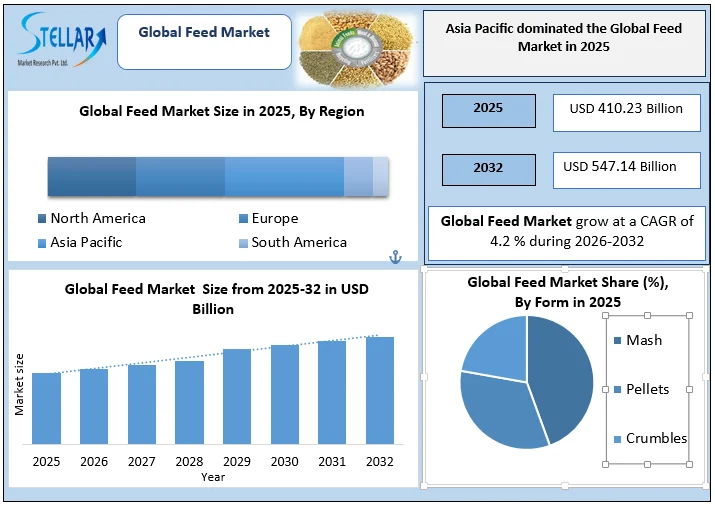
According to the latest Feed Market Report by Stellar Market Research, the global market is expected to reach USD 547.14 billion by 2032, growing at a CAGR of 4.2% during the forecast period 2026–2032. The market growth is supported by increasing livestock production, demand for high-quality animal nutrition, adoption of functional feed additives, and investments in sustainable feed solutions.
Animal Nutrition Becomes a Strategic Priority for Food Security
The feed industry plays a vital role in supporting global meat, dairy, egg, and aquaculture production. Modern animal feed formulations have evolved beyond traditional grain-based diets and now incorporate cereals, oilseeds, vitamins, minerals, amino acids, enzymes, probiotics, and other functional ingredients designed to improve animal growth, immunity, and productivity.
With the global population increasing and consumer demand for protein-rich diets rising, livestock producers are under pressure to achieve higher output while reducing resource consumption. This has accelerated the adoption of scientifically formulated feed products that improve feed conversion efficiency and optimize animal performance.
The shift toward precision nutrition is also reshaping the industry, allowing manufacturers to develop species-specific and life-stage-specific feed solutions that improve productivity while minimizing waste.
𝐃𝐨𝐰𝐧𝐥𝐨𝐚𝐝 𝐅𝐫𝐞𝐞 𝐏𝐃𝐅 𝐁𝐫𝐨𝐜𝐡𝐮𝐫𝐞: https://www.stellarmr.com/report/req_sample/feed-market/2896
Key Market Drivers Accelerating Growth
Rising Demand for Animal Protein
Increasing consumption of meat, dairy products, eggs, and seafood is one of the primary factors driving demand for commercial animal feed. Expanding middle-class populations in emerging economies are contributing to higher consumption of animal-based products, encouraging livestock producers to increase production capacity.
Growth of Commercial Livestock Farming
The expansion of large-scale poultry, cattle, swine, and aquaculture farms is creating consistent demand for high-quality feed products. Commercial producers increasingly rely on scientifically balanced diets to improve production efficiency and maintain animal health.
Increasing Adoption of Feed Additives
Functional additives such as amino acids, vitamins, enzymes, probiotics, and minerals are gaining importance as producers seek improved animal performance and disease prevention solutions.
Focus on Sustainable Feed Production
Environmental concerns are encouraging feed manufacturers to explore alternative ingredients, including insect protein, algae-based products, agricultural by-products, and other sustainable sources that reduce dependence on traditional raw materials.
Feed Market Segmentation Overview
The Feed Market covers multiple segments based on ingredients, additives, livestock categories, forms, and sources.
By Ingredients
Cereals
Cakes & Meals
By-products
Cereals remain a major ingredient category due to their availability, nutritional value, and widespread use in poultry, livestock, and aquaculture feed formulations.
By Additives
Amino Acids
Phosphates
Vitamins
Acidifiers
Carotenoids
Enzymes
Feed additives are gaining importance as producers focus on improving digestion, immunity, growth rates, and overall animal productivity.
By Livestock
Poultry
Ruminants
Swine
Aquaculture
Others
Poultry and ruminant feed segments represent significant market opportunities due to rising global demand for meat, milk, and egg production.
By Form
Pellets
Powder
Liquid
Crumbles
Pelleted feed continues gaining preference due to improved handling, reduced waste, and better nutrient utilization.
Regional Market Outlook
Asia-Pacific Leads Global Feed Demand
Asia-Pacific represents one of the most influential regions in the global Feed Market due to its large livestock population, expanding food processing sector, and rising demand for animal protein.
Countries including China and India are witnessing strong growth due to increasing poultry production, dairy expansion, aquaculture development, and government initiatives supporting agricultural modernization.
North America Focuses on Advanced Feed Technologies
North America remains a technologically advanced feed market, supported by established livestock industries, strong research capabilities, and increasing adoption of precision nutrition solutions.
The region is witnessing growing demand for sustainable ingredients, antibiotic-free feed solutions, and advanced feed additives designed to improve animal health.
Europe Advances Sustainable Feed Innovation
European countries are emphasizing environmentally responsible livestock production through stricter regulations, sustainable sourcing initiatives, and investments in alternative feed ingredients.
The region’s focus on reducing agricultural emissions and improving traceability is encouraging innovation across feed manufacturing processes.
Technology and Sustainability Trends Reshaping the Industry
Technology is becoming a major driver of transformation across the Feed Market.
Key developments include:
Artificial intelligence-based feed formulation
Precision nutrition platforms
Automated feed production systems
Digital livestock monitoring
Data-driven farm management
Alternative protein ingredients
Sustainable sourcing practices
Precision nutrition enables farmers to provide optimized diets based on animal genetics, age, health conditions, and production goals. This improves efficiency while reducing environmental impact.
Sustainability has also become a central focus, with manufacturers exploring circular economy approaches by converting agricultural waste and by-products into valuable feed ingredients.
Recent Industry Developments
Cargill (2025): Expanded focus on sustainable animal nutrition solutions through investments in alternative ingredients, digital farming tools, and feed innovation to improve livestock efficiency and reduce environmental impact.
ADM (2025): Continued strengthening of its animal nutrition portfolio through investments in specialty feed additives and nutrition technologies supporting livestock health and productivity.
DSM-Firmenich (2024): Advanced sustainable animal nutrition solutions by expanding research into feed additives, enzymes, and nutritional technologies designed to improve animal performance.
Bunge (2024): Increased focus on sustainable agricultural supply chains and ingredient solutions supporting efficient feed production.
Nutreco (2025): Accelerated innovation in aquaculture and livestock nutrition through advanced feed formulations and sustainability-focused product development.
Competitive Landscape
The Feed Market includes global and regional players competing through product innovation, strategic partnerships, sustainability initiatives, and expansion of production capabilities.
Leading companies are focusing on:
Development of functional feed additives
Expansion into emerging markets
Sustainable ingredient sourcing
Digital nutrition platforms
Advanced feed manufacturing technologies
Major industry participants include Cargill, ADM, Nutreco, Alltech, Charoen Pokphand Foods, ForFarmers, and Land O’Lakes Purina.
Companies are increasingly investing in research and development to create specialized feed solutions that improve productivity, animal welfare, and environmental performance.
Market Challenges and Restraints
Despite strong growth prospects, the Feed Market faces several challenges.
Fluctuations in raw material prices, particularly grains and oilseeds, can affect production costs and profit margins. Climate change also creates uncertainty in agricultural supply chains by impacting crop availability and ingredient sourcing.
Additionally, increasing regulatory scrutiny regarding antibiotic usage, animal welfare, and environmental impact is forcing manufacturers to adapt formulations and production practices.
𝐃𝐨𝐰𝐧𝐥𝐨𝐚𝐝 𝐅𝐫𝐞𝐞 𝐏𝐃𝐅 𝐁𝐫𝐨𝐜𝐡𝐮𝐫𝐞: https://www.stellarmr.com/report/req_sample/feed-market/2896
Future Outlook
The future of the Feed Market will be shaped by sustainable production, technological innovation, and rising global demand for animal protein. As livestock producers prioritize efficiency and environmental responsibility, advanced feed formulations will become increasingly important.
Investments in precision nutrition, alternative ingredients, digital farming technologies, and sustainable manufacturing will create new opportunities for feed producers and agricultural stakeholders.
Through 2032, the industry is expected to evolve from traditional feed manufacturing toward intelligent nutrition systems designed to improve productivity, reduce environmental impact, and strengthen global food security.
For businesses, investors, and agriculture stakeholders seeking detailed market insights, competitive analysis, regional trends, and growth opportunities, the Feed Market Report from Stellar Market Research provides comprehensive intelligence to support strategic decision-making.
