Key Highlights
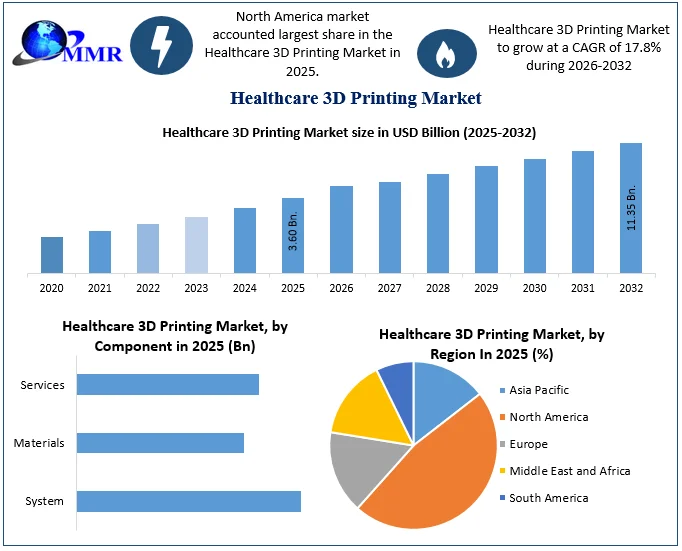
Healthcare 3D Printing Market size was valued at USD 3.60 Billion in 2025 and is expected to reach nearly USD 11.35 Billion by 2032, growing at a CAGR of 17.8% from 2026 to 2032; this signals a shift from prototyping to routine clinical and commercial use.
Growth is driven by patient-specific implants, anatomical models, surgical guides and custom tools derived from CT, MRI and other imaging datasets.
Hospital-based 3D printing labs and centralized service providers are emerging as new infrastructure layers in surgical care and device design.
Regulatory approvals and standards for 3D printed devices are expanding, enabling broader reimbursable use and formal adoption in care pathways.
Competitive activity focuses on materials, printers, software, workflows and integrated platforms that connect imaging, planning and manufacturing.
Why This Matters Now
Medical device manufacturers and hospital executives are facing a structural change: care teams no longer accept one‑size‑fits‑all implants and tools when imaging‑driven customization is feasible and scalable. A market moving from USD 3.60 Billion in 2025 to nearly USD 11.35 Billion by 2032 at 17.8% CAGR means 3D printing will become a core capability in surgical, orthopaedic, dental and oncology workflows rather than an isolated innovation project.
For investors and procurement leaders, this trajectory translates into new capital categories—printers, materials, software, staff—and new vendor types. Decisions taken now on platforms, partners and regulatory strategies will define who controls future economics of patient‑specific devices and procedural efficiency.
Market Overview
Healthcare 3D printing size uses additive manufacturing technologies to convert digital models—often derived from CT, MRI and other imaging modalities—into physical objects. These objects include anatomical models for planning and training, bespoke implants and prosthetics, patient-specific surgical guides and custom tools and accessories.
The market’s rise to nearly USD 11.35 Billion by 2032 at 17.8% CAGR shows that healthcare has moved beyond early prototyping use cases. 3D printing is increasingly embedded in routine workflows where personalization improves fit, reduces operative time or enhances decision-making. As adoption spreads, hospital procurement and device design teams treat 3D printing as part of mainstream infrastructure and product strategy.
What changed is the alignment of imaging, software and manufacturing. Hospitals now routinely generate high-quality digital anatomy from scanners; 3D design tools translate that data into printable geometries; and printers and materials can deliver clinical-grade output under controlled processes.
Key Trends Driving Growth
The first major trend is the integration of 3D printing with diagnostic imaging. Radiology and surgical teams collaborate to transform CT and MRI datasets into 3D models that surgeons use for planning, simulation and patient communication. This improves understanding of complex anatomies—such as congenital heart disease, craniofacial deformities and tumour locations—and informs more precise, minimally invasive strategies.
Second, patient-specific implants and guides are gaining traction across orthopaedics, cranio-maxillofacial procedures, dental implants and oncology. Custom devices can match patient anatomy more closely than standard sizes, supporting better fit, load distribution and alignment, which can translate into fewer revisions and better functional outcomes.
Third, hospital-based 3D printing labs and centralized manufacturing hubs are forming connected ecosystems. Some health systems invest in in-house capabilities tied to imaging suites and surgical theatres, while others partner with specialized providers that deliver design and printing services at scale. This hybrid model reshapes vendor relationships and procurement structures.
Request a Free Sample Copy or View Report Summary: https://www.maximizemarketresearch.com/request-sample/213654/
Segment Insights
Dominant Segment – Patient-Specific Anatomical Models and Surgical Guides
The dominant segment today comprises anatomical models and surgical guides for planning and intraoperative use. These deliver clear clinical value—better visualization, improved orientation and more accurate cuts or placements—while avoiding the highest regulatory hurdles of implantable devices.Fastest-Growing Segment – Custom Implants and Prosthetics
The fastest-growing segment is custom implants and prosthetics, including orthopaedic implants, cranial and facial plates, dental implants and personalized oncology accessories. This segment leverages the full promise of precision medicine by aligning device geometry with patient-specific morphology.Diagnostic Technology and Minimally Invasive Care
Advances in imaging and minimally invasive procedures drive demand for intricate models and guides. As surgeons perform more complex interventions through small incisions or robotic platforms, the need for accurate preoperative planning and tailored guides intensifies.Software and Workflow Platforms
Software that converts medical images into printable models, manages approvals and documents processes becomes a critical layer. These platforms impact hospital efficiency and compliance, and they often anchor commercial offerings from device makers and service providers.
Regional Growth Story
In the United States, high healthcare spending, advanced imaging infrastructure and a favourable innovation environment make it a leading market for healthcare 3D printing. Large academic medical centres and integrated systems invest in in-house labs and partnered solutions, aligning 3D printing with surgical robotics, minimally invasive procedures and value-based care.
Europe, with strong regulatory frameworks and innovation clusters in Germany and the UK, shows growing adoption in orthopaedics, dental, cardiology and oncology. Hospitals in these markets emphasise evidence-based deployment and reimbursement pathways, which encourages rigorous data collection on outcomes and cost-effectiveness.
China and India represent rising markets where expanding imaging networks, surgical capabilities and medical device manufacturing bases create new demand. Local manufacturers and hospital networks explore 3D printing for affordable customization and for export-ready device portfolios, while regulators build frameworks for safety and performance.
Japan and South Korea, with advanced technology ecosystems and strong interest in minimally invasive and robotic surgery, leverage healthcare 3D printing to support complex surgical planning and high-end device design. Their focus on precision and efficiency creates strong niches for high-performance materials and integrated software.
Competitive Landscape
The competitive field includes global medical device OEMs, specialist 3D printing companies, materials manufacturers, software vendors and healthcare service providers. Large device firms integrate 3D printing into implant development and production, signalling a shift toward mass customization and patient-specific portfolios.
Regulatory approvals for 3D printed devices and accessories signal which players have mastered design controls, validation and documentation. Each clearance or CE marking not only opens a product’s commercial path, but also demonstrates process capability that can be reused for future devices, strengthening technology leadership.
Hospital purchasing behaviour is changing as well. Procurement teams now evaluate not just printers and materials, but full solutions: imaging integration, software, workflow support, training and compliance. Vendors that offer comprehensive ecosystems—hardware, software and services—gain influence in long-term contracts and standard-setting.
Recent Developments
Hospital systems establishing multidisciplinary 3D printing labs that link radiology, surgery and biomedical engineering.
Medical device companies expanding portfolios of 3D printed implants and surgical guides, often tied to specific anatomical indications.
Software vendors launching planning platforms tailored to medical imaging imports, segmentation, design approval and print management.
Regulatory bodies issuing guidance and approvals for 3D printed devices, clarifying expectations for quality, documentation and post-market surveillance.
Strategic Implications
For medical device manufacturers, a Healthcare 3D Printing Market heading to nearly USD 11.35 Billion by 2032 at 17.8% CAGR means customization and rapid iteration are becoming baseline capabilities, not premium add-ons. Portfolio strategies must account for patient-specific offerings, integrated planning tools and production models that support global scalability with local adaptation.
Hospital leaders and procurement teams must decide whether to build 3D printing capacity internally, rely on external partners or pursue hybrid models. These choices affect capital allocation, staffing, data flows and control over design IP—issues that matter in competitive regions and in value-based care contracts.
Investors and healthcare technology strategists should view healthcare 3D printing as a critical enabler for precision medicine and minimally invasive care. The most attractive opportunities lie where imaging, software and device manufacturing intersect to deliver measurable improvements in outcomes, throughput and cost.
Future Outlook
With the Healthcare 3D Printing Market expected to grow from USD 3.60 Billion in 2025 to nearly USD 11.35 Billion by 2032 at 17.8% CAGR, the next decade will be defined by how quickly hospitals and device makers embed 3D printing into standard care pathways instead of isolated pilot projects. Success will depend on robust software, validated materials, clear regulatory routes and proven reimbursement.
The divide will be sharp: future medical technology leaders will treat healthcare 3D printing as a strategic engine for personalized devices, surgical precision and workflow efficiency—while laggards that cling to generic hardware and slow design cycles will find their products sidelined in a healthcare system that expects tailored, data‑driven treatment for every patient.
Related Reports
Global Medical Device Cleaning Market https://www.maximizemarketresearch.com/market-report/global-medical-device-cleaning-market/116521/
Global Metastatic Bone Disease Market https://www.maximizemarketresearch.com/market-report/global-metastatic-bone-disease-market/22267/
Global Fragile X-Syndrome Market https://www.maximizemarketresearch.com/market-report/global-fragile-x-syndrome-market/102731/
Analyst Perspective
“As imaging, software and manufacturing converge, companies and hospitals that scale 3D printing from prototypes to everyday clinical tools will set the new standard for personalized care, outcomes and economic value in the medical devices sector.” Komal Patil
About Maximize Market Research
Maximize Market Research Pvt. Ltd. (MMR) is a global market research and consulting company that provides reliable, data-focused, and practical business insights. The firm serves a wide range of industries, including healthcare, pharmaceuticals, technology, automotive, electronics, chemicals, personal care, and consumer goods. Through market forecasts, competitive analysis, strategic consulting, and industry impact assessments, MMR helps organizations understand changing market conditions, identify growth opportunities, and make informed business decisions for long-term success.
2nd Floor, Navale IT Park Phase 3
Pune Banglore Highway, Narhe
Pune, Maharashtra 411041, India
+91 9607365656
sales@maximizemarketresearch.com
