Key Highlights:
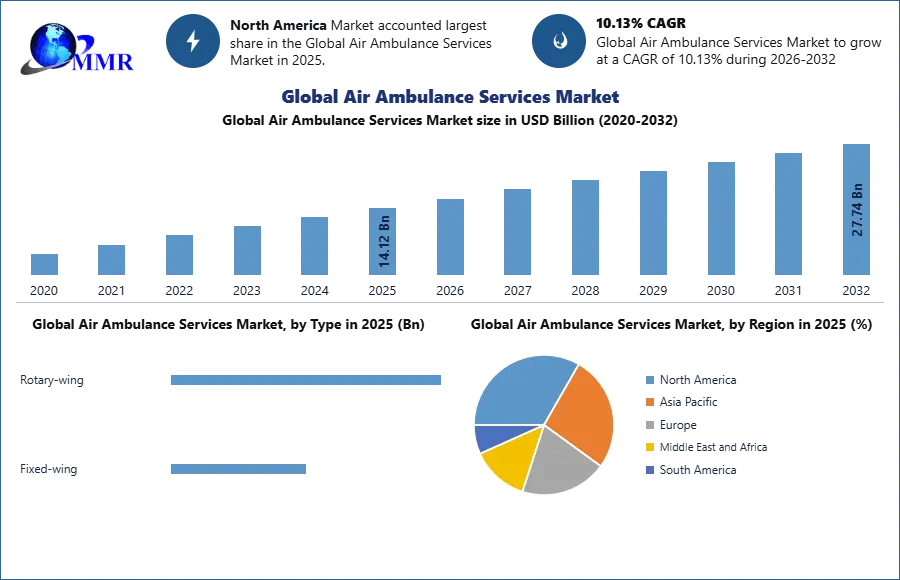
Global market valuation reached USD 14.12 billion in 2025 and is projected to reach USD 27.75 billion by 2032, sustaining a 10.13% CAGR.
Rotary-wing aircraft held a dominant 76% market share in 2025 due to localized landing flexibility in dense urban and remote areas.
Hospital-based service models led the industry with a 45% market share in 2025, optimizing regional clinical referral networks.
North America led the sector in 2025 and is projected to grow at a regional rate of 11.2%, backed by robust reimbursement pathways.
Chronic conditions account for 60% of deaths globally, increasing demand for time-sensitive specialized air transport.
Inadequate regional aircraft availability and clinical infrastructure shortages remain primary growth constraints in developing economies.
Why This Matters Now Hospitals and healthcare payers face severe clinical access problems as chronic diseases, aging demographics, and specialist capabilities concentrate high-acuity treatments into fewer centralized facilities. Air ambulance operators are no longer merely episodic rescue assets; they are essential structural links connecting regional emergency departments to specialized trauma, burn, and cardiac care networks. Healthcare networks that fail to implement rapid, medically equipped transport systems risk poor patient outcomes and escalating downstream clinical costs.
The business imperative is clear for hospital systems, procurement teams, and device developers: care delivery must extend beyond physical walls. As health systems centralize specialized interventions, patient transport becomes a major clinical variable that dictates survival rates and hospital efficiency metrics. Medical equipment manufacturers must modify product designs to create lighter, ruggedized, and wirelessly connected life-support systems optimized for the tight physical spaces and severe vibration profiles of aircraft.
Market Overview The global Air Ambulance Services Market use medically equipped aircraft staffed by trained personnel to move patients from accident scenes to hospitals or from one hospital to another. The market serves emergency response, interfacility transfer, rescue helicopter services, and organ transplant logistics. MMR forecasts the global air ambulance services market to expand from USD 14.12 billion in 2025 to nearly USD 27.75 billion by 2032 at a 10.13% CAGR. This rapid scaling transitions the market from a fragmented emergency option into a structured, planned component of national healthcare capacity.
The underlying driver of this clinical shift is the rising global burden of non-communicable illnesses. World Health Organization (WHO) data indicates that chronic diseases account for 60% of deaths worldwide, rising to nearly 80% in medium- and low-income countries. Specific conditions including diabetes, cancer, and acute cardiovascular failures often require immediate, specialized surgical or intensive care interventions. When geographic distance prevents ground ambulances from meeting critical care windows, specialized medical aviation becomes the only viable clinical pathway to preserve life.
Key Trends Driving Growth Patient acuity is the first driver accelerating market utilization. The market is experiencing an influx of complex transport requests driven by an aging population suffering from concurrent conditions such as heart disease, stroke, osteoporosis, and severe arthritis. These geriatric demographics frequently require intensive monitoring during transit, which shifts the market toward advanced mobile intensive care setups.
Clinical centralization forms the second driver. To maximize efficiency and outcomes, healthcare networks are centralizing complex surgical specialties into regional centers of excellence. While this centralization improves surgical outcomes, it creates regional gaps in emergency care. Air ambulance providers directly bridge these geographic divides, allowing remote facilities to safely route unstable patients into high-capacity trauma centers.
Reimbursement and public funding represent the third driver. In North America, structural growth is sustained by favorable payer policies and established air-medical transport associations that standardize billing pathways. In Europe, public capital injections are actively modernizing emergency fleets; for instance, England provided dedicated funding to nine air ambulance charities to purchase clinical equipment and upgrade base facilities.
Digital care integration is the newest paradigm shift. International SOS and SAF Aerogroup moved to integrate tele-ICU capabilities into long-range air ambulance operations. This technological convergence allows ground-based specialists to monitor real-time physiological telemetry, adjust mechanical ventilation settings remotely, and guide flight nurses through complex clinical procedures during transport.
Segment Insights
Rotary-wing (Dominant Segment): Rotary-wing aircraft held a 76% market share in 2025. Helicopters can land on highways, parks, farms, and congested urban pads, making them highly practical when ground traffic is blocked or traditional runway access is unavailable.
Hospital-based (Dominant Service Model): Hospital-based services accounted for a 45% market share in 2025. Under this model, hospital systems provide medical staff while licensed aviation partners manage aircraft operations, allowing hospitals to expand referral footprints without owning fleets.
Fastest-Growing Segment: The supplied MMR report does not specify a fastest-growing segment by type, service model, service type, or application. No segment growth rate is stated, so this data is omitted.
Application Scope: Interfacility transfer, rescue helicopter services, and organ transplant logistics represent the primary commercial applications, with each tied directly to time-sensitive clinical outcomes.
Regional Growth Story North America dominates the global air ambulance services market, backed by a large provider base and widespread transport facilities. The region is projected to expand at an 11.2% growth rate, driven by a reliable commercial insurance landscape and mature government reimbursement pathways that offset high operational flight costs. This reliable capital flow enables local flight operators to continuously reinvest in newer aircraft and advanced clinical equipment.
The United States is covered within North America. The report does not disclose US-specific spending, reimbursement mechanics, or regulatory shifts.
Europe is covered through the UK, Germany, France, Italy, Spain, Sweden, CIS countries, and the rest of Europe. For the UK, England charity funding points to equipment and facility investment. Germany is included in scope, but no Germany-specific figures or policy detail are provided.
The Asia-Pacific region represents a high-potential opportunity area for market expansion. This momentum is driven by advanced healthcare technology adoption, the establishment of large multispecialty hospital chains, and expanding medical tourism networks. China, India, and Japan are acting as primary regional demand drivers, while South Korea is included in the APAC forecast.
Developing economies face the main constraint. MMR identifies healthcare infrastructure shortages and inadequate aircraft availability as restraints. Operators that pair fleet investment with hospital partnerships can benefit, but execution risk rises where regulations and facilities remain strained.
Competitive Landscape The market includes global and regional operators across emergency medical aviation, hospital-linked transport, and specialized evacuation. MMR lists Envision Healthcare, Falck A/S, Air Methods Corporation, AirMed International, PHI Air Medical, Metro Aviation, Rega, DRF Luftrettung, ADAC Luftrettung, Royal Flying Doctor Service, REVA, AMR, FAI Aviation Group, Japan Air Medical Service, and Deer Jet Medical as key participants. These entities are moving away from basic flight operations toward building integrated mobile intensive care units.
This competitive environment signals a shift in hospital purchasing and partnership behavior. Leading flight operators are securing exclusive long-term integration agreements with major health systems, embedding their dispatch software directly into hospital electronic health record platforms. This digital alignment speeds up deployment times, improves clinical coordination, and establishes clear, predictable reimbursement documentation. This operational integration makes it difficult for standalone aviation providers without medical software integrations to compete.
Recent Developments
In September 2025, International SOS and SAF Aerogroup expanded their long-range clinical evacuation capabilities by integrating advanced tele-ICU telemetry suites across their active transport fleets. This deployment allows real-time data transmission between transport aircraft and tertiary medical centers.
In 2025, England allocated direct public funding to nine regional air ambulance charities. This financial intervention focused on replacing legacy transport ventilators, upgrading patient monitoring hardware, and improving base maintenance facilities.
Strategic Implications The development of the air ambulance services market is forcing a redistribution of medical device procurement priorities. Manufacturers of defibrillators, infusion pumps, and point-of-care diagnostic devices must meet strict aviation safety certifications, including electromagnetic compatibility standards that ensure medical signals do not interfere with aircraft navigation instruments. Devices must feature extended battery lives and universal mounting systems that transition seamlessly from a ground ambulance to an aircraft interior.
From an operational standpoint, hospital systems must treat air medical transport as a direct extension of their intensive care units rather than a simple transit option. This approach requires implementing continuous training programs for flight nurses and paramedics, focusing on advanced procedures like extracorporeal membrane oxygenation (ECMO) management during flight. Establishing these specialized clinical capabilities allows healthcare systems to safely manage highly unstable patients over long distances, optimizing overall regional bed utilization.
Future Outlook The global air ambulance services market will see deeper integration between aviation platforms and smart hospital ecosystems. As regional medical centers of excellence continue to concentrate clinical capabilities, the demand for secure interfacility transfers will grow. Flight operators will increasingly deploy artificial intelligence tools to optimize flight path routing, predict maintenance needs, and manage clinical staffing based on patient acuity scores.
The market will separate into two clear tiers based on technological adoption. Future medical technology leaders will be defined by their ability to maintain uninterrupted, tele-ICU-connected care environments across international borders, while laggards will remain restricted to basic, low-altitude transit operations that fail to satisfy modern clinical standards.
Analyst Perspective “The air ambulance sector is transitioning from an isolated emergency dispatch model into a highly connected component of the value-based healthcare continuum,” stated Komal Patil, Lead Analyst at Maximize Market Research. “The strongest market growth belongs to operators that successfully embed tele-ICU platforms into their fleets, ensuring that advanced specialist oversight begins the moment the patient is secured inside the aircraft cabin.”
About Maximize Market Research
Maximize Market Research Pvt. Ltd. (MMR) is a global market research and consulting company that provides reliable, data-focused, and practical business insights. The firm serves a wide range of industries, including healthcare, pharmaceuticals, technology, automotive, electronics, chemicals, personal care, and consumer goods. Through market forecasts, competitive analysis, strategic consulting, and industry impact assessments, MMR helps organizations understand changing market conditions, identify growth opportunities, and make informed business decisions for long-term success.
2nd Floor, Navale IT Park Phase 3
Pune Banglore Highway, Narhe
Pune, Maharashtra 411041, India
+91 9607365656
sales@maximizemarketresearch.com
