Key Highlights:
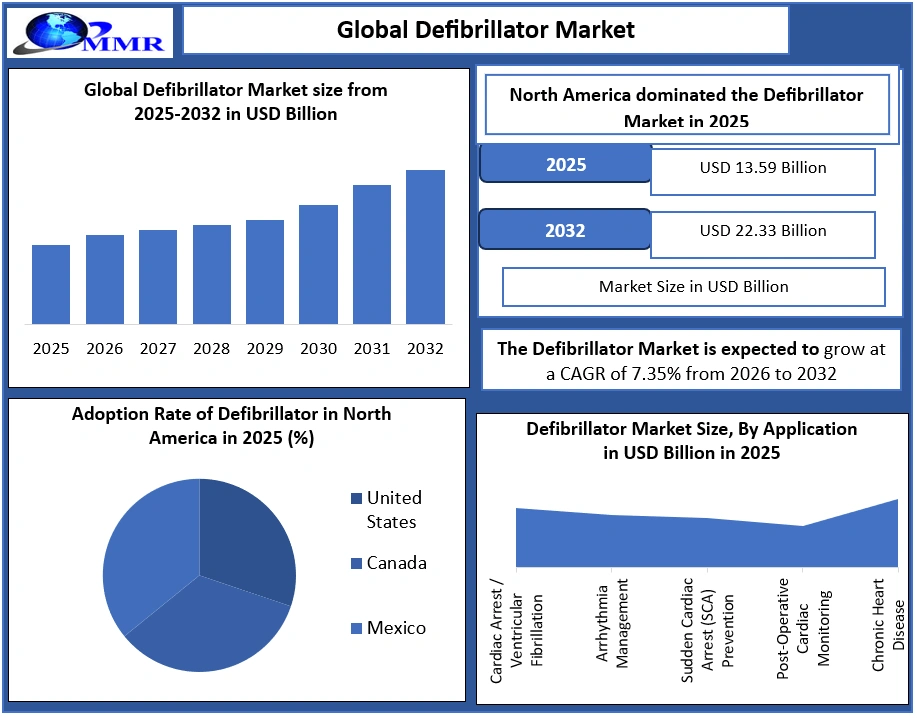
Global market valuation reached USD 13.59 billion in 2025 and is projected to reach USD 22.33 billion by 2032, maintaining a 7.35% CAGR.
Cardiovascular diseases drive 19.8 million annual deaths globally, creating a persistent, urgent demand for immediate cardiac intervention systems.
Non-communicable diseases caused 18 million premature deaths in 2021, with cardiovascular failures accounting for 38% of those fatalities.
Implantable Cardioverter Defibrillators (ICDs) held the dominant product market position in 2025 due to widespread utilization for chronic arrhythmia management.
Transvenous ICDs (T-ICDs) led the implantable segment share, while Subcutaneous ICDs (S-ICDs) expanded rapidly due to lower procedural risks.
Public access infrastructure has scaled significantly, placing over 200,000 active AED units across the United States and 83,000 units throughout China.
Why This Matters Now
Hospital leadership groups, emergency services networks, and medical device manufacturers face critical capital restructuring challenges as the integration of smart healthcare ecosystems shifts defibrillation from a static, reactive intervention into a connected, data-driven therapeutic pathway. Procurement teams can no longer view Automated External Defibrillators (AEDs) as standalone safety appliances, nor can electrophysiologists view Implantable Cardioverter Defibrillators (ICDs) as isolated hardware devices. Every device asset purchased must now function as an intelligent node within a broader remote patient monitoring network that transmits real-time physiological telemetry directly to acute care registries.
The business imperative requires manufacturers to minimize the structural invasiveness of internal hardware while building continuous cloud connectivity into public-access infrastructure. High upfront acquisition costs—ranging from USD 30,000 to USD 50,000 for complex implantable systems and USD 1,200 to USD 2,500 for baseline automated external units—demand verifiable clinical return on investment. For hospital executives and institutional healthcare investors, this market transformation creates opportunities to lower post-procedural complication costs, streamline outpatient clinic workflows, and establish value-based cardiovascular care management networks.
Market Overview
The global Defibrillators Market produces specialized medical devices engineered to deliver controlled electrical impulses to depolarize myocardial tissue, allowing normal sinus rhythm to re-establish during sudden cardiac arrest (SCA) and severe ventricular arrhythmias. The industry supplies a diverse product spectrum ranging from high-capacity manual units used in clinical emergency departments to long-term implantable arrays and public-access external devices deployed in high-traffic transport hubs. According to Maximize Market Research data, the global defibrillators market size was valued at USD 13.59 billion in 2025 and is projected to reach USD 22.33 billion by 2032, growing at a CAGR of 7.35% over the forecast period.
The commercial necessity of this sector is underscored by an escalating epidemiological crisis: cardiovascular diseases (CVDs) are responsible for approximately 19.8 million annual deaths worldwide. Furthermore, public tracking highlights that out of 18 million premature deaths linked to non-communicable illnesses recorded in 2021, cardiovascular failures caused 38% of those losses, frequently impacting individuals under the age of 70. This substantial premature mortality rate translates into severe societal and economic productivity losses, prompting international healthcare authorities to mandate the systematic installation of immediate-intervention therapeutic networks.
Key Trends Driving Growth
The primary driver expanding market volume is the institutional transition toward less invasive cardiac rhythm management hardware. For decades, transvenous implantable cardioverter defibrillators (T-ICDs) served as the default clinical approach for patients at risk for sudden cardiac arrest. However, the specialized surgical procedures required to route transvenous leads through the vascular system expose patients to long-term risks, including lead fracture, venous thrombosis, and systemic endovascular infections. To bypass these procedural vulnerabilities, medical technology developers have advanced subcutaneous implantable cardioverter defibrillators (S-ICDs) that sit entirely outside the thoracic cage and vascular system, minimizing surgical complication liabilities.
Concurrently, public health legislation and regional facility mandates are accelerating the deployment of public-access AED networks in commercial spaces, schools, transport hubs, and fitness centers. Because sudden cardiac arrest frequently occurs outside traditional hospital environments, survival rates depend entirely on the immediate availability of public-access defibrillation systems. This spatial decentralization of clinical equipment has created a massive volume market for manufacturers who design intuitive, voice-guided external units that can be safely operated by minimally trained bystanders or emergency first responders.
Furthermore, medical technology research and development pipelines are steering away from isolated hardware configurations to build comprehensive, integrated diagnostic-therapeutic solutions. Modern defibrillation platforms are paired with advanced algorithms capable of analyzing cardiac rhythm changes in real-time, allowing for early detection and preventative therapeutic delivery before an unstable arrhythmia progresses to full cardiac arrest. This shift changes the role of the device from a late-stage rescue tool to an active component of continuous chronic disease management, enabling physicians to monitor patient health status remotely through integrated telemetry systems.
Segment Insights
Implantable Cardioverter Defibrillators (Dominant Segment): The ICD segment maintained the leading market position in 2025 due to its critical, long-term therapeutic role in patients diagnosed with severe ventricular tachyarrhythmias. This hardware represents a high-value category that generates steady contractual revenue for leading medical device providers.
Transvenous ICDs (Dominant Sub-segment): Within the implantable product division, T-ICDs captured the larger operational market share in 2025, supported by long-term clinical validation data, widespread physician familiarity, and established insurance reimbursement pathways across major hospital groups.
Subcutaneous ICDs (Fastest-Growing Sub-segment): S-ICDs emerged as a high-growth category in 2025, favored by electrophysiologists for patients with compromised vascular access or elevated infection risks due to their less invasive implantation technique.
Automated External Defibrillators (Significant Growth Segment): The AED segment is expanding rapidly within the external product category, driven by legislative public-access mandates and high-volume procurement contracts from corporate facilities, public transit authorities, and primary education networks.
Regional Growth Story
North America secured the largest revenue share in the global defibrillators market in 2025, driven by a sophisticated healthcare technology ecosystem and mature public access laws. The region has established extensive emergency response safety nets, placing more than 200,000 active AED units across public spaces in the United States alone. This high device density is supported by structured insurance reimbursement policies and comprehensive clinical practice guidelines that incentivize hospitals to integrate remote patient monitoring systems into standard cardiovascular care pathways.
The United States is evaluated within the North American regional boundary. The report does not disclose separate state-level spending allocations, specific GPO contract distributions, or distinct local regulatory approvals.
The Asia-Pacific region represents a high-potential volume market due to expanding healthcare spending and targeted regulatory modernization initiatives. Regional governments are actively working to improve sudden cardiac arrest survival statistics by deploying diagnostic and emergency hardware across high-density urban areas. For example, public access initiatives have scaled the deployment of AEDs across China to over 83,000 units, while markets like India and Japan are increasing healthcare infrastructure investments to update legacy emergency medical service equipment.
Competitive Landscape
The global defibrillators market is consolidated, with dominant market share controlled by an elite tier of medical technology enterprises. MMR lists Medtronic PLC, Stryker Corporation (Physio-Control), Boston Scientific Corporation, Abbott Laboratories, Koninklijke Philips N.V., Nihon Kohden Corporation, ZOLL Medical Corporation (Asahi Kasei Group), and Mindray Medical International Limited as key participants. These companies are engaging in intensive research and development competition to integrate advanced digital connectivity and artificial intelligence into their cardiac rhythm management portfolios.
This competitive environment signals a shift in hospital procurement and technological leadership requirements. Leading device manufacturers are shifting away from selling standalone pieces of medical equipment toward offering integrated cardiovascular care software platforms. By bundling hardware with proprietary remote patient monitoring analytics and cloud-connected diagnostics, these manufacturers embed their systems directly into hospital electronic medical record networks. This deep software integration helps secure multi-year consumable and service agreements while making it difficult for regional hardware manufacturers to displace them.
Recent Developments
Throughout 2025, leading implantable hardware developers increased clinical deployment of next-generation S-ICD arrays, prioritizing patients showing high susceptibility to transvenous lead complications.
Public safety departments in major metropolitan areas expanded their cloud-connected AED networks in late 2025, using automated remote testing software to verify device battery levels and pad readiness across thousands of public locations simultaneously.
Strategic Implications
The evolution of the defibrillators market requires a complete re-evaluation of institutional procurement and asset management frameworks. Hospital procurement teams must look past the initial purchase price of equipment to analyze the total lifecycle cost of ownership, including battery replacements, software update protocols, and specialized clinical training requirements. Investing in connected AED fleets that automatically alert engineering teams to component failures allows large health systems to eliminate manual inspection schedules and lower operational overhead liabilities.
From a clinical delivery perspective, the rapid growth of less invasive options like S-ICDs alters post-operative recovery timelines. Patients undergoing subcutaneous device placement typically experience fewer procedural complications and shorter hospital stays compared to traditional transvenous placements. This shift optimizes hospital bed utilization rates and aligns clinical operations with value-based healthcare models that penalize institutions for high readmission rates linked to surgical site infections.
Future Outlook
The global defibrillators market will experience deeper convergence with advanced remote patient monitoring networks and predictive artificial intelligence algorithms. As public safety regulations continue to expand the presence of external units in residential and commercial settings, cloud-managed AED fleets will become standard infrastructure in modern smart cities. In the implantable segment, the adoption of subcutaneous systems will accelerate as technology boundaries shrink battery sizes and extend operational lifespans.
The market will separate into two distinct performance tiers based on digital connectivity and workflow integration. Future medical technology leaders will be defined by their ability to deliver smart, connected defibrillation platforms that transmit real-time patient data to care teams during cardiac emergencies, while laggards will remain restricted to isolated hardware units that fail to satisfy modern value-based healthcare coordination standards.
Analyst Perspective
“The defibrillator industry has evolved past the era of standalone emergency response hardware,” stated Komal Patil, Lead Analyst at Maximize Market Research. “Modern hospital networks and municipal procurement teams are demanding smart, cloud-connected platforms that continuously report device readiness and stream real-time patient telemetry straight to emergency clinical teams before the aircraft or ambulance arrives at the scene.”
About Maximize Market Research
Maximize Market Research Pvt. Ltd. (MMR) is a global market research and consulting company that provides reliable, data-focused, and practical business insights. The firm serves a wide range of industries, including healthcare, pharmaceuticals, technology, automotive, electronics, chemicals, personal care, and consumer goods. Through market forecasts, competitive analysis, strategic consulting, and industry impact assessments, MMR helps organizations understand changing market conditions, identify growth opportunities, and make informed business decisions for long-term success.
2nd Floor, Navale IT Park Phase 3
Pune Banglore Highway, Narhe
Pune, Maharashtra 411041, India
+91 9607365656
sales@maximizemarketresearch.com
