The UK Bike Sharing Market is rapidly evolving as cities across the country embrace sustainable urban mobility solutions to reduce congestion, lower carbon emissions, and improve public health. With increasing government support, expanding cycling infrastructure, and the integration of smart technologies, bike-sharing systems are becoming a vital component of the UK’s transportation ecosystem.
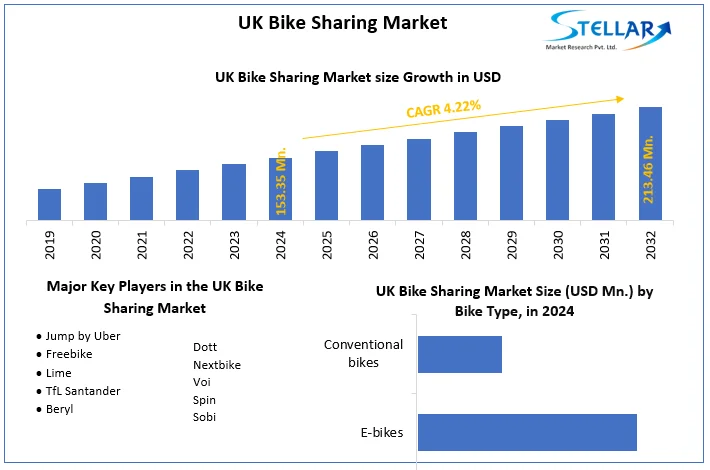
UK Bike Sharing Market size was valued at US$ 153.35 Million in 2024 and the total UK Bike Sharing Market revenue is expected to grow at 4.22% through 2025 to 2032, reaching nearly US$ 213.46 Million.
From London to regional cities like Manchester, Birmingham, and Glasgow, bike sharing is gaining traction among commuters, tourists, and environmentally conscious consumers, positioning the UK as a leading market in Europe’s micromobility landscape.
A Market Driven by Sustainability and Smart Urban Transport
A defining trend in the UK bike sharing market is the alignment with net-zero targets and smart city initiatives. The UK government’s commitment to reducing greenhouse gas emissions is encouraging the adoption of low-carbon transport solutions, including bike-sharing programs.
Urban congestion and rising fuel costs are also pushing consumers toward alternative modes of transport. Bike sharing offers a flexible, cost-effective solution for short-distance travel, complementing public transport systems such as buses, trains, and the London Underground.
The integration of mobile apps, GPS tracking, and digital payments is enhancing user convenience, making bike sharing more accessible and efficient.
Key Market Insights
- Bike sharing is expanding rapidly across major UK cities.
- Government policies are promoting sustainable transportation solutions.
- Dockless bike-sharing systems are gaining popularity.
- Integration with public transport networks is improving accessibility.
- E-bikes are emerging as a high-growth segment.
- Urban commuters and tourists are key user groups.
- Environmental awareness is driving adoption rates.
𝐃𝐨𝐰𝐧𝐥𝐨𝐚𝐝 𝐅𝐫𝐞𝐞 𝐏𝐃𝐅 𝐁𝐫𝐨𝐜𝐡𝐮𝐫𝐞: https://www.stellarmr.com/report/req_sample/UK-Bike-Sharing-Market/116
Market Drivers Accelerating Growth
1. Government Support for Sustainable Mobility
Policies aimed at reducing emissions and promoting cycling are boosting the adoption of bike-sharing systems.
2. Rising Urban Congestion
Increasing traffic congestion in cities is driving demand for alternative transportation options.
3. Growth of Smart Mobility Technologies
Digital platforms, mobile apps, and IoT-enabled bikes are enhancing user experience and operational efficiency.
Market Challenges and Restraints
1. Infrastructure Limitations
Despite improvements, the availability of dedicated cycling lanes and parking facilities remains uneven across regions.
2. Operational Costs and Maintenance
Managing large fleets and ensuring regular maintenance can be challenging for operators.
Technology and Sustainability Trends
Technology is at the core of the UK bike sharing market. Companies are leveraging IoT-enabled bikes, GPS tracking, and real-time data analytics to optimize fleet management and improve user experience.
Electric bikes (e-bikes) are gaining popularity, offering extended range and convenience, particularly in hilly or longer-distance routes. These bikes are also attracting new user segments, including older commuters.
Sustainability remains a key focus, with bike sharing contributing to reduced carbon emissions, improved air quality, and lower traffic congestion. Many operators are also adopting eco-friendly materials and renewable energy solutions.
𝐃𝐨𝐰𝐧𝐥𝐨𝐚𝐝 𝐅𝐫𝐞𝐞 𝐏𝐃𝐅 𝐁𝐫𝐨𝐜𝐡𝐮𝐫𝐞: https://www.stellarmr.com/report/req_sample/UK-Bike-Sharing-Market/116
Regional Insights: London Leads, Regional Cities Expand
London dominates the UK bike sharing market, supported by a well-established cycling infrastructure and strong government backing. The city’s bike-sharing system is one of the most recognized globally, serving millions of users annually.
Regional cities such as Manchester, Birmingham, and Glasgow are also witnessing significant growth, driven by urban development and increasing awareness of sustainable transport options.
The expansion of bike-sharing systems into smaller cities and towns is creating new growth opportunities and broadening market reach.
Recent Industry Developments
- Transport for London (2025): Expanded cycling infrastructure and enhanced bike-sharing services across London.
- Lime (2024): Increased its e-bike fleet in major UK cities, improving accessibility and convenience.
- Tier Mobility (2025): Expanded operations and introduced new e-bike solutions in the UK market.
- UK Government (2024): Strengthened policies promoting cycling and sustainable urban transport.
- Santander (2025): Continued support for London’s bike-sharing scheme, enhancing service quality.
Competitive Landscape
The UK bike sharing market is moderately competitive, with a mix of global micromobility companies and local operators. Companies are focusing on fleet expansion, technology integration, and partnerships with local authorities to strengthen their market position.
Operators are also introducing subscription models, dynamic pricing, and value-added services to attract and retain users. Collaboration with public transport systems is a key strategy for improving accessibility and scalability.
Analyst Perspective
A senior market analyst notes:
“The UK bike-sharing market is benefiting from strong policy support and increasing consumer awareness of sustainable mobility. The integration of digital technologies and expansion of cycling infrastructure will be critical in driving long-term growth.”
Future Outlook
The UK Bike Sharing Market is expected to witness robust growth in the coming years, driven by urbanization, environmental awareness, and technological advancements. The continued expansion of cycling infrastructure and integration with public transport will further enhance market potential.
Electric bikes and smart mobility platforms are likely to play a significant role in shaping the future of the market. As competition intensifies, companies will need to focus on operational efficiency, user experience, and sustainability.
Overall, the UK bike sharing market represents a strong opportunity for operators, investors, and stakeholders seeking to capitalize on the growing demand for sustainable urban mobility solutions.
