Key Highlights:
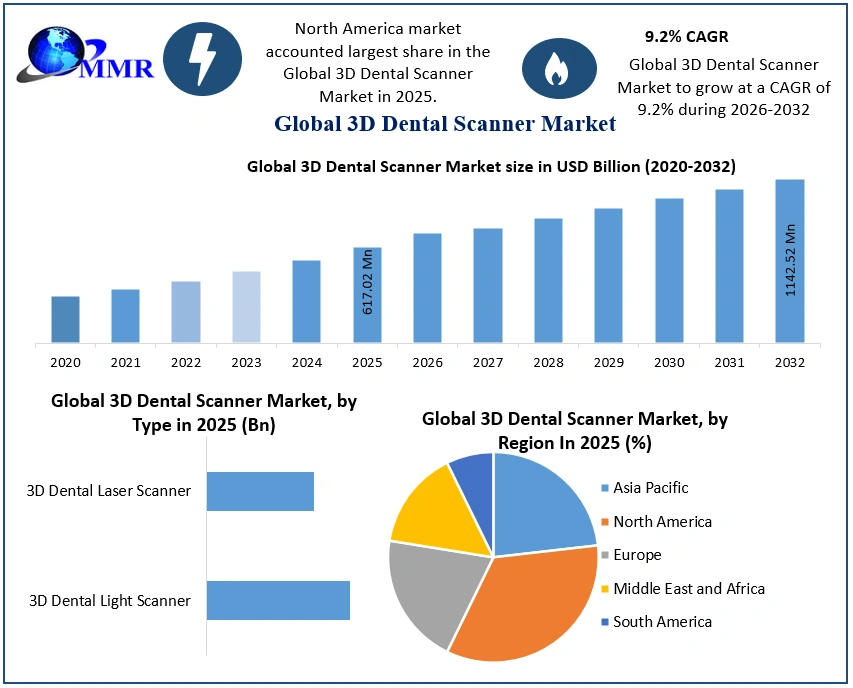
Global market valuation reached USD 617.02 million in 2025 and is projected to scale to USD 1,142.52 million by 2032, maintaining a 9.2% CAGR.
Intraoral scanners hold the dominant product segment share, driven by rapid clinician adoption and immediate chairside diagnostic utility.
The growing prevalence of dental diseases, edentulism, and orthodontic malocclusions provides a continuous global volume baseline for advanced intraoral imaging systems.
North America led global revenue generation in 2025, supported by widespread adoption of computer-aided design and manufacturing networks.
The Asia-Pacific region is emerging as a high-volume market, propelled by expanding dental tourism, healthcare infrastructure investments, and local hardware manufacturing.
Rising consumer demand for cosmetic dentistry and fast, minimally invasive restorative procedures accelerates private clinic procurement activity.
Why This Matters Now Dental group purchasing organizations, hospital systems, and private dental practices face immediate operational disruptions as legacy manual elastomeric impressions are systematically phased out in favor of real-time digital oral imaging. Procurement leaders must transition capital budgets away from traditional physical model materials and toward integrated 3D scanning ecosystems that connect directly to automated dental laboratories. Dental networks that fail to update their diagnostic infrastructure to incorporate automated chairside scanning will face immediate patient churn, losing volume to modern clinics that offer single-visit crowns, precise orthodontic clear aligner setups, and highly accurate surgical implant workflows.
The business imperative requires medical technology companies to re-engineer scanning hardware around open-architecture software platforms, machine learning diagnostics, and cloud-integrated laboratory management networks. Institutional updates, such as value-based dental care metrics and stricter cross-contamination controls, are lowering the operational barriers to full-scale digital adoption. For healthcare executives and institutional dental procurement teams, these clinical advancements present clear opportunities to improve patient safety, optimize chair time efficiency, and eliminate repetitive shipping or physical storage overhead.
Market Overview The global 3D Dental Scanner Market produces specialized optical imaging devices, including intraoral scanners, desktop laboratory scanners, and specialized software modules utilized by dental professionals to construct precise virtual models of teeth and surrounding soft tissues. The industry serves a critical role across prosthodontics, orthodontics, and implantology, serving as the essential data-capture step for modern digital manufacturing. Maximize Market Research documents that the global 3D dental scanner market size was valued at USD 617.02 million in 2025 and is projected to reach USD 1,142.52 million by 2032, growing at a compound annual growth rate (CAGR) of 9.2% over the forecast period.
The commercial scaling of this sector is driven by an escalating global burden of periodontal diseases, tooth loss, and structural dental alignment defects. Traditional impression techniques expose dental networks to material distortion risks, shipping delays, and significant patient discomfort, creating a massive opportunity for non-contact digital optical systems. By converting physical dental architecture into standardized open data files, these advanced medical imaging systems allow clinics to reduce chair time, eliminate clinical errors, and scale up their procedural volumes.
Key Trends Driving Growth The primary driver expanding market volume is the rapid integration of artificial intelligence and machine learning algorithms directly into chairside scanning software. Modern 3D dental scanners are no longer simple camera arrays; they function as intelligent diagnostic nodes that automatically recognize and filter out mobile soft tissues, saliva, and clinical artifacts during the scanning process. This automated filtering capability shortens the learning curve for auxiliary clinical staff, allowing practices to delegate image collection confidently while ensuring highly accurate data outputs.
Concurrently, dental infrastructure is shifting rapidly toward fully integrated, single-visit chairside CAD/CAM networks. In legacy workflows, digital impressions had to be transmitted to external laboratories, adding days to patient treatment timelines. By combining high-speed intraoral scanners with chairside design software and compact milling units, dental operators can manufacture definitive restorations within a single appointment window. This workflow modernization optimizes clinic operations, maximizes asset utilization, and fulfills growing patient demands for fast, immediate restorative treatment.
Furthermore, medical device engineering is prioritizing open-architecture ecosystems over proprietary closed data networks. Historically, early adopters of digital scanning hardware were locked into specific manufacturers for their software, milling blocks, and laboratory support. To stay competitive, leading 3D scanner providers are offering hardware that exports universal file formats, allowing dental practices to collaborate freely with any third-party dental laboratory or 3D printing bureau. This software flexibility removes institutional purchasing friction, enabling hospital procurement teams to negotiate competitive manufacturing agreements.
Segment Insights
Intraoral Scanners (Dominant Product Segment): Intraoral scanners held the largest market share within the product segment in 2024. This dominant position is sustained by their direct chairside utility, ease of operation, and versatility across multiple clinical specialties, including prosthodontics and clear aligner therapies.
Dental Clinics (Dominant End User Segment): Private dental practices and specialized dental groups represented the leading end-user category in 2024. Widespread clinician adoption is accelerated by the need to increase throughput and improve case acceptance through clear 3D patient visualizations.
Desktop Laboratory Scanners (Significant Maintenance Segment): Desktop scanners continue to maintain a stable operational footprint within commercial dental laboratories. These systems are used to digitize legacy physical models and handle high-volume structural milling setups.
Fastest-Growing Segment: The supplied MMR report does not break out a separate fastest-growing sub-segment by mechanical architecture, software configuration, or specific surgical application. Unspecified growth metrics are omitted to maintain strict reporting compliance.
Regional Growth Story North America maintained its position as the largest regional market in 2025, supported by high dental expenditures, mature clinical infrastructure, and widespread integration of digital healthcare platforms. Private practices and corporate dental service organizations (DSOs) across the region leverage advanced 3D scanning networks as a core differentiator to attract patients and lower laboratory bills. This technology-focused operational environment allows medical device manufacturers to launch premium, high-definition intraoral systems with predictable baseline sales volume.
The United States is analyzed within the North American regional boundary. The report does not break out separate state-level capital subsidies, individual DSO procurement volumes, or distinct local regulatory developments.
The Asia-Pacific region represents a high-potential volume market due to expanding middle-class populations, increasing healthcare modernization, and a rapidly growing dental tourism sector. Countries such as China, India, Japan, and South Korea are experiencing major healthcare infrastructure investments, as local governments work to improve access to modern dental diagnostics. This regional market growth drives high-volume distribution contracts for affordable, portable intraoral hardware that can be easily integrated into expanding community health centers and private group practices.
Competitive Landscape The global 3D dental scanner market features high consolidation among established multinational medical technology corporations, including Align Technology, Inc., Envista Holdings Corporation, Dentsply Sirona Inc., 3Shape A/S, Planmeca Oy, Carestream Dental LLC, Medit Corp., and Straumann Group. These primary operators are engaging in intensive technology development campaigns, utilizing continuous software updates and integrated cloud platforms to lock in clinician allegiance.
This competitive landscape signals a structural shift in technology leadership and clinic purchasing patterns. Rather than competing solely on scanner weight or tip size, leading manufacturers are building comprehensive digital ecosystems that encompass clear aligner design, implant surgical guides, and patient monitoring software. By providing integrated software tools that allow clinicians to track tooth wear and gingival recession over time, manufacturers embed their hardware deeply into routine patient care, creating long-term brand loyalty.
Recent Developments
Throughout 2025, leading intraoral scanner developers focused heavily on releasing modular software updates that utilize generative AI to predict restorative margins, automatically flagging preparation errors before the patient leaves the chair.
Major distribution agreements were solidified in late 2025 between global dental equipment suppliers and cloud infrastructure providers to guarantee secure, high-speed transfer of large 3D clinical files across cross-border laboratory networks.
Strategic Implications The transition to open-architecture, high-speed 3D dental scanning fundamentally changes the financial dynamics of dental laboratory procurement. By eliminating the ongoing costs of physical impression materials, custom trays, and courier services, large dental networks can achieve immediate operational savings after deploying digital scanner fleets. For institutional healthcare managers, the reduction in clinical error rates translates directly into fewer patient remakes, stabilizing clinical operating margins and optimizing scheduling efficiency.
Furthermore, the integration of 3D scanning into standard clinical intake protocols improves communication during value-based patient consultations. Showing patients high-definition, three-dimensional models of their dentition on chairside screens significantly increases case acceptance rates for complex restorative and orthodontic procedures. This interactive diagnostic approach allows clinics to maximize their return on capital equipment investments while helping patients better understand their treatment plans.
Future Outlook The global 3D dental scanner market will transition completely toward cloud-connected, AI-directed diagnostic ecosystems that bridge the gap between initial clinical intake and final device fabrication. The reliance on legacy physical models will decline as dental laboratories require fully digitized workflows to feed automated 3D printing and milling lines. In the practice environment, intraoral scanning hardware will become lighter, more ergonomic, and tightly integrated with secondary imaging modalities like cone-beam computed tomography (CBCT).
The market will split into two competitive performance tiers based on cloud integration capability and automated software features. Future medical technology leaders will secure dominant market shares by delivering open, AI-driven chairside scanning software that simplifies data collection and speeds up restoration delivery, while market laggards will remain confined to selling isolated hardware components that fail to meet modern value-based healthcare standards.
Analyst Perspective “The 3D dental scanner has evolved from an expensive technological luxury into the essential foundation of modern restorative dentistry,” stated Komal Patil, Lead Analyst at Maximize Market Research. “Hospital procurement systems and group dental practices are actively prioritizing open-architecture intraoral ecosystems that leverage artificial intelligence to automate scan cleanups and cut down on patient appointment times.”
About Maximize Market Research
Maximize Market Research Pvt. Ltd. (MMR) is a global market research and consulting company that provides reliable, data-focused, and practical business insights. The firm serves a wide range of industries, including healthcare, pharmaceuticals, technology, automotive, electronics, chemicals, personal care, and consumer goods. Through market forecasts, competitive analysis, strategic consulting, and industry impact assessments, MMR helps organizations understand changing market conditions, identify growth opportunities, and make informed business decisions for long-term success.
2nd Floor, Navale IT Park Phase 3
Pune Banglore Highway, Narhe
Pune, Maharashtra 411041, India
+91 9607365656
sales@maximizemarketresearch.com
