Key Highlights
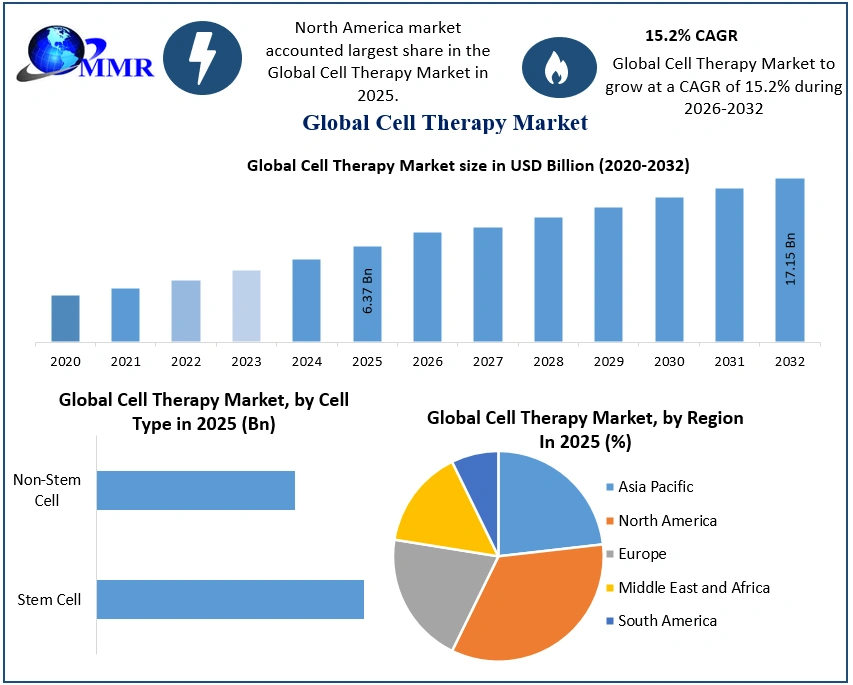
The global market reached USD 6.37 Billion in 2025, expanding commercial capacity across oncology and degenerative medicine pipelines.
Total market revenue is projected to hit USD 17.15 Billion by 2032, growing at a 15.2% compound annual growth rate (CAGR).
Autologous stem cells and CAR-T therapies represent dominant shares, while allogeneic platforms drive off-the-shelf volume scalability.
High clinical delivery costs and fragmented reimbursement networks remain primary hurdles to widespread enterprise hospital procurement.
Rapidly growing investment in AI-led cell analytics and specialized biobanking infrastructure accelerates production cycles and stabilizes cell viability.
North America commands the largest regional footprint, sustained by targeted federal oncology funding and accelerated regulatory approval windows.
Why This Matters Now
The therapeutic landscape is undergoing an irreversible pivot from managing chronic symptoms to deploying targeted biological interventions that cure underlying disease pathology. For medical device manufacturers, clinical laboratory leaders, and specialized hospital procurement teams, cell therapies introduce deep operational shifts in cryopreservation, cleanroom supply chains, and point-of-care delivery models. Organizations that fail to install automated, high-precision manufacturing and preservation technologies will be locked out of the highest-margin clinical pipelines over the next ten years.
Market Overview
The Global Cell Therapy Market was valued at USD 6.37 Billion in 2025 and is expanding at a 15.2% CAGR to surpass USD 17.15 Billion by 2032. This rapid commercial valuation highlights a major industrial transition toward gene-modified biological platforms, moving away from conventional small-molecule pharmaceutical designs. Global medical technology providers are reallocating capital to build specialized hardware and software ecosystems capable of sustaining living cellular products.
The overall expansion is structurally tethered to a sharp rise in the global prevalence of chronic illnesses, solid tumors, and hematological malignancies. The integration of high-throughput gene-editing toolsets, particularly CRISPR-Cas9 systems, has changed preclinical pipelines into standardizable, highly reproducible manufacturing protocols. This structural stability encourages long-term capital deployments from healthcare venture funds and institutional providers.
Key Trends Driving Growth
The core structural transformation in the cell therapy market revolves around automated manufacturing systems and AI-powered cellular analytics. Historically, manual handling of cellular materials limited scalability and introduced human error into the cultivation phase. Today, closed-loop automated bioprocessing platforms permit continuous monitoring of critical quality attributes, directly maximizing batch consistency while driving down operating overhead.
At the same time, the aggressive development of scalable off-the-shelf allogeneic cell platforms addresses the extreme logistical friction of patient-specific manufacturing. Allogeneic models utilize healthy donor tissue to manufacture uniform, mass-distributed product batches, completely bypassing the weeks-long extraction and re-infusion cycles required by autologous therapies. This advance shifts the corporate landscape toward traditional high-volume medical device and pharmaceutical logistics models.
To support this volume, investments in global biobanking networks and specialized cryogenic transport systems have increased. Advanced storage facilities ensure long-term cell viability and potency across international supply chains, establishing a predictable procurement framework for major multi-site hospital networks. These infrastructure expansions directly match value-based healthcare targets by mitigating product loss during intercontinental transport.
Segment Insights
Dominant Segment: Autologous Stem Cells and CAR-T therapies command the highest revenue allocation due to their established track record in treating specialized blood malignancies, including leukemia and lymphoma.
Fastest-Growing Segment: The Maximize Market Research report indicates that allogeneic cell platforms represent the highest-velocity expansion trajectory due to their off-the-shelf delivery capabilities, which substantially reduce hospital length-of-stay and processing bottlenecks.
Target Antigens and Drivers: CD19 and CD22 target antigens lead commercial CAR-T portfolios, while B-cell maturation antigen (BCMA) pipelines are expanding fast to capture multi-line myeloma clinical markets.
End-User Distribution: Institutional deployment is heavily concentrated across Tier-1 oncology centers, advanced academic research hospitals, and specialized ambulatory surgical networks optimized for complex biological infusions.
Regional Growth Story
North America maintains structural dominance within the global cell therapy landscape, driven by centralized healthcare spending, sophisticated clinical trial networks, and streamlined FDA regulatory pathways. The United States acts as the primary engine for this regional performance, where multi-billion-dollar initiatives like the federal Cancer Moonshot program inject substantial capital directly into clinical translation infrastructure.
Europe represents the second-largest commercial footprint, characterized by harmonized regulatory oversight and robust public-private laboratory partnerships across Germany and the United Kingdom. These regulatory frameworks provide developers with predictable milestones for clinical testing and commercial market authorization, incentivizing regional technology investments.
The Asia-Pacific region is experiencing the fastest deployment of manufacturing operations, led by expanding infrastructure investments in China, Japan, and India. Local governments are aggressively creating supportive regulatory zones and funding domestic biobanking systems to manage the expanding burden of chronic diseases. This localized scaling lowers production costs, making the region a critical hub for international contract manufacturing alliances.
Competitive Landscape
The global competitive matrix is defined by massive capital deployment toward manufacturing capability and automated analytics integration. Industry leaders are pivoting away from early-stage asset acquisition to focus squarely on securing manufacturing scale and reliable supply chains, recognizing that production capacity is the true bottleneck to market dominance.
As clinical adoption scales from ultra-rare conditions to broader oncological indications, market leaders are actively acquiring specialized point-of-care processing technologies. These acquisitions signal an industry-wide effort to reduce reliance on centralized manufacturing facilities, moving toward hub-and-spoke hospital distribution models that protect product viability.
Recent Developments
In February 2026, Johnson & Johnson committed more than USD 1.00 Billion to construct a next-generation cell therapy manufacturing hub in Pennsylvania, directly escalating regional CAR-T and regenerative medicine throughput.
Enterprise clinical providers have initiated collaborative rollouts of AI-enabled analytics suites designed to evaluate cell potency and identify manufacturing anomalies in real time.
Regulatory agencies in the United States and Europe have expanded priority review designations for CRISPR-cas9 engineered products targeting rare genetic and neurodegenerative conditions.
Tier-1 research networks have finalized a series of multi-year biobanking integrations to standardize cryogenic storage metadata and cross-border transport protocols.
Strategic Implications
For medical device and clinical procurement executives, the growth of cell therapies creates a critical demand for modern infrastructure. Traditional hospital storage systems are completely inadequate for managing biological therapeutics that require continuous cryogenic validation. Procurement teams must rapidly establish specialized storage ecosystems or risk being excluded from high-margin precision medicine programs.
Furthermore, reimbursement structures must evolve to keep pace with these highly technical, single-intervention cure models. The high initial cost of cell therapies forces health systems and commercial payers to create risk-sharing, outcomes-based payment frameworks. Medical technology firms that bundle their therapeutic platforms with real-time digital monitoring and diagnostic tracking tools will gain a significant competitive advantage in hospital contract negotiations.
Future Outlook
The trajectory of the cell therapy sector will be determined by the successful optimization of large-scale manufacturing models. Over the next five years, the industry will move decisively past manual, small-batch open processing to adopt fully enclosed, automated bioreactor ecosystems. This shift will significantly lower the cost of goods sold, making these life-saving therapies accessible to a much broader global patient population.
As clinical pipelines expand to target complex solid tumors and prevalent neurodegenerative conditions like Alzheimer’s disease, the pressure on raw material supply chains will intensify. Companies that secure stable, automated supply chains and advanced distribution logistics will establish long-term market dominance.
Future medical technology leaders will be defined by their ability to scale closed-loop, automated allogeneic production lines, whereas laggards will remain stuck in high-cost, manually dependent autologous service models.
Analyst Perspective
“The transition toward automated cell therapy platforms represents a complete paradigm shift in healthcare delivery,” states Komal Patil, Lead Analyst at Maximize Market Research. “We are seeing an aggressive industrial transformation where production scalability, AI-guided cellular analytics, and automated supply chains are overtaking basic drug discovery as the primary drivers of commercial success. Winners in this market are those standardizing the manufacturing process to deliver reliable, off-the-shelf living therapeutics at a predictable price point.”
About Maximize Market Research
Maximize Market Research Pvt. Ltd. (MMR) is a global market research and consulting company that provides reliable, data-focused, and practical business insights. The firm serves a wide range of industries, including healthcare, pharmaceuticals, technology, automotive, electronics, chemicals, personal care, and consumer goods. Through market forecasts, competitive analysis, strategic consulting, and industry impact assessments, MMR helps organizations understand changing market conditions, identify growth opportunities, and make informed business decisions for long-term success.
2nd Floor, Navale IT Park Phase 3
Pune Banglore Highway, Narhe
Pune, Maharashtra 411041, India
+91 9607365656
sales@maximizemarketresearch.com
