Key Highlights
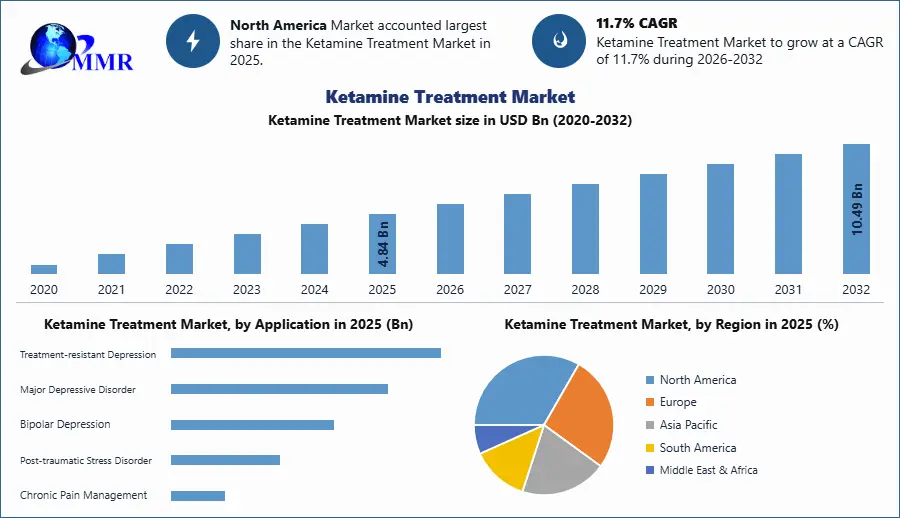
The global ketamine treatment market was valued at USD 4.84 Billion in 2025, validating its transition from niche anesthetic use to a frontline psychiatric intervention.
Market revenues are projected to reach USD 10.49 Billion by 2032, expanding at an 11.7% CAGR over the forecast period.
Intravenous (IV) infusions and intranasal esketamine sprays dictate current commercial volumes across institutional care providers.
High clinical administration overhead and stringent regulatory compliance mandates represent the primary operational friction points for new healthcare infrastructure setups.
Increasing data integration between specialized digital therapeutics, remote patient monitoring devices, and clinical EHR software drives safety and patient follow-up efficiency.
North America represents the largest regional market footprint, supported by a dense network of dedicated ketamine infusion clinics and expanded public-private insurance coverage.
Why This Matters Now
The mental healthcare delivery model is experiencing a profound structural crisis as conventional daily pharmaceuticals fail nearly a third of all patients diagnosed with major depression. For hospital systems, psychiatric network executives, and medical technology developers, the ketamine treatment paradigm shifts mental health care from an at-home prescription framework to a highly controlled, high-margin, in-clinic medical procedure. This transformation demands rapid clinical infrastructure upgrades, specialized patient-monitoring ecosystems, and precise clinical tracking tools to manage complex administrative protocols safely and profitably.
Market Overview
The Global Ketamine Treatment Market reached a commercial valuation of USD 4.84 Billion in 2025 and is projected to expand at an 11.7% CAGR to achieve USD 10.49 Billion by 2032. This rapid growth marks a significant shift in hospital procurement and psychiatric treatment methodologies, transitioning away from monoaminergic oral antidepressants that often require weeks to demonstrate clinical efficacy.
The industry’s expansion is structurally tied to the global surge in treatment-resistant depression (TRD), major depressive disorder (MDD), post-traumatic stress disorder (PTSD), and chronic pain conditions. As clinical data continues to demonstrate ketamine’s ability to achieve rapid symptom resolution within hours rather than weeks, institutional healthcare buyers are actively reallocating capital. They are moving funds from traditional long-term outpatient management to build dedicated, high-throughput interventional psychiatry suites.
Key Trends Driving Growth
The most impactful transformation in the ketamine treatment market is the integration of digital health applications and remote patient monitoring tools into post-infusion care protocols. Because ketamine induces rapid neuroplasticity, the clinical window immediately following administration is highly critical for therapeutic consolidation. Hospital networks are responding by deploying synchronized digital therapeutics and wearable physiological sensors to track patient mood fluctuations, heart-rate variability, and sleep architecture in real time, creating an objective data feedback loop for clinicians.
At the same time, the market is benefiting from a wave of professionalization and corporate consolidation among independent ketamine clinics. Scattered, single-physician boutique clinics are rapidly being replaced by multi-state, institutional-grade clinical networks that utilize standardized electronic health records (EHR) and unified patient selection criteria. This operational maturity helps clear the historic stigma surrounding psychedelic-adjacent medicines, establishing ketamine as a legitimate, reproducible tier within standard value-based healthcare pathways.
Furthermore, telehealth integration has emerged as a major patient acquisition tool, streamlining the initial evaluation, psychiatric screening, and post-treatment follow-up phases. While federal and regional regulations tightly enforce the physical, in-person administration of controlled substances, digital triage platforms significantly reduce administrative bottlenecks. This allows enterprise medical systems to maximize physical clinic throughput and optimize room utilization rates.
Segment Insights
Dominant Segment: Intravenous (IV) Infusion therapy and Intranasal Esketamine (Spravato) represent the dominant revenue shares due to their high clinical accuracy, predictable bioavailability, and widespread adoption across Tier-1 medical centers.
Fastest-Growing Segment: Intranasal delivery systems and telehealth-supported clinical hybrid models represent the fastest-growing operational segments, significantly lowering the barrier to entry for outpatient psychiatric practices.
Primary Indications: Treatment-resistant depression (TRD) and major depressive disorder (MDD) compose the largest patient volumes, while chronic pain management and PTSD protocols show increasing market share within veteran and tertiary care facilities.
End-User Distribution: Commercial revenue remains concentrated within specialized psychiatric clinics, major academic hospital networks, and integrated pain management clinics equipped with dedicated physiological monitoring infrastructure.
Regional Growth Story
North America dominates the global ketamine treatment market, sustained by an extensive network of specialized private clinics, high healthcare spending per capita, and favorable regulatory progress regarding intranasal esketamine formulations. The United States acts as the primary engine for this growth, where private insurance companies and Medicare lines are increasingly approving reimbursement for esketamine under strictly defined clinical criteria. This shifting payer stance lowers out-of-pocket costs and accelerates enterprise clinic adoption.
Europe represents the second-largest commercial landscape, anchored by structured healthcare delivery models in Germany, the United Kingdom, and France. European market expansion is characterized by a high reliance on public hospital installations and rigid adherence to country-specific regulatory bodies, ensuring high clinical safety profiles but resulting in a more controlled, deliberate rollout of new clinical centers.
The Asia-Pacific region is poised for significant infrastructural development, driven by escalating mental health awareness campaigns and expanding healthcare budgets in Japan, China, India, and South Korea. Emerging regulatory adjustments and partnerships with western clinical networks are paving the way for localized manufacturing and clinic franchise models, unlocking massive, previously unserved patient populations across the region.
Competitive Landscape
The competitive matrix of the global ketamine treatment market is defined by a shift from independent clinical practices to heavily capitalized corporate networks and advanced biotech delivery developers. Industry players are focusing on service standardization, proprietary monitoring software integration, and data-driven clinical outcomes to secure market share and gain long-term institutional trust.
As large-scale medical technology companies eye the broader mental health and psychedelic medicine sectors, market participants are investing heavily in protective clinic infrastructure. This includes smart infusion pumps, advanced biometric tracking rings, and cloud-based patient engagement apps. These investments signal that technology leadership in this market will not belong to the molecule itself, but to the ecosystem that wraps around its safe clinical delivery.
Recent Developments
In March 2026, Maximize Market Research tracked multiple corporate clinic networks completing institutional funding rounds to scale physical clinic counts across secondary North American and European metropolitan markets.
Global medical device suppliers introduced next-generation, cloud-connected infusion pumps designed specifically for low-dose anesthetic psychiatric protocols, minimizing manual programming errors.
Regulatory frameworks in select Asia-Pacific healthcare markets initiated formal reviews of intranasal esketamine for hospital-wide procurement, speeding up international clinical integration timelines.
Leading clinical research organizations launched multi-center validation trials combining ketamine delivery with virtual reality (VR) guided cognitive behavioral therapy to extend the duration of symptom remission.
Strategic Implications
For hospital procurement officers and healthcare system executives, the rapid growth of the ketamine market presents an immediate operational challenge. Setting up an interventional psychiatry suite requires specific capital investments: dedicated recovery bays, specialized crash carts, trained nursing staff for real-time hemodynamic monitoring, and rigorous inventory tracking for controlled substances. Hospital systems must adopt automated scheduling and monitoring technologies to ensure these rooms remain profitable while meeting strict safety mandates.
Moreover, the shifting payer landscape dictates that clinic networks must collect robust real-world data. As insurers transition toward value-based reimbursement, providers cannot rely solely on subjective patient self-reports. Clinical leaders must implement validated, digital tracking tools that objectively document functional recovery, reduced hospitalization rates, and successful long-term symptom control to maintain favorable insurance coverage.
Future Outlook
The next phase of the ketamine treatment market will be characterized by its integration into mainstream healthcare systems and standard primary care referral loops. As the operational models for fast-acting interventional psychiatry stabilize, the market will move beyond isolated cash-pay clinics into fully integrated neurotherapeutic wings within traditional hospitals. This shift will expand the patient base and stabilize the industry’s revenue streams against economic fluctuations.
Furthermore, the technology infrastructure developed to support ketamine delivery will serve as the foundation for the broader psychedelic and neuroplastic medicine industries over the next decade. Companies that build robust, compliant, and data-driven delivery networks today will hold a massive first-mover advantage as alternative molecules clear phase-III regulatory pipelines.
Future medical technology leaders will be defined by their ability to provide integrated, data-backed clinical ecosystems that maximize patient safety and guarantee consistent insurance coverage, while laggards will remain restricted to siloed, cash-dependent, and logistically unscalable treatment models.
Analyst Perspective
“The ketamine treatment market is moving past its early, fragmented infrastructure phase and entering a period of strict corporate and clinical standardization,” states Komal Patil, Lead Analyst at Maximize Market Research. “We are observing a clear transition where market leadership is no longer determined simply by opening clinics, but by integrating advanced remote patient monitoring, digital therapeutics, and secured insurance pathways. The providers that invest in automated, high-compliance delivery ecosystems are the ones that will secure long-term contracts with enterprise healthcare systems and commercial insurance carriers.”
About Maximize Market Research
Maximize Market Research Pvt. Ltd. (MMR) is a global market research and consulting company that provides reliable, data-focused, and practical business insights. The firm serves a wide range of industries, including healthcare, pharmaceuticals, technology, automotive, electronics, chemicals, personal care, and consumer goods. Through market forecasts, competitive analysis, strategic consulting, and industry impact assessments, MMR helps organizations understand changing market conditions, identify growth opportunities, and make informed business decisions for long-term success.
2nd Floor, Navale IT Park Phase 3
Pune Banglore Highway, Narhe
Pune, Maharashtra 411041, India
+91 9607365656
sales@maximizemarketresearch.com
