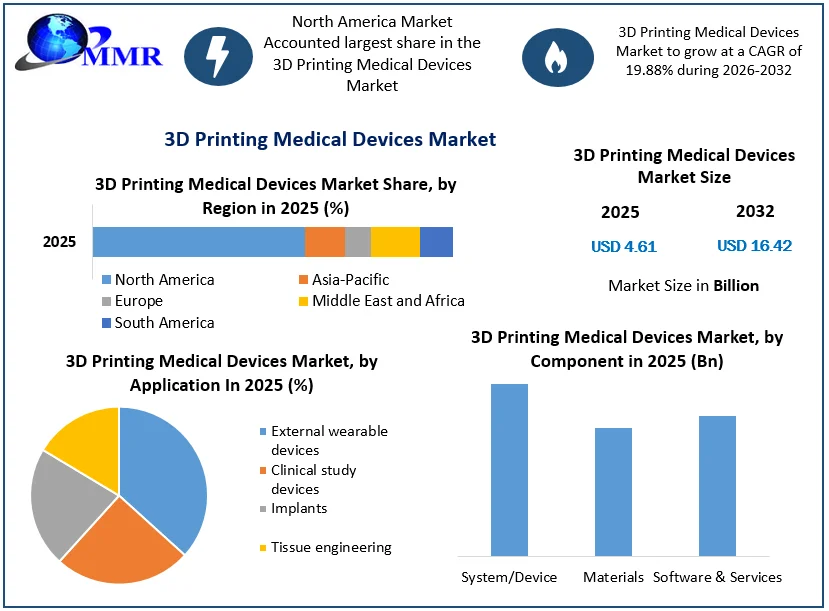
Key Highlights
The global market was valued at USD 3.851 Billion in 2024, driven by institutional demand for personalized reconstructive surgery components.
Total market revenue is projected to reach USD 14.98 Billion by 2032, demonstrating a 19.88% CAGR over the forecast period.
Implants represented the dominant application segment, capturing major market share across orthopedic, dental, and cranial reconstruction procedures.
Selective Laser Sintering (SLS) and Stereolithography (SLA) technologies lead industrial hardware adoption due to precision and structural stability.
Point-of-care 3D printing labs are transitioning from academic research centers into standard community hospital procurement infrastructure.
North America commands the primary market footprint, sustained by high medical technology investments and established FDA regulatory clearances.
Why This Matters Now
The centralized medical device manufacturing model is facing systemic disruption as hospitals transition toward decentralized, on-site production. For medical technology executives, hospital procurement leaders, and orthopedic surgeons, 3D printing transforms devices from bulk-ordered inventory into real-time, patient-specific clinical interventions. This shift slashes hospital lead times, minimizes specialized component waste, and optimizes surgical workflows. Organizations that delay investing in localized additive manufacturing partnerships and regulatory-compliant printing software risk losing higher-margin surgical volumes to automated, decentralized competitors.
Market Overview
The Global 3D Printing Medical Devices Market was valued at USD 3.851 Billion in 2024 and is expanding at an annual growth rate of 19.88% to cross USD 14.98 Billion by 2032. This rapid commercial scaling underscores a significant industrial migration toward customized precision medicine, replacing traditional mass-produced, standardized implants. Global health systems are systematically reallocating capital to procure internal additive manufacturing machinery and advanced medical modeling software.
The market’s continuous expansion is directly connected to a sharp rise in complex orthopedic injuries, degenerative bone conditions, and advanced maxillofacial defects. Traditional manufacturing methodologies often require extensive manual adjustment during live surgeries, which increases patient anesthesia time and overall hospital operational expenses. By utilizing direct additive printing, healthcare facilities can convert patient-specific CT scans into highly precise titanium or polymer implants, lowering infection risks and improving post-surgical recovery timelines.
Key Trends Driving Growth
The most impactful operational development within the 3D printing medical devices market is the rapid rise of point-of-care 3D printing labs directly inside hospital networks. Previously, healthcare providers had to export patient imaging data to third-party engineering contractors, waiting days or weeks for surgical guides and specialized models to arrive. Today, hospital groups are establishing on-site additive manufacturing suites that allow internal staff to print highly detailed anatomical models, personalized prosthetics, and patient-tailored instruments in real time.
At the same time, technical developments in bioprinting for regenerative medicine are starting to cross the line from pure laboratory research into early clinical evaluation. Manufacturers are successfully creating complex vascularized tissue scaffolds and highly specific bioresorbable matrices designed to degrade naturally as organic cells regenerate. This progress signals a shift in the long-term market landscape from passive, structural medical devices toward active, living tissue integration.
Furthermore, advanced academic-industry collaborations are accelerating the creation of next-generation biocompatible materials. Global chemical and industrial printing firms are launching specialized cobalt-chromium, titanium alloys, and advanced polyetheretherketone (PEEK) formulations that provide superior bone-ingrowth properties. These certified medical-grade materials allow hospitals to utilize on-site machinery for permanent, high-stress structural implant fabrications, which optimizes local procurement budgets.
Segment Insights
Dominant Segment: Implants dominated the application space, driven by high clinical demand for tailored orthopedic, dental, and cranial structural components that integrate smoothly with existing bone architecture.
Fastest-Growing Segment: Point-of-care medical models and customized surgical guides represent the highest-velocity expansion trajectory due to their immediate role in reducing intraoperative errors and lowering operating room times.
Technology Leadership: Selective Laser Sintering (SLS) and Stereolithography (SLA) lead industrial technology adoption, favored for their high geometric precision and ability to produce durable parts without support structures.
End-User Distribution: Institutional investment remains concentrated within Tier-1 trauma hospitals, dedicated pediatric surgical centers, and corporate dental networks utilizing automated digital dentistry lines.
Regional Growth Story
North America dominates the global 3D printing medical devices market, driven by substantial regional healthcare spending, a dense network of advanced surgical centers, and a clear regulatory pathway for additive devices. The United States acts as the primary regional catalyst, where widespread hospital adoption of localized printing labs is backed by robust private insurance systems and structured Medicare billing codes for patient-specific planning.
Europe forms the second-largest commercial hub, defined by comprehensive medical technology investments across Germany, France, and the United Kingdom. European market development relies heavily on strict CE-mark certifications and public hospital procurement groups that prioritize long-term clinical efficiency and reduced hospital stay metrics.
The Asia-Pacific region is experiencing the highest growth velocity, led by infrastructure modernization in China, Japan, India, and South Korea. Local ministries of health are aggressively funding domestic medical device innovation hubs and lowering barriers for local manufacturing facilities. This structural support helps manage expanding geriatric populations requiring joint replacements while reducing dependence on costly western medical technology imports.
Competitive Landscape
The global competitive environment is transitioning from basic hardware sales to integrated digital ecosystems that tie automated design software directly to localized production tools. Top tier companies are focus-shifting toward software clearance, advanced materials development, and cloud-integrated workflow automation to anchor their presence in hospital operating suites.
As medical device distribution decentralizes, market leaders are forming close alliances with healthcare software developers. These strategic partnerships ensure that advanced additive machinery functions as part of a fully connected healthcare system, taking inputs straight from medical imaging machinery and outputting custom devices with minimal human intervention.
Recent Developments
In March 2024, Carbon Inc. rolled out advanced high-performance biocompatible materials designed to accelerate the local automated production of cleared medical components.
In February 2024, Materialise NV secured FDA 510(k) clearance for its AI-driven “Mimics Enlight” software suite, which increases precision in 3D-printed cardiac and orthopedic patient models.
GE Additive and Desktop Metal launched coordinated production programs for medical-grade titanium powders, expanding high-throughput implant production options for commercial medical centers.
International research consortiums finalized a series of multi-center clinical studies confirming that 3D-printed custom surgical guides reduce average joint reconstruction times by more than 15 percent.
Strategic Implications
For hospital procurement officers and medical device executives, the mainstreaming of additive manufacturing demands an overhaul of traditional supply chain models. Buying pre-fabricated implants in fixed size increments is becoming an inefficient practice that results in excess inventory and high holding costs. Hospital groups must pivot toward investing in scalable on-site printing hardware, digital design licenses, and technical staff to create an agile, just-in-time device infrastructure.
Additionally, changing regulatory updates require hospitals to operate essentially as mini-manufacturers when printing patient devices on-site. Hospital legal and procurement teams must ensure that their software suites, printing materials, and post-processing systems strictly adhere to international regulatory standards. Partnering with cleared, end-to-end digital ecosystem providers will be essential to manage liability risks and guarantee consistent patient outcomes.
Future Outlook
The 3D printing medical devices sector will be defined by the widespread adoption of automated, AI-driven pre-surgical design workflows. Within the next few years, the manual translation of patient scans into printable files will be entirely replaced by automated software pipelines that generate optimized implant geometries in minutes. This advance will make point-of-care medical printing viable for emergency trauma settings, vastly widening the addressable patient market.
As multi-material printing capabilities mature, hospitals will gain the ability to fabricate single devices with varying structural properties, such as an implant with a dense, load-bearing core and a highly porous, drug-eluting outer surface. Companies that control these integrated hardware, software, and material ecosystems will lock in long-term enterprise dominance.
Future medical technology leaders will be defined by their control over automated, point-of-care digital printing workflows, while laggards will remain stuck in slow, centralized mass-production distribution models.
Analyst Perspective
“The healthcare sector is moving past the stage of viewing 3D printing as an exotic tool for rare surgical cases,” says Komal Patil, Lead Analyst at Maximize Market Research. “We are now seeing additive manufacturing become a standard structural component of modern hospital procurement. The real competitive value has shifted from the physical printing machinery to the underlying AI-powered modeling software and cleared biocompatible materials. Health systems that master this integrated digital workflow will significantly reduce operating costs while delivering superior patient-specific clinical outcomes.”
About Maximize Market Research
Maximize Market Research Pvt. Ltd. (MMR) is a global market research and consulting company that provides reliable, data-focused, and practical business insights. The firm serves a wide range of industries, including healthcare, pharmaceuticals, technology, automotive, electronics, chemicals, personal care, and consumer goods. Through market forecasts, competitive analysis, strategic consulting, and industry impact assessments, MMR helps organizations understand changing market conditions, identify growth opportunities, and make informed business decisions for long-term success.
2nd Floor, Navale IT Park Phase 3
Pune Banglore Highway, Narhe
Pune, Maharashtra 411041, India
+91 9607365656
sales@maximizemarketresearch.com
