Key Highlights
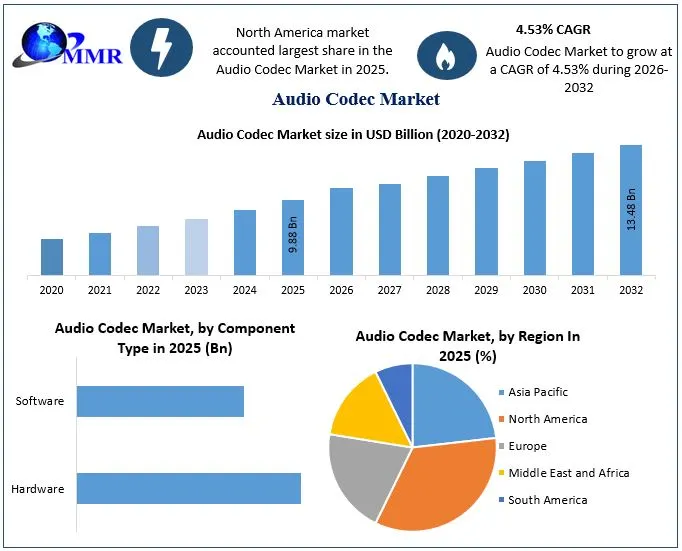
Global Market Scale and Valuation: Global Audio Codec Market valued at USD 9.88 Billion in 2025.
Forward Projection: Projected to scale steadily to USD 13.48 Billion by 2032, advancing at a 4.53% CAGR.
Format Dominance: Lossy codecs (such as MP3 and AAC) continue to lead the market share by achieving significant data compression while retaining viable acoustic quality for bandwidth-constrained streaming.
Open-Source Disruption: The rapid rise of open-source configurations (including Opus and FLAC) is exerting significant downward pricing pressure on commercial licensing models.
Voice and Spatial Optimization: Architectural demand is shifting rapidly toward advanced codecs optimized for voice recognition accuracy and multi-dimensional spatial imaging.
Key Regional Locomotive: The Asia-Pacific region is expanding at the highest growth rate globally, driven by dense consumer electronics manufacturing hubs and surging domestic streaming consumption.
Why This Matters Now
Global semiconductor manufacturers, consumer electronics OEMs, and automotive infotainment engineers can no longer treat audio coding and decoding as a basic background utility. For boardroom executives, hardware architects, and platform investors, the audio codec framework represents a vital technical frontier under intense pressure from shifting user expectations. The rapid market transition toward immersive virtual reality (VR) landscapes, smart-home voice ecosystems, and premium spatial vehicle cabins requires immediate hardware-software optimization. Component suppliers that successfully integrate low-power, high-accuracy multi-channel decoding blocks directly into application-specific silicon will capture premium design wins. Meanwhile, legacy chip developers relying on traditional stereo architectures risk fast displacement by highly agile, open-source open-architecture software engines.
Market Overview
The Global Audio Codec Market is shifting from a mature field focused purely on data compression into a dynamic engineering sector balanced between dedicated hardware processing units and highly optimized software algorithms. Reaching a baseline valuation of USD 9.88 Billion in 2025, the industry’s projected expansion to USD 13.48 Billion by 2032 highlights a global enterprise reliance on low-latency wireless transmission, ultra-high voice recognition precision, and rich spatial acoustic properties. As data networks struggle to cope with soaring multimedia volumes, device makers are adopting advanced codecs to compress sound files effectively without degrading the end-user experience.
Advanced hardware design and flexible software compilation models are altering the basic cost structures across the entire sector. Processing facilities are developing specialized integrated circuits (ICs) featuring minimal latency and high power efficiency, catering directly to professional music production, live audio distribution, and premium automotive cockpits. These technological improvements, paired with a massive consumer transition toward wireless hearables and voice-enabled smart appliances, allow device engineering teams to minimize power usage while running heavy spatial audio routines. This operational evolution ensures strict compliance with modern consumer electronics parameters and evolving multi-channel wireless testing standards.
Key Trends Driving Growth
The systematic integration of voice-assistant applications and smart-home management nodes across consumer device portfolios serves as a primary market accelerator. Engineering teams prioritize advanced codecs like Opus and AMR-WB+ because they provide highly accurate speech data delivery under noisy conditions, which directly improves automated speech recognition engines.
Rapid expansion within the immersive gaming and virtual reality sectors drives intense volume demand for multi-dimensional spatial sound processing. Software and silicon teams rely heavily on advanced spatial engines like Dolby Atmos and DTS:X to deliver precise, object-based sound coordinates, where realistic consumer immersion remains mandatory.
Escalating investment in global 5G network rollouts creates a steady pipeline of specialized high-resolution streaming orders. The combination of broader wireless bandwidth and lower transmission delays allows platform operators to deliver premium high-resolution formats like FLAC and MQA to millions of mobile devices simultaneously without causing buffer stalls.
Furthermore, changing licensing economics and rising corporate demands for cost reduction force mainstream streaming operations to evaluate alternative open-source codecs. This transition pushes hardware developers to invest in flexible, dual-mode processing architectures capable of running both established proprietary commercial layers and royalty-free open-source formats to maximize device compatibility while controlling software licensing liabilities.
Segment Insights
Dominant Technology Segment: Lossy Codecs. Retaining absolute volume leadership across the global landscape due to their superior capability to compress data heavily while preserving acceptable sound quality. This characteristic makes them the standard choice for major music streaming platforms, mobile networks, and mass-market digital storage arrays.
Dominant Component Division: Hardware vs. Software. The market remains split into dedicated silicon hardware (which delivers ultra-low latency for professional engineering and live broadcasting) and agile software codecs (which provide flexible, lower-cost updates across smart device applications).
High-Growth Applications: Voice Recognition and Immersive Media. Expanding rapidly as smart speakers, vehicle infotainment units, and standalone VR gear demand specialized encoding profiles optimized for high clarity and multi-channel spatialization.
Regional Growth Story
The Asia-Pacific region is positioned to grow at the highest rate in the global marketplace, anchored by massive consumer electronics manufacturing corridors across China, India, and South Korea. The heavy concentration of international device assembly lines, combined with booming domestic demand for mobile music streaming and interactive online video platforms, makes this region the primary driver for high-volume audio component consumption. China, in particular, remains a core locomotive due to its immense manufacturing scale and early adoption of advanced acoustic components.
North America holds a substantial share of total market value, supported by deep corporate investments in smart home ecosystems, voice assistant development, and premium automotive sound engineering. The United States market benefits from strong consumer adoption patterns for smart speakers and immersive entertainment platforms, forcing technology providers to continuously upgrade their hardware and software architectures.
In Europe, industry development is heavily shaped by professional audio production clusters, broadcast infrastructure modernization, and strict automotive safety and noise-management engineering. European design teams focus on optimizing high-purity, lossless transmission systems to satisfy regional premium market preferences. Meanwhile, rising investments in advanced communication networks throughout the Middle East and Africa are starting to accelerate the regional adoption of modern low-latency wireless codecs.
Competitive Landscape
The global competitive profile features a highly consolidated mix of specialized intellectual property (IP) licensing giants, massive semiconductor chip fabricators, and advanced industrial electronics suppliers. Top-tier industry organizations rely on vast patent portfolios, close integration with global operating system platforms, and established chip-distribution networks to lock in multi-year design wins with consumer technology brands and automotive OEMs.
To protect their operating margins from fluctuating silicon production costs and shifting developer preferences, leading market participants focus on building flexible, multi-standard hardware blocks. Prominent global enterprises—including Dolby Laboratories Inc., Qualcomm Technologies Inc., Fraunhofer IIS, Texas Instruments Inc., Cirrus Logic Inc., Analog Devices Inc., Realtek Semiconductor Corp., and STMicroelectronics—maintain dominant positions across international supply routes. These major players deploy integrated system-on-chip (SoC) architectures to deliver high-fidelity audio processing capabilities directly to hardware manufacturers worldwide.
Smaller independent software developers and specialized component suppliers capture target market share by providing highly specialized low-latency algorithms, custom multi-channel interfaces, and rapid technical support. By catering to niche professional audio recording systems, custom medical hearing hardware, and localized industrial acoustic monitoring setups, these agile firms remain crucial drivers of engineering innovation.
Recent Developments
Massive Silicon Stack Optimization (2025–2026): Leading international chip manufacturers complete major fabrication upgrades, maximizing the integration of multi-channel decoding blocks directly into mobile application processors to streamline device manufacturing.
Open-Source Audio Codec Deployments Scaled (Late 2025): Top-tier streaming services expand their use of non-proprietary formats like FLAC and Opus, successfully reducing their corporate software licensing costs while supporting high-resolution playback profiles.
Advanced Immersive Automotive Audio Systems Launched (Early 2026): Premium vehicle component providers roll out advanced multi-channel spatial decoders engineered specifically to manage highly responsive, object-based sound fields inside next-generation vehicle cabins.
Strategic IP Infrastructure Mergers Finalized (2026): Major global audio technology holding groups complete tactical asset buyouts of independent low-latency software firms, consolidating essential spatial acoustic patents ahead of regional hardware cycles.
Strategic Implications
For high-volume consumer device brands, premium automotive system designers, and professional broadcasting groups, maintaining a highly flexible and modern audio codec integration strategy represents a critical commercial priority. Engineering organizations must adopt multi-format hardware decoders and open-architecture software layers to ensure broad device compatibility and protect product lines from sudden shifts in commercial patent pool pricing.
National industrial technology authorities must view domestic semiconductor design capabilities and advanced digital signal processing (DSP) networks as vital foundations for economic competitiveness. Governments that establish clear validation frameworks for smart communication devices and provide structural support for low-power chip development will successfully attract premium technology investments while reinforcing regional supply-chain durability.
Future Outlook
The next competitive era will belong to audio codec developers who successfully combine ultra-low power consumption with native, hardware-accelerated spatialization and advanced voice-clarity filtering. Corporate structures that direct their long-term R&D spending toward open-source format optimization, highly responsive low-latency wireless architectures, and automated multi-channel acoustic adaptation will dominate long-term contract wins across smart device and automotive ecosystems. Conversely, unhedged component suppliers that remain tethered to rigid, legacy stereo processing structures will face declining design wins and diminishing access to tomorrow’s premium consumer hardware platforms.
Analyst Perspective
“The global audio codec market is moving rapidly out of its traditional compression phase into an era focused on immersive spatialization and extreme processing efficiency,” says an Analyst at Maximize Market Research. “While established lossy configurations continue to anchor the volume baseline for mass-market mobile devices, future high-value differentiation is concentrating within open-source, highly responsive formats tailored for smart voice systems and interactive virtual environments. With the global market pathing toward USD 13.48 Billion by 2032, sustainable industry leadership belongs to companies that can deliver ultra-low latency multi-channel decoding blocks without increasing thermal or battery drain. Shifting from simple audio file playback to smart, multi-dimensional acoustic management is now essential for protecting engineering margins in a highly competitive hardware landscape.”
About Maximize Market Research
Maximize Market Research Pvt. Ltd. (MMR) is a global market research and consulting company that provides reliable, data-focused, and practical business insights. The firm serves a wide range of industries, including healthcare, pharmaceuticals, technology, automotive, electronics, chemicals, personal care, and consumer goods. Through market forecasts, competitive analysis, strategic consulting, and industry impact assessments, MMR helps organizations understand changing market conditions, identify growth opportunities, and make informed business decisions for long-term success.
2nd Floor, Navale IT Park Phase 3
Pune Bangalore Highway, Narhe
Pune, Maharashtra 411041, India
+91 9607365656
