Key Highlights
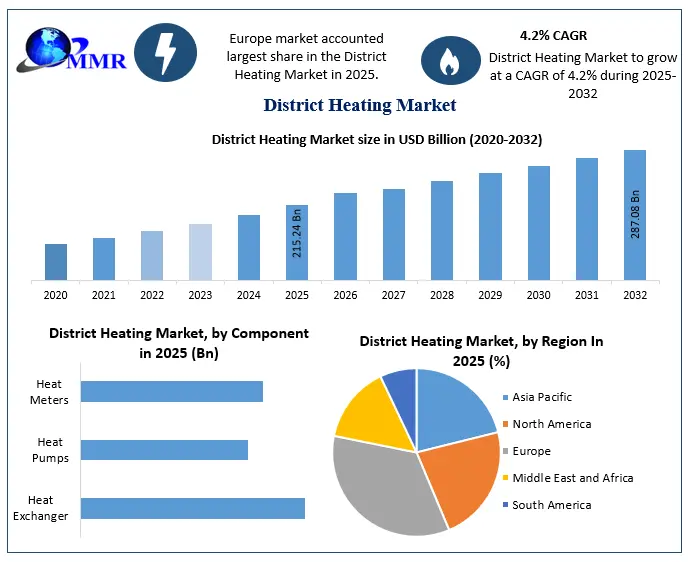
Global Market Scale and Valuation: The Global District Heating Market was valued at USD 196.70 Billion in 2025.
Forward Projection: Anticipated to scale to approximately USD 308.30 Billion by 2034, expanding at a steady compound annual growth rate (CAGR) of 5.1% across the forecast period.
Technology/Plant Leader: The Combined Heat and Power (CHP) segment holds absolute sector dominance, maximizing resource utilization by co-generating electricity and captured thermal energy from a single fuel source.
Primary Operational Application: The Residential segment commands the largest market share by application, propelled by connection-ready modern multi-family housing developments and dense urban heating demands.
Primary Regional Locomotive: Europe maintains the leading global market position, driven by well-established thermal grids, rigid cross-border decarbonization targets, and aggressive state subsidies for phasing out fossil-fuel building boilers.
Why This Matters
Now The structural and financial viability of urban master-planned developments depends heavily on decoupling municipal energy distribution from volatile fossil-fuel markets. As severe seasonal temperature fluctuations test localized networks and governments enforce strict environmental penalties, standard individual building furnaces no longer provide a practical path to compliance. Municipal planners, real estate developers, and infrastructure investors are realizing that localized, building-by-building heating systems generate high maintenance overheads and elevated carbon profiles. Upgrading to centralized, smart district heating infrastructure has shifted from an eco-conscious alternative to a core operational strategy for capital preservation and urban resource optimization.
Market Overview
The district heating market serves as a vital anchor for global industrial sustainability and smart city integration. This utility-scale infrastructure involves distributing hot water or steam through highly insulated underground pipeline networks, shielding residential and commercial real estate assets from localized equipment failures and high peak energy costs. Valued at USD 196.70 Billion in 2025, the market’s projected scale toward USD 308.30 Billion by 2034 highlights an intensive worldwide modernization phase focused on rolling out high-efficiency localized grids and maximizing district energy density.
What changed is the operational baseline for thermal network performance. In legacy infrastructure cycles, simple high-temperature steam distribution via coal-fired boilers was the global default. Today, the rapid deployment of fourth-generation networks requires lower distribution temperatures, corrosion-resistant insulated pipes, and integrated digital twin architectures. This evolution aligns closely with broader grid modernization goals, as utility regulators mandate predictable, ultra-efficient energy delivery that accommodates a highly diverse mix of input fuels.
Key Trends Driving Growth
The primary catalyst driving the market is the rapid deployment of smart digital management architectures, utilizing IoT sensors, machine learning algorithms, and AI demand forecasting. These advanced configurations allow utility companies to analyze flow dynamics, optimize water pump cycles, and predict thermal requirements up to several days in advance, directly reducing network heat losses and stabilizing operating costs.
Another dominant trend is the intensive integration of alternative energy inputs and waste heat recovery systems. Modern district networks are pivoting away from coal and heavy oil toward biomass, deep geothermal fields, and solar thermal arrays. Concurrently, utilities are forming strategic linkages with localized data centers, manufacturing plants, and wastewater treatment facilities to harvest low-grade industrial exhaust heat, feeding it back into the municipal loop via large-scale electric heat pumps.
Furthermore, strict regional decarbonization laws and municipal green building standards are pushing massive institutional capital into urban thermal infrastructure. Real estate developers are increasingly building connection-ready residential complexes and commercial campuses that sync directly with local district pipelines right from the design phase. This integration avoids the space constraints and safety liabilities of installing independent, high-pressure combustion hardware inside modern architectural footprints.
Segment Insights
Combined Heat and Power (CHP) [Dominant Plant Type]: This configuration commands the dominant share of total market revenue. Its ability to simultaneously output electrical energy and capture secondary thermal exhaust for public distribution yields absolute thermodynamic efficiencies often exceeding 80%, making it the top design choice for municipal energy agencies.
Residential Application [Dominant Application]: This vertical leads global market share by application. The massive growth of high-density multi-family apartment housing, urban residential retrofits, and state-backed public housing heating upgrades establishes a vast, predictable base of thermal consumers requiring long-term district loop connections.
Regional Growth Story
Europe continues to anchor the global district heating market, commanding a massive share of active operational revenue. Nations across Scandinavia, Central Europe, and Eastern European corridors benefit from expansive, pre-existing pipeline systems that are currently receiving billions in capital grants to execute zero-carbon upgrades, low-temperature transition projects, and extensive heat-pump integrations.
Meanwhile, Asia Pacific stands out as the fastest-growing geographical region. Rapid urbanization and massive commercial building booms in Northern China and South Korea are driving extensive underground pipeline construction. Municipalities in these cold-climate, densely populated areas are aggressively implementing centralized heating loops to replace decentralized coal furnaces, optimizing air quality and establishing highly efficient neighborhood energy hubs.
Competitive Landscape The competitive matrix of the district heating industry highlights a strong trend toward vertical consolidation and technology-focused partnerships. Major multi-national energy utilities and specialized industrial component manufacturers are expanding their regional capabilities to align with massive municipal tender pipelines. This corporate activity indicates that component vendors offering generic, non-communicative insulation pipes or simple mechanical valves will face severe price compression as institutional buyers transition exclusively to tier-one systems capable of smart tracking and long-term performance guarantees.
Furthermore, intellectual property regarding advanced network thermodynamics is becoming the primary competitive edge. Engineering firms and hardware developers controlling the upstream supply of integrated heat interface units (HIUs), smart automated substations, and AI-enabled digital twin software are securing dominant market positioning. This shift forces a structural change where long-term collaborative agreements between metallurgical specialists, software developers, and municipal civil works contractors are required to successfully secure and execute large-scale network installation pipelines.
Recent Developments
AI-Driven Demand Forecasting Deployed (2025-2026): European and North American district energy operators roll out advanced AI-powered network optimization systems, achieving up to 90% accuracy in predicting seasonal heat loads and optimizing supply pipe temperatures.
Major Capital Investment in Utility Grids Executed (Mid-2025): Institutional energy funds and European development banks approve multi-million dollar financing lines directed at scaling low-carbon electricity and district heating infrastructure across major municipal sectors.
Industrial Waste Heat Harvesting Partnerships Expand (2025): Tier-one utilities ink major joint ventures with high-capacity data centers and industrial chemical parks to capture exothermic exhaust heat, channeling it directly into urban residential heating networks.
Advanced Carbon-Neutral Target Shares Achieved (Late 2024): Leading municipal heat producers report a substantial surge in their carbon-neutral generation portfolios, driven by the successful integration of large-scale industrial heat pump systems into regional networks.
Strategic Implications
For energy executives and municipal planners, the strategic choices made regarding network design are directly tied to long-term lifecycle costs and capital risk protection. Relying on outdated, high-temperature steam loops or unmonitored insulation systems drastically increases the risk of premature pipe corrosion, extensive water leaks, and high thermal transmission losses. This operational inefficiency degrades cash flow generation, directly impacting infrastructure investors who require predictable financial returns over multi-decade utility cycles.
For structural manufacturers and material suppliers, compliance with green standards dictates access to major infrastructure projects. As regional governments implement strict procurement checklists regarding energy loss thresholds, manufacturers utilizing uncertified materials or basic mechanical configurations will find themselves locked out of high-value smart-city public tenders. Investing heavily in pre-insulated pipe technologies, IoT-compatible smart heat meters, and advanced heat exchange modules is therefore essential to maintain global market relevance and protect brand equity.
Future Outlook
The evolution of the district heating market will be defined by its ability to merge with multi-energy smart grids and flexible renewable energy assets. As modern cities transition toward fully integrated utility ecosystems, district heating pipelines will transform from simple water delivery tubes into flexible, multi-directional thermal storage systems. Future market dominance will belong to advanced grid architectures that combine solar thermal fields, deep geothermal reservoirs, and recovered industrial heat with large-scale thermal storage tanks, balancing heat generation with real-time consumer demand. Ultimately, the industry will divide along clear lines of operational intelligence: forward-thinking developers utilizing fourth-generation low-temperature designs and integrated digital twin analytics will secure leading market shares, while operators stuck with inflexible, high-loss fossil-fuel systems will face obsolescence in a decarbonized energy economy.
Analyst Perspective
“The district heating market has evolved past the phase of basic commodity thermal delivery; it is now a foundational pillar of modern smart city decarbonization and structural resource optimization,” states an Analyst at Maximize Market Research. “As municipal energy authorities and private infrastructure developers aggressively transition to multi-source renewable configurations and deploy low-temperature pipeline loops, intelligent, centralized thermal grids represent the primary defense line securing energy efficiency and protecting capital investments across dense urban landscapes.”
About Maximize Market Research
Maximize Market Research is a high-growth market research and business consulting firm serving global clients with deeply quantified institutional insights across high-technology supply chains, energy systems, and advanced materials. For an exhaustive breakdown of localized data, structural segment forecasts, and granular competitive intelligence, the complete official study can be accessed via the verified source report: Global District Heating Market.
2nd Floor, Navale IT Park Phase 3
Pune Bangalore Highway, Narhe
Pune, Maharashtra 411041, India
+91 9607365656
