Key Highlights
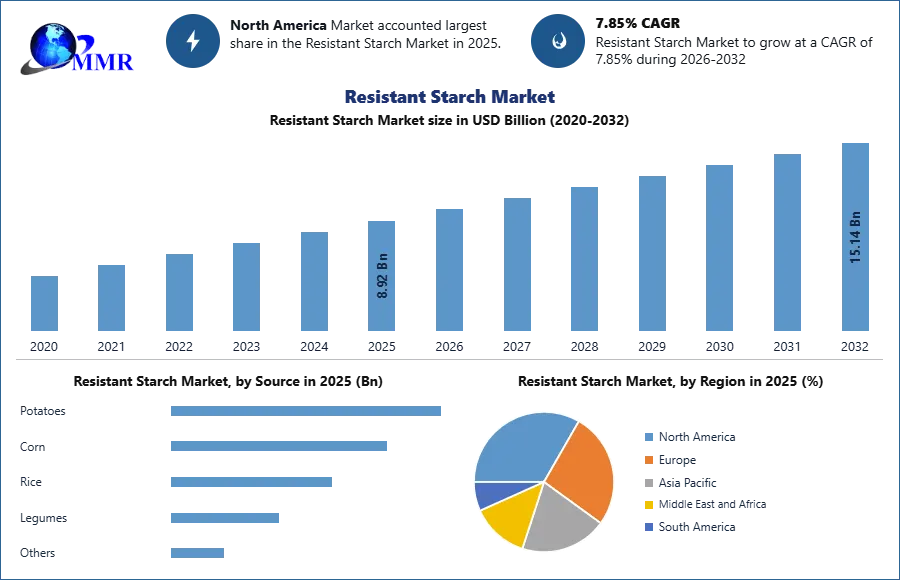
Capital Scale: Expanded from a baseline valuation of USD 8.92 billion in 2025 to a projected USD 15.38 billion by 2032.
Compounded Growth: Maintaining a steady 7.85% CAGR across the 2026 to 2032 forecast window.
Geographic Core: North America holds the dominant market share, backed by extensive processing networks and functional ingredient demand.
Raw Material Anchor: Potato-based starch processing led the market in 2025 due to baseline material availability and cost-efficiency.
Primary Application Vector: Food and beverage formulations generated the maximum revenue during the baseline evaluation period.
Operational Constraint: Elevated processing costs for natural resistant starch variants present a primary hurdle to immediate commercial expansion.
Why This Matters Now
High production costs for natural resistant starch varieties are forcing chemical and food ingredients processors to completely re-engineer their factory floors. Legacy batch-processing methods generate severe yield deviations, making it difficult to achieve consistent bacterial fermentation and uniform fatty acid conversion. To survive a highly competitive ingredient market filled with lower-priced alternatives like inulin, pectin, and psyllium husk, manufacturers are turning to immediate factory modernization.
Deploying smart manufacturing initiatives has shifted from an optional technology upgrade to a survival requirement for global ingredient suppliers. Production lines must achieve perfect molecular structural integrity during enzymatic or thermal modification cycles. Plant operators who install advanced process optimization technologies can significantly reduce raw material waste and lower energy consumption. This structural shift allows forward-thinking enterprises to insulate their profit margins from volatile raw material costs and fluctuating utility rates.
Market Overview
The global resistant starch market Size is scaling rapidly as consumer demand shifts toward functional foods, weight management additives, and blood sugar regulation supplements. Data compiled by Maximize Market Research reveals the market was valued at USD 8.92 billion in 2025. Propelled by a 7.85% CAGR, total revenue is projected to reach USD 15.38 billion by 2032 (with internal report projections tracking up to USD 15.14 billion). This multi-billion-dollar valuation accelerates demand for sophisticated industrial automation and process control architectures.
Refining raw materials into stable, non-digestible dietary fibers requires absolute control over moisture profiles, enzymatic reaction durations, and cooling rates. Minor fluctuations within thermal treatment vessels disrupt retrogradation processes, rendering whole production batches unmarketable. To mitigate these risks, processing operations are accelerating industrial IoT adoption to link physical production hardware directly with higher-level enterprise planning platforms.
Key Trends Driving Growth
The primary catalyst reshaping the resistant starch market is the surging expansion of plant-based and gluten-free products. Consumers are actively seeking out functional alternatives that enhance gut microbiota while regulating blood cholesterol. To capitalize on these trends safely, global ingredient processors must scale up their production capacities without compromising delicate chemical structures.
This rapid volume scaling is driving the implementation of next-generation distributed control systems (DCS) and programmable logic controllers (PLC) across chemical treatment lines. Modern refineries use automated continuous-flow reactors to replace slow, variable batch-processing techniques. Automated systems enable granular control over chemical dosing, slurry viscosity, and dryer heat profiles, maximizing the yield of high-purity resistant starch from every metric ton of raw input.
Segment Insights
Dominant Raw Material Segment: Potato-based starch inputs dominated the market in 2025, serving as the primary revenue generator due to the widespread availability and localized cost-effectiveness of raw potato crops.
Alternative Material Inputs: Corn, rice, and legume sub-segments represent key alternative raw material lines, each requiring customized process optimization technologies to manage distinct gelatinization temperatures.
Dominant Application Segment: The food and beverages sub-segment generated the maximum market revenue in 2025, driven by the broad adoption of functional fibers in commercial snacks, bakery items, and health foods.
High-Value Application Segment: The pharmaceuticals and dietary supplements segment is experiencing targeted development, pushing manufacturers to adopt high-precision cleanroom automation and strict batch validation controls.
Regional Growth Story
North America dominated the resistant starch market in 2025 and is projected to maintain its leading position throughout the 2026 to 2032 forecast period. This regional strength is sustained by massive consumer demand for dietary fibers and functional foods throughout the United States. To maintain high output volumes, North American processing facilities are investing heavily in advanced manufacturing technologies, supervisory control and data acquisition (SCADA) upgrades, and end-to-end factory digitization.
Concurrently, Europe and the Asia Pacific region are expanding their domestic manufacturing footprints. European manufacturers focus on strict compliance with multi-national food safety mandates, driving investments in industrial cybersecurity initiatives and precise electronic batch tracking. In the Asia Pacific region, industrial operators are integrating robotics and automated material handling equipment to increase factory throughput and offset rising labor costs.
Competitive Landscape
The global resistant starch market is highly competitive and concentrated among established agricultural processing giants. Industry leaders including Ingredion Incorporated, Tate & Lyle PLC, Cargill, Incorporated, Archer Daniels Midland Company, Roquette Frères, Emsland Group, Palsgaard A/S, and Japan Corn Starch Co., Ltd. dominate international supply networks. These tier-one corporations are continually expanding their product portfolios and investing in extensive plant modernization initiatives to consolidate market share.
The strategic maneuvers of these market leaders signal a broader shift toward software-defined manufacturing leadership. Dominance is no longer achieved simply through purchasing massive quantities of raw agricultural commodities. Instead, market leadership is determined by how effectively a company utilizes edge computing, digital twin deployment, and predictive maintenance advancements to maximize factory uptime. By linking real-time field data with advanced control loops, these companies optimize energy use and protect their processing systems from unexpected mechanical failures.
Recent Developments
Global starch processors are executing targeted capital investments to update aging SCADA architectures and integrate cloud-based operational dashboards.
Manufacturers are commercializing advanced enzymatic modification techniques that utilize precision automated dosing systems to cut total processing times.
Leading ingredient suppliers are expanding their regional production facilities through tactical partnerships to secure raw potato and corn supplies.
Refineries are embedding specialized inline machine vision systems and automated quality-testing instruments to verify fiber grading instantly during continuous production.
Strategic Implications
For plant managers and automation engineers, the rapid growth of the resistant starch market requires immediate changes to operational technology (OT) networks. Relying on disconnected control loops limits visibility into product quality and exposes operations to severe energy waste. Implementing unified process control systems allows plants to dynamically alter processing speeds based on real-time moisture changes in the raw inputs.
Furthermore, protecting these interconnected processing environments requires robust industrial cybersecurity initiatives. As factories transition away from legacy isolated systems toward open industrial IoT architectures, they face a higher risk of external network disruptions. Plant leadership must deploy defensive security strategies, including strict network segmentation and continuous endpoint monitoring, to safeguard critical PLC and DCS configurations.
Future Outlook
The next phase of evolution within the resistant starch market will center on the widespread implementation of autonomous industrial operations. As the market expands toward its USD 15.38 billion target, traditional manufacturing setups will struggle to remain profitable against fluctuating margins and strict quality mandates. Processors who install self-optimizing control loops, real-time analytics, and predictive asset tracking will achieve unmatched production flexibility and lower overhead costs. The industry is reaching an automation inflection point: forward-thinking enterprises that deploy scalable smart manufacturing systems will dominate global functional fiber supply chains, while legacy operators relying on manual processing will be squeezed out by high production costs and volatile margins.
Analyst Perspective
“The global resistant starch market has arrived at a major technology turning point,” states Sidhhi Dole, Research Analyst at Maximize Market Research. “Faced with high production costs and stiff competition from alternative dietary fibers, manufacturers can no longer rely on inefficient legacy processing methods. Embracing advanced process automation, automated control loops, and unified data architectures is the only sustainable way for producers to lower costs, ensure product consistency, and scale operations efficiently.”
About Maximize Market Research
Maximize Market Research Pvt. Ltd. (MMR) is a global market research and consulting company that provides reliable, data-focused, and practical business insights. The firm serves a wide range of industries, including healthcare, pharmaceuticals, technology, automotive, electronics, chemicals, personal care, and consumer goods. Through market forecasts, competitive analysis, strategic consulting, and industry impact assessments, MMR helps organizations understand changing market conditions, identify growth opportunities, and make informed business decisions for long-term success.
2nd Floor, Navale IT Park Phase 3
Pune Banglore Highway, Narhe
Pune, Maharashtra 411041, India
+91 9607365656
sales@maximizemarketresearch.com
