Key Highlights
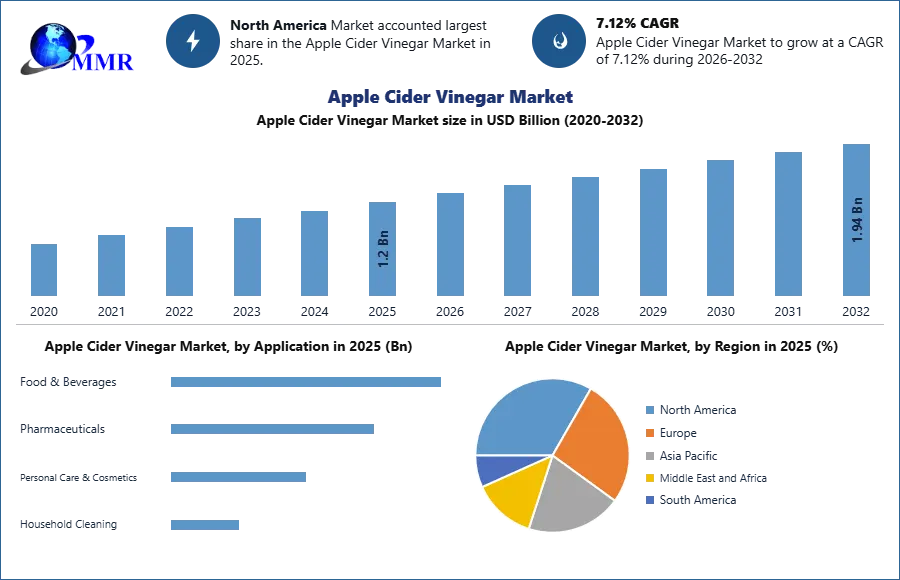
Market valuation expanding from USD 1.2 billion in 2025 to USD 1.94 billion by 2032 at a 7.12% CAGR.
Liquid formulations dominate the production landscape, accounting for approximately 66% of total market share.
Food and beverage applications dictate industrial demand, commanding a 54% share of the manufacturing volume in 2025.
PepsiCo’s USD 2 billion acquisition of Poppi marks a major consolidation wave driving high-volume automated line investments.
North America retains market leadership, supported by intensive manufacturing capacity expansions and automation adoption.
Europe emerges as the secondary production hub, relying on advanced enzymatic extraction and process control technologies to maximize juice yields.
Why This Matters Now The rapid scale-up of the global apple cider vinegar market from USD 1.2 billion to USD 1.94 billion creates severe technical pressure on legacy production lines. Processors can no longer rely on manual, single-stage fermentation monitoring without risking catastrophic batch variances and costly yield losses. As corporate consolidation accelerates, plant managers face an immediate mandate to integrate smart manufacturing systems, precision instrumentation, and advanced process control architecture to handle the precise multi-stage biochemical conversion of raw apples into standardized acetic acid.
Market Overview Apple Cider Vinegar Market Industrial manufacturing of apple cider vinegar involves a dual-stage biological fermentation process where crushed apple sugars transition into alcohol before secondary bacterial oxidation yields acetic acid. Managing this delicate biochemical progression at an industrial scale requires rigid environmental control over dissolved oxygen, temperature gradients, and raw input profiles.
Rising global demand for natural wellness additives, organic preservatives, and functional food ingredients has accelerated commercial factory throughput. With a projected 7.12% CAGR leading to a USD 1.94 billion valuation by 2032, global producers are migrating away from fragmented craft operations toward automated, continuous, or highly synchronized batch production facilities to ensure consistency and compliance with global food safety standards.
Key Trends Driving Growth A fundamental transformation is occurring within consumer packaged goods as health-conscious demographics demand high-purity functional foods. According to a 2025 industry survey, more than 50% of respondents actively seek out superfoods, a trend that directly translates into massive volume requirements for raw apple cider vinegar.
This consumer shift has forced food and beverage conglomerates to invest heavily in functional drink formulations, wellness shots, and clean-label seasonings. To keep pace with these high-volume supply contracts, processors are modernizing their factory floors with industrial automation solutions. Modern operations require real-time inline sensory tracking to manage critical parameters like total acidity, minimizing human intervention and boosting manufacturing asset utilization.
Segment Insights
Liquid Apple Cider Vinegar (Dominant Segment): Holding a dominant 66% share of the market, liquid production requires specialized, high-capacity fluid handling, precise automated dosing, and high-speed bottling lines equipped with machine vision inspection.
Food & Beverage (Dominant Application): Capturing 54% of market application in 2025, this segment dictates upstream automation demands, as large-scale blending, mixing, and pasteurization systems must run continuously to supply institutional buyers.
Capsules, Tablets, and Powders (Fastest-Growing Segment): Driven by premium health supplement trends, the diversification into solid dose configurations creates emerging opportunities for specialized spray-drying automation and cleanroom material-handling systems.
Regional Growth Story North America maintains its position as the global market leader, supported by an established agricultural supply chain and major capital expenditure allocations into advanced manufacturing plants. U.S. manufacturers are actively deploying automated process control networks to introduce sophisticated functional variations, helping them stay ahead of rising domestic consumption.
Europe secures the second-largest market share, positioning itself as a hub for advanced process optimization. European producers utilize specialized pectolytic enzymes to maximize apple juice yields before fermentation begins. This strategy relies on highly integrated dosing controls and analytical instrumentation to monitor enzyme activity in real time. Meanwhile, the Asia-Pacific region is experiencing rapid growth, driven by an influx of key market players establishing highly automated manufacturing sites in China, South Korea, Japan, and India to satisfy regional demand.
Competitive Landscape The competitive environment indicates a clear shift toward deep corporate consolidation and ecosystem positioning. When Bragg Live Foods introduced its first-of-its-kind Metabolism Support Supplement in January 2026, the company purposefully bridged traditional vinegar production with modern metabolic science. This product launch signals that forward-thinking market leaders are moving beyond simple bulk liquid processing toward highly specialized, premium product lines that require complex, agile manufacturing configurations.
Furthermore, Bragg’s late 2025 expansion of its organic footprint via Costco distribution underlines the critical importance of secure supply chain execution and highly reliable packaging throughput. For system integrators and automation providers, this indicates that major brands need flexible packaging lines capable of rapid changeovers between organic clean-label seasonings and traditional bulk liquids without risking cross-contamination.
The most disruptive signal occurred in mid-2025 when PepsiCo acquired the prebiotic soda brand Poppi for USD 2 billion. This massive transaction validates functional gut-health beverages as a core pillar of future product portfolios, steering capital away from high-sugar legacy soft drinks. PepsiCo’s entry into the space means production lines must immediately transition to high-speed, multi-million-unit automated bottling architectures, setting a high standard for operational efficiency across the entire industry.
Recent Developments
January 02, 2026: Bragg Live Foods launched a metabolism support supplement targeting the metabolic health sector, introducing new cleanroom processing and precise solid-dose formulation requirements to their operations.
November 13, 2025: Bragg Live Foods expanded regional distribution of its organic seasoning portfolio, requiring plants to optimize batch tracking and clean-label material processing.
June 25, 2025: PepsiCo finalized its multi-billion-dollar acquisition of Poppi, an event that instantly scaled up production demands and accelerated the adoption of automated line architectures across the functional beverage sector.
Strategic Implications For plant operators, these market shifts change how production lines must be designed. Legacy batch-processing methods are ill-equipped to handle the strict quality metrics demanded by global brands like PepsiCo. Processors must invest in advanced process control technology, such as automated distributed control systems (DCS), to orchestrate fermentation, filtration, and bottling within a single, unified digital framework.
Investing in automation also directly protects margins against fluctuating raw material quality and changing apple crop yields. By deploying continuous inline monitoring tools, plants can dynamically adjust fermentation times and enzyme volumes based on live chemical readouts. This analytical approach minimizes raw material waste, stabilizes factory throughput, and ensures that every batch meets exact acidity specifications.
Future Outlook Looking forward, the global apple cider vinegar market will split along lines of technological capability. The transition from basic bulk blending to advanced functional beverage production requires strict compliance with international food safety standards and precise traceability protocols. Tomorrow’s leading facilities will be defined by fully integrated smart factories that use digital twin concepts and automated quality assurance to adapt instantly to changing market demands.
Analyst Perspective “The global scale-up of the apple cider vinegar market is driving a fundamental shift from traditional processing methods to highly automated industrial manufacturing,” states Siddhi Dole, Research Analyst at Maximize Market Research. “As multi-billion-dollar beverage enterprises acquire functional brands, the factories that win will be those utilizing advanced process control technologies to guarantee strict batch consistency at high volumes.”
About Maximize Market Research
Maximize Market Research Pvt. Ltd. (MMR) is a global market research and consulting company that provides reliable, data-focused, and practical business insights. The firm serves a wide range of industries, including healthcare, pharmaceuticals, technology, automotive, electronics, chemicals, personal care, and consumer goods. Through market forecasts, competitive analysis, strategic consulting, and industry impact assessments, MMR helps organizations understand changing market conditions, identify growth opportunities, and make informed business decisions for long-term success.
2nd Floor, Navale IT Park Phase 3
Pune Banglore Highway, Narhe
Pune, Maharashtra 411041, India
+91 9607365656
sales@maximizemarketresearch.com
