Key Highlights
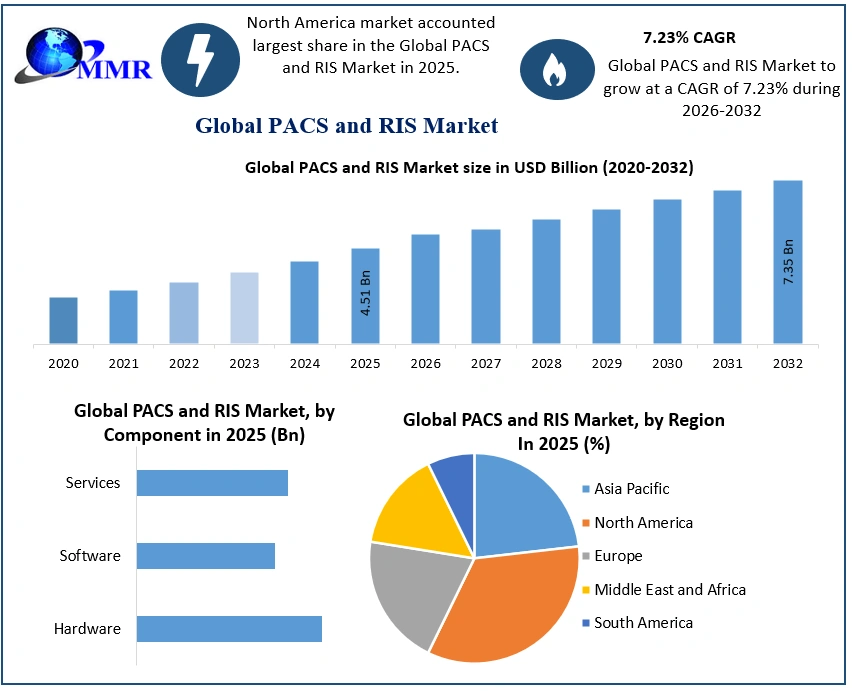
The global PACS and RIS market size reached USD 4.51 Billion in 2025 and is projected to scale to nearly USD 7.35 Billion by 2032.
Market expansion accelerates at a compound annual growth rate (CAGR) of 7.23% from 2026 to 2032.
The web-based deployment model remains the dominant market architecture for multi-modality data distribution across multiple physical locations.
Cloud-based architectures represent the fastest-growing delivery segment due to immediate demand for low-cost enterprise storage and on-demand scalability.
The hospital end-user category maintains market dominance while simultaneously expanding at the fastest localized growth rate of around 8.5% during the forecast period.
North America secured the leading regional market position in 2025, supported by widespread capital investments in complex data management infrastructure.
Why This Matters Now
The legacy architecture of medical image distribution is undergoing structural obsolescence as clinical throughput volumes outpace manual human coordination. Organizations operating without automated data orchestration layers face escalating operational friction, severe information silos, and compounding data transit delays across multi-facility networks. To protect operational margins and maintain service velocities amid severe workforce constraints, healthcare enterprises are compelled to treat medical imaging data streams as high-throughput, automated industrial pipelines.
This technical transition redefines how large-scale diagnostic networks deploy software infrastructures. System integrators, automation engineers, and technology buyers are pivoting from localized software maintenance toward enterprise-wide, cloud-connected process automation platforms. Systems that eliminate physical and temporal boundaries by automating the retrieval, distribution, and display of complex multi-modality imagery are capture-ready assets. Conversely, operations tied to unlinked localized networks risk complete strategic isolation as data volumes expand beyond human sorting capacities.
Market Overview
The global PACS and RIS market Size is transitioning through a definitive digitization phase, moving from its 2025 foundation of USD 4.51 Billion to a targeted valuation of nearly USD 7.35 Billion by 2032. This trajectory is sustained by a 7.23% CAGR from 2026 to 2032, highlighting an intense integration of information management platforms into core medical operations. The structural mechanics of the market show that data distribution is no longer a localized task but a centralized enterprise resource planning initiative.
What changed? The old reliance on isolated diagnostic workflows and manual tracking systems has been superseded by integrated, web-enabled architectures that manage multi-modality support seamlessly across decentralized facilities. Why now? The accelerating incidence of chronic diseases requires a massive increase in diagnostics volumes, which cannot be efficiently cataloged using legacy frameworks. The primary beneficiaries of this transformation are large hospital systems and specialized diagnostics providers that implement automated, low-cost digital storage layers to eliminate operational bottlenecks.
Key Trends Driving Growth
The most prominent macro trend steering this industry is the transition of medical networks toward automated, cloud-based data ecosystems. Industrial internet of things (IIoT) logic is actively applied to medical devices, linking diagnostic modalities like MRI, X-ray, ultrasonography, and digital pathology directly to unified archiving layers. This continuous pipeline configuration minimizes manual intervention, ensures data integrity, and enables rapid data access for high-volume operational environments.
Process optimization technologies are also altering how facilities manage structural assets and daily scheduling. By implementing automated radiology information systems (RIS), facility operators track patient workflows, asset utilization, and resource distribution via centralized supervisory architectures. This programmatic control reduces equipment idle times, shortens wait cycles, and optimizes machine throughput, mimicking the continuous flow improvements seen in modern automated factories.
Concurrently, industrial cybersecurity initiatives have become foundational to enterprise risk management. The rapid shift toward web-based and cloud-hosted data pipelines exposes proprietary networks to complex digital threats. To insulate sensitive operational infrastructure from external disruptions, medical technology providers are building deep cybersecurity frameworks directly into PACS architectures, ensuring compliance with strict global standards while maintaining uninterrupted data streams.
Segment Insights
Deployment Configuration: The web-based PACS and RIS segment acts as the Dominant Segment, providing essential multi-modality support and driving efficient workflow management across geographically separate healthcare locations.
Delivery Innovation: The cloud-based infrastructure model is the Fastest-Growing Segment by deployment type, driven by immediate organizational demands for wide network connectivity, swift data access, and elastic on-demand service capacity.
End-User Application: The hospital segment operates as both the Dominant Segment and the Fastest-Growing Segment by end-user, accounting for the absolute largest market share in 2025 and projecting an aggressive growth rate of around 8.5% over the forecast period.
Modality Variation: High-value specialized clinical segments, including cardiology, orthopedic, and oncology architectures, are generating sustained procurement activity due to their complex data handling requirements.
Regional Growth Story
North America commanded the premier global position in the PACS and RIS market in 2025, establishing an operational benchmark through its expansive technical developments. The region benefits from high disease incidence rates that demand continuous, high-volume diagnostic interventions, forcing immediate enterprise data management modernizations. Capital deployments across the United States focus tightly on migrating on-premises systems toward advanced, cloud-enabled orchestration frameworks to reduce total cost of ownership.
Europe follows as an advanced market characterized by structured infrastructure modernizations and strict data governance policies. Facilities in core industrial nations like Germany are prioritizing network interoperability, integrating PACS and RIS nodes into broader regional healthcare automation frameworks. Meanwhile, the Asia-Pacific region—anchored by escalating healthcare investments in China, Japan, South Korea, and India—is scaling up its infrastructure footprint, with new medical facilities deploying automated digital solutions directly at the point of construction to bypass legacy operational constraints.
Competitive Landscape
The competitive landscape is defined by aggressive product development and enterprise-level system integration strategies among established global technology providers. Market leaders are no longer competing strictly on standalone software features; instead, value leadership is dictated by a provider’s capacity to deliver end-to-end data automation across disjointed operational architectures. Key market players, including General Electric Healthcare, Fujifilm Holdings Corporation, Agfa Healthcare, Philips Healthcare, Siemens Healthineers, McKesson Corporation, Allscripts Healthcare Solutions, and Koninklijke Philips, are continuously adjusting their platform capabilities to secure market share.
Platform development signals a distinct shift toward unified ecosystem positioning rather than isolated tool deployment. When dominant players roll out multi-modality workflow upgrades, they are signaling to the market that standalone, non-integrated systems are no longer viable for modern high-volume environments. These investments demonstrate that long-term market dominance belongs to providers who can successfully merge medical data storage with real-time operational analytics, allowing enterprise buyers to optimize facility-wide resource allocation from a single digital dashboard.
Recent Developments
Market participants are escalating investments in cloud-connected, multi-modality support tools to streamline complex workflows across dispersed regional healthcare networks.
Enterprise developers have introduced enhanced integration modules that link traditional RIS scheduling functions directly with high-capacity cloud archiving layers, reducing data processing delays.
Implementation of advanced encryption protocols and zero-trust framework features within core PACS networks has accelerated in response to elevated industrial cybersecurity requirements globally.
Strategic Implications
The primary business consequence of this digital migration is the rapid erosion of cost competitiveness for organizations that delay automation investments. Facilities that rely on fragmented, film-based, or siloed electronic record retrieval suffer significant margin compression due to elevated physical management costs and time-consuming manual workflows. In contrast, enterprises employing fully automated data pipelines maximize asset utilization by keeping diagnostic machinery running at peak technical capacity.
What happens next is a clear divergence in operational survival based on enterprise software integration. Smaller regional operators who fail to update their workflow automation layers face structural margin erosion and eventual consolidation into larger, tech-driven medical networks. Real competitive advantage belongs exclusively to operations leaders who treat data management not as an administrative expense, but as a critical, high-efficiency production engine.
Future Outlook
The trajectory of the PACS and RIS market points to an autonomous operational paradigm where data routing, archiving, and system monitoring require zero manual oversight. Future infrastructure frameworks will heavily leverage predictive data tiering, automatically shifting aging imaging assets to low-cost cloud archives while holding critical immediate data at the network edge for instantaneous access. This approach will balance bandwidth consumption and storage costs without compromising clinical delivery speeds.
The ultimate differentiation between industry leaders and laggards will center on digital agility and network integration capabilities. The market is rapidly approaching a milestone where software flexibility determines overall facility throughput. Organizations that build open, scalable, and highly secure digital storage pipelines will lead the next generation of healthcare delivery, leaving unautomated operators to manage rising capital friction.
The division across the industry will separate highly integrated enterprises utilizing cloud-enabled, self-optimizing data pipelines from fragmented facilities locked into legacy on-premises storage and manual workflow routing.
Analyst Perspective
“The transition from localized web-based systems to highly scalable cloud architectures marks a critical evolution in the PACS and RIS ecosystem. To navigate rising diagnostic demands and strict cost constraints, modern healthcare enterprises must treat data pipelines with the same precision and automation focus found in advanced industrial smart factories.” — Komal Patil, Research Analyst, Maximize Market Research
About Maximize Market Research
Maximize Market Research Pvt. Ltd. (MMR) is a global market research and consulting company that provides reliable, data-focused, and practical business insights. The firm serves a wide range of industries, including healthcare, pharmaceuticals, technology, automotive, electronics, chemicals, personal care, and consumer goods. Through market forecasts, competitive analysis, strategic consulting, and industry impact assessments, MMR helps organizations understand changing market conditions, identify growth opportunities, and make informed business decisions for long-term success.
2nd Floor, Navale IT Park Phase 3
Pune Banglore Highway, Narhe
Pune, Maharashtra 411041, India
+91 9607365656
sales@maximizemarketresearch.com
