Key Highlights
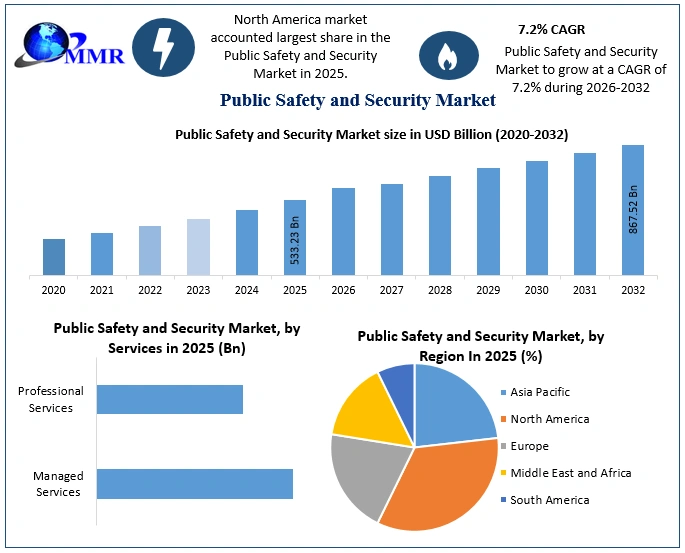
The global public safety and security market is projected to expand from USD 533.23 Billion in 2025 to USD 867.52 Billion by 2032.
The market operates at a compounding annual growth rate (CAGR) of 7.2% throughout the 2026–2032 forecast period.
The Homeland Security sub-segment holds the largest historical market share by vertical.
The Transportation Systems sub-segment is projected to register the highest growth rate among industry verticals.
Managed Services represent the fastest-growing service segment, driven by complex operational demands.
North America dominates global market share, while Asia Pacific emerges as the fastest-growing regional theater due to major infrastructural spending.
Why This Matters Now
Global industrial operations face immediate disruption as physical infrastructure and digital networks converge under Industry 4.0 paradigms. Legacy systems lack the interoperability required to defend modernized factories against sophisticated, synchronized security threats. Plant managers and operations executives must deploy advanced critical infrastructure security or risk catastrophic downtime from environmental, physical, and cyber incidents.
High installation costs act as a temporary capital barrier for manufacturing leaders navigating factory digitization. However, the threat of uncoordinated disaster management forces rapid investments in unified critical communication network solutions. Industrial technology buyers are transitioning away from unintegrated standalone security devices toward comprehensive, automated ecosystem security platforms to ensure continuous operational uptime.
Market Overview
The public safety and security market Size encompasses systems that protect citizens, organizations, institutions, and infrastructure from criminal acts, terrorist threats, natural disasters, severe accidents, and systemic social disruption. In 2025, the market achieved a valuation of USD 533.23 Billion, reflecting dense deployment across public and private operating environments. As operations leaders interconnect factory floors with public utilities, the boundary between municipal safety and industrial automation disappears.
The market will reach USD 867.52 Billion by 2032, expanding at a steady 7.2% CAGR. This capital influx stems directly from massive infrastructural developments and a surge in complex commercial construction projects worldwide. To sustain this momentum, system integrators are actively addressing the technical deficits of legacy equipment through targeted middleware and unified communication protocols.
Key Trends Driving Growth
The primary transformation accelerating the public safety and security market is the rapid expansion of smart manufacturing initiatives and urban infrastructure projects. Commercial buildings and modern manufacturing hubs require continuous monitoring, automated access control, and proactive threat mitigation. This shift forces automation engineers to integrate physical safety protocols directly into factory-floor distributed control systems (DCS) and supervisory control and data acquisition (SCADA) platforms.
Why now? The rising complexity of hybrid infrastructure demands instantaneous, automated data exchange to prevent localized operational failures from cascading into regional blackouts or production halts. Who benefits? Early adopters among technology investors and operations leaders secure immediate resilience, protecting heavy capital investments from unexpected physical or cyber interventions. What happens next? The market will witness a comprehensive phaseout of siloed, non-interoperable safety equipment in favor of adaptive, software-defined safety networks.
Segment Insights
Homeland Security (Dominant Segment): Holding the largest historical market share since 2019, this vertical segment leads capital expenditure due to state-level investments in border protection, domestic intelligence integration, and foundational civil defense.
Transportation Systems (Fastest-Growing Segment): Driven by smart city expansions and logistics modernization, this sub-segment is projected to expand at the highest vertical CAGR as operators automate rail, air, and transit safety networks.
Critical Communication Network Solutions (High-Growth Segment): This technology sub-segment is projected to experience high growth compared to alternative solutions, addressing the immediate industrial need for secure, reliable, and real-time operational data transmission.
Managed Services (Fastest-Growing Service Segment): Projected to grow at a high CAGR, managed services capture significant corporate spend as manufacturers outsource security monitoring to overcome internal technical labor shortages.
Professional Services: While maintaining a steady baseline for custom installations and system architecture design, this service segment experiences steady demand as plant modernizations scale.
Regional Growth Story
North America dominates the global public safety and security market share, acting as the largest marketplace during the forecast period. The region benefits from intensive capital allocations in the United States, where industrial operators rapidly deploy predictive maintenance, industrial IoT, and advanced factory digitization. High regulatory compliance standards regarding critical infrastructure security further lock in North American market dominance.
Europe follows closely as the second-largest regional market, supported by strict manufacturing protocols and automation adoption across German, French, and British industrial hubs. Meanwhile, Asia Pacific is positioned as the fastest-growing region through 2032. Huge infrastructural investments and smart factory developments in China and India drive this growth, creating expansive commercial pipelines for automation providers and system integrators.
Competitive Landscape
Market leadership in the public safety and security sector is concentrated among dominant international technology providers, including Cisco (US), Ericsson (Sweden), General Dynamics (US), Harris Corporation (US), Hexagon (Sweden), Huawei Technologies (China), IBM (US), and Motorola Solutions (US). The strategic movements of these players signal an industry-wide pivot toward software-defined, hybrid infrastructure architectures. Pure hardware manufacturing is no longer sufficient; market leaders are winning contracts by delivering comprehensive digital environments that blend edge computing with physical asset protection.
Recent corporate actions validate this trajectory. On September 30, 2025, Blaize partnered with Yotta Data Services to advance a USD 56 Million smart public safety deployment powering hybrid AI infrastructure. This massive capitalization confirms that future market direction depends on processing data closer to the industrial edge. Security platforms are evolving from passive recording tools into active, predictive systems capable of managing processing loads across distributed cloud networks.
Concurrently, emergency service providers are prioritizing advanced interoperability. On February 13, 2025, a major deployment allowed emergency services to securely link land mobile radio networks and access personnel location data, significantly enhancing large-scale disaster coordination. This technical milestone proves that ecosystem positioning relies on breaking down communication barriers between distinct operational networks, a trend that directly influences how plant managers sync field-level programmable logic controllers (PLCs) with corporate safety layers. Furthermore, automated innovations like Axon’s software integration with Axon Evidence to automatically generate transcript summaries demonstrate how technology leaders are cutting digital review times to optimize workforce productivity.
Recent Developments
Blaize and Yotta Data Services executed a USD 56 Million partnership to deploy hybrid AI infrastructure for smart public safety networks.
Emergency services successfully achieved cross-network links between legacy land mobile radio systems and modern personnel location trackers.
Axon integrated automated transcript summary generation into its Axon Evidence platform to streamline law enforcement digital review times.
Major global industrial hubs expanded regional testing of critical communication network solutions to protect municipal transit and utility grids.
Strategic Implications
For manufacturing executives and automation engineers, these market shifts dictate an immediate overhaul of operational technology (OT) security frameworks. The rapid growth of the transportation and critical communication segments means that factories can no longer operate as isolated entities. Plant managers must treat safety and security installations as core components of their overall digital twin deployment and predictive maintenance advancements.
Technology investors must target companies specializing in managed services and interoperable communication software rather than single-use hardware components. As installation costs remain a key market restraint, system integrators who offer scalable, modular upgrade paths for legacy factories will capture disproportionate market share. Businesses that fail to integrate these public safety protocols into their automated workflows risk severe regulatory penalties and extended insurance liabilities.
Future Outlook
The public safety and security market will continue its rapid evolution as AI-driven automation trends and edge computing become standard components of industrial infrastructure. By 2032, the standard factory floor will rely on automated, self-healing safety networks that communicate directly with municipal emergency services. The integration of high-growth critical communication solutions ensures that industrial systems will maintain operations even during severe environmental or regional disruptions.
The dividing line between market leaders and failing enterprises will depend entirely on their approach to system interoperability and factory digitization. Manufacturers who proactively retire legacy systems to deploy unified, secure, and automated public safety platforms will achieve total operational resilience, while laggards who delay modernization will see their productivity crushed by systemic vulnerabilities, high maintenance costs, and catastrophic uncoordinated downtime.
Analyst Perspective
“The convergence of physical security and industrial automation is no longer a future projection—it is an active operational reality,” says Yash Ghosalkar, Research Analyst at Maximize Market Research. “As critical infrastructure faces unprecedented, sophisticated vulnerabilities, the deployment of unified critical communication network solutions and hybrid AI infrastructure is the only viable pathway for global manufacturers to safeguard their physical assets, optimize workforce productivity, and guarantee continuous uptime in an increasingly volatile operating environment.”
About Maximize Market Research
Maximize Market Research Pvt. Ltd. (MMR) is a global market research and consulting company that provides reliable, data-focused, and practical business insights. The firm serves a wide range of industries, including healthcare, pharmaceuticals, technology, automotive, electronics, chemicals, personal care, and consumer goods. Through market forecasts, competitive analysis, strategic consulting, and industry impact assessments, MMR helps organizations understand changing market conditions, identify growth opportunities, and make informed business decisions for long-term success.
2nd Floor, Navale IT Park Phase 3
Pune Banglore Highway, Narhe
Pune, Maharashtra 411041, India
+91 9607365656
sales@maximizemarketresearch.com
