Key Highlights
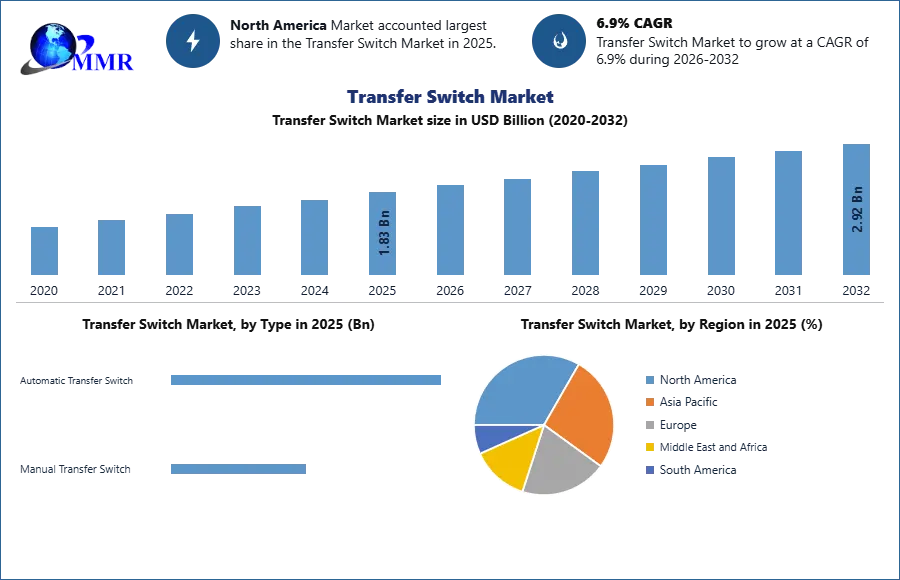
The global market reached USD 1.83 billion in 2025 and is projected to hit USD 2.92 billion by 2032.
A steady compound annual growth rate (CAGR) of 6.9% guides capital investment through the 2026–2032 forecast window.
Manual transfer switches held the dominant position in 2025, capturing more than three-fifths of total market revenue.
Automatic transfer switches represent the fastest-growing technology format, advancing at a specific 7.45% CAGR.
The commercial application segment is set to expand rapidly, posting an 8.99% CAGR driven by energy cost awareness.
North America maintains clear regional dominance, holding a 45% share of the global market in 2025.
Why This Matters Now
Unplanned electrical interruptions impose immediate financial penalties on automated manufacturing environments. A single voltage drop can halt high-speed robotics, corrupt ongoing batches within a manufacturing execution system (MES), and force prolonged supervisory control and data acquisition (SCADA) system recalibrations. For modern industrial operators, power infrastructure resilience is no longer an isolated facilities management issue but a core determinant of overall equipment effectiveness (OEE). As factories transition toward autonomous industrial operations, any dependency on unstable primary electrical grids introduces unacceptable operational liabilities.
What changed? The historical reliance on slow, human-intervention power restoration protocols has become a distinct failure point for digitized plants. Why now? The rapid proliferation of industrial IoT (IIoT) sensors, edge-computing arrays, and automated process control loops demands continuous, clean power without milliseconds of interruption. Who benefits? Plant managers, operations executives, and automation engineers gain the ability to shield sensitive programmable logic controller (PLC) networks from erratic grid behaviors. What happens next? Power switching infrastructure is evolving from a reactive safety mechanism into an intelligent, data-generating edge asset tied directly to main industrial control architectures.
Market Overview
The global Transfer Switch Market Size achieved a valuation of USD 1.83 billion in 2025. Driven by an escalation in primary power grid failures and the urgent need for continuous facility continuity, the market is positioned to expand to nearly USD 2.92 billion by 2032. This trajectory reflects an 6.9% CAGR over the seven-year forecast period, proving that enterprises are actively committing capital to secure their secondary power links. The financial motivation for these investments stems from the escalating costs associated with production line resets, scrap material generation, and labor idleness during blackouts.
The implementation of backup power architecture requires a secure, automated link to transition operations away from failing utility feeds. Transfer switches provide the critical physical gateway that isolates a facility’s electrical distribution network from dead utility lines while connecting it to an on-site generator or uninterruptible power supply (UPS). This mechanism prevents dangerous backfeeding, protects on-site electrical assets from damage, and ensures that critical automation systems receive immediate, stable electricity. Industrial operators use these solutions to turn volatile power disruption risks into highly manageable, predictable operational conditions.
Key Trends Driving Growth
The structural growth of the market is tightly bound to the increasing popularity of decentralized microgrid networks. A microgrid operates on a smaller, localized scale than a traditional centralized electrical grid, generating, distributing, and regulating its own internal power flow. As large industrial parks and modern smart factories install localized solar arrays, battery storage banks, and fuel cells, they create highly complex, multi-source power ecosystems. This evolution requires advanced switching capabilities to dynamically balance loads between the utility grid, localized renewable generation assets, and emergency backup diesel generators.
Simultaneously, the rising global frequency of severe weather events and structural grid overloads has accelerated backup power generator adoption across the commercial and industrial spectrum. Traditional industrial plants previously viewed backup generators as non-essential insurance policies, but frequent grid instabilities have redefined them as critical operational requirements. Because automatic transfer switches initiate transitions instantly when utility power drops, they protect complex process control setups from abrupt shutdowns. This automatic mitigation allows robotic assembly tools, machine vision inspection stations, and distributed control systems (DCS) to remain fully operational during external grid failures.
Segment Insights
Manual Transfer Switch (Dominant Segment): Securing more than three-fifths of the total market share in 2025, this product segment remains highly utilized due to its lower initial cost and proven mechanical reliability in predictable environments.
Automatic Transfer Switch (Fastest-Growing Segment): Advancing at the fastest rate of 7.45% from 2025 to 2032, this segment is expanding rapidly because it eliminates manual human errors and drastically reduces facility downtime during power losses.
Residential Application: Accounted for almost half of the transfer switch market share by application in 2025, propelled by the introduction of smart, intelligent, and user-friendly features built into residential power ecosystems.
Commercial Application: Positioned to exhibit an 8.99% CAGR between 2025 and 2032, expanding rapidly due to improving product efficiency levels and heightened corporate awareness regarding energy cost optimization.
Regional Growth Story
North America commanded the global landscape in 2025, holding a dominant 45% market share. Within this region, the United States accounted for over 70% of the market share, a concentration caused by the urgent requirement to replace aging, vulnerable transmission and distribution grid infrastructure. The regional corporate environment is heavily prioritizing the adoption of customized switching products and advanced smart control switching technology. This technological upgrade allows operators to gain granular visibility into power quality parameters right at the point of common coupling.
The North American market is expected to maintain significant forward momentum, expanding at a CAGR of 5.5% through the forecast period. This investment pattern highlights how advanced economies refuse to allow grid deterioration to compromise their highly automated industrial bases. Furthermore, the rapid growth of data centers and highly automated fulfillment hubs across the United States forces an absolute intolerance for power quality deviations. These demanding facilities utilize advanced automatic transfer switches to maintain constant synchronization between multiple redundant power paths.
Competitive Landscape
The global market features prominent electrical engineering and industrial technology corporations, including Schneider Electric, ABB, Eaton, Siemens AG, General Electric Company, Cummins, Generac Power Systems, and Kohler. The competitive focus among these clear industry leaders signals a structural movement toward total digitalization and smart system integration. Rather than treating transfer switches as simple mechanical toggles, leading manufacturers are embedding microprocessors, communication modules, and automated diagnostic sensors directly into the physical units. This integration allows the switch to interface smoothly with broader industrial control networks, including SCADA frameworks and plant energy management systems.
This strategic direction indicates that technology leadership is defined by how effectively a switching device can contribute to predictive maintenance and facility energy optimization. Major engineering firms are designing units that monitor their own contact wear, temperature profiles, and switching speeds in real time. For automation providers and system integrators, this internal intelligence transforms the transfer switch from a passive electrical component into an active participant in industrial cybersecurity and operational asset health monitoring. By deploying these smart switches, companies gain a secure, reliable foundation for their broader factory modernization and digitalization strategies.
Recent Developments
Tier-one market participants are introducing customized smart control switching technologies designed to integrate smoothly into automated building management systems and industrial SCADA platforms.
Providers are developing transfer switch modules with advanced communication protocols to allow remote monitoring, testing, and status reporting for plant operators managing multiple sites.
Industry leaders are engineering more compact, efficient automatic transfer switches to support space-constrained edge-computing centers and localized microgrid control stations.
Strategic Implications
For manufacturing executives, automation leaders, and industrial technology buyers, the continued evolution of the transfer switch market changes how operational risk is evaluated. Relying on older manual switching systems introduces a critical bottleneck, as human operators cannot react fast enough to protect active software and automated machinery from a sudden power drop. Upgrading to advanced automatic systems eliminates this vulnerability, ensuring that power transitions happen fast enough to keep digital twins, automated assembly lines, and industrial networks fully synchronized.
Who benefits most from this transition? Plant operations teams and electrical system integrators gain substantial strategic advantages. Integrators can design highly reliable power distribution networks that automatically handle multi-source inputs without requiring complex custom code or specialized external enclosures. Plant managers receive clear, real-time data regarding switch health and power quality metrics, allowing them to optimize routine maintenance schedules. This visibility ensures that backup power assets perform perfectly when a primary utility grid experiences a critical failure.
Future Outlook
What happens next? The market is moving toward an intelligent, automated inflection point where transfer switches participate directly in dynamic load shedding and algorithmic energy sourcing. Over the next decade, these components will serve as the vital gateways connecting smart factories to broader regional smart grids and local microgrid networks. This shift will create a clear division in operational performance: forward-thinking industrial companies will use automated power infrastructure to guarantee uninterrupted production uptime, while slow-moving operators will continue to experience expensive production halts, premature equipment wear, and unexpected system downtime caused by unmitigated grid volatility.
Analyst Perspective
“The intersection of factory digitization and microgrid adoption requires absolute reliability at the main power entry points,” says Yash Ghosalkar, Research Analyst at Maximize Market Research. “By implementing modern automatic transfer switches, industrial enterprises secure the critical power foundation needed to support advanced automation, reduce operational friction, and maintain continuous smart manufacturing performance.”
About Maximize Market Research
Maximize Market Research Pvt. Ltd. (MMR) is a global market research and consulting company that provides reliable, data-focused, and practical business insights. The firm serves a wide range of industries, including healthcare, pharmaceuticals, technology, automotive, electronics, chemicals, personal care, and consumer goods. Through market forecasts, competitive analysis, strategic consulting, and industry impact assessments, MMR helps organizations understand changing market conditions, identify growth opportunities, and make informed business decisions for long-term success.
2nd Floor, Navale IT Park Phase 3
Pune Banglore Highway, Narhe
Pune, Maharashtra 411041, India
+91 9607365656
sales@maximizemarketresearch.com
