Key Highlights
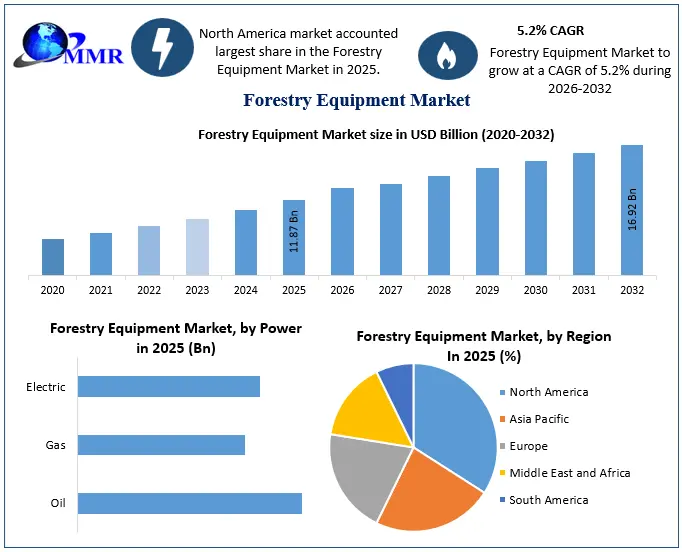
Global Market Valuation: The market capital size reached USD 11.87 Billion in 2025, proving the steady transition toward mechanized, automated timber extraction.
Long-Term Projection: Validated to reach USD 16.92 Billion by 2032, logging equipment procurement is growing at a stable 5.2% CAGR driven by global wood-alternative material initiatives.
Segment Dominance: Wheeled harvesters and intelligent cut-to-length (CTL) configurations led market volumes in 2025 due to their lower ground disturbance and extreme cutting precision.
Electrification Milestones: The deployment of hybrid and mid-size electric material handlers accelerated rapidly, offering zero-emission operation options for sustainable logging yards.
Regional Dominance: North America maintained the largest market share in 2025, supported by expansive commercial logging operations and strict environmental safety protocols.
Why This Matters Now The financial viability of modern logging operations is increasingly dependent on high-speed automation and precise cut-to-length precision. As global consumer demand surges for sustainable building materials, paper-based structural packaging, and bio-friendly energy alternatives, commercial forestry companies can no longer rely on inefficient manual labor or legacy mechanical setups. A single unoptimized cut pattern or poorly managed transport route reduces raw timber yield, spikes operational downtime, and directly eats into tight manufacturing margins. Implementing heavy forestry machinery embedded with real-time Internet of Things (IoT) sensors and automated logging controls has transformed from an isolated technological upgrade into a foundational strategic shield to maximize timber yields and secure multi-year supplier contracts.
Market Overview
The global forestry equipment market acts as the operational backbone for the commercial timber, construction, and global paper supply chains. By manufacturing highly advanced industrial assets—such as heavy excavators, log loaders, forwarders, feller bunchers, and specialized harvester heads—this market allows operators to extract, process, and transport large timber volumes across challenging terrains. Valued at USD 11.87 Billion in 2025, the market’s trajectory toward USD 16.92 Billion by 2032 shows an explicit, industry-wide focus on heavy machinery asset tracing and process automation.
The baseline expectation for logging site productivity has undergone a radical transformation. Historically, logging setups measured success through raw physical muscle and bulk engine horsepower. Today, the industry prioritizes localized sensor metrics and precision data capture. Modern commercial forestry operations require equipment that seamlessly feeds live harvest counts, machinery engine health, and localized material weights directly into centralized cloud-based management platforms, reducing fuel waste and minimizing human logging errors.
Key Trends Driving Growth The leading driver pushing market value forward is the massive adoption of advanced automated cut-to-length (CTL) harvester heads. These advanced attachments are no longer basic mechanical jaws; they operate as smart robotic systems featuring automated edge sensors, precise length-measuring wheels, and smart delimbing knives. These innovations allow a single operator inside a climate-controlled cabin to fell, strip, and section a tree in seconds, radically increasing yield efficiency while protecting operator safety.
Another primary driver is the systematic rollout of smart fleet telematics and predictive maintenance monitoring across logging equipment lines. Heavy machinery brands are building out connected hardware infrastructures that track real-time machine stress levels, track hydraulic pressure fluctuations, and monitor oil contamination values. By catching tiny component errors before they manifest into catastrophic structural failures, forest contractors reduce sudden downtime by up to 25%, protecting tight operating margins.
Additionally, strict international environmental mandates regarding forest soil preservation and carbon emission limits are pushing OEMs to re-engineer their drivetrain solutions. Heavy equipment operators are transitioning from heavy, destructive tracked systems to multi-wheeled forwarders fitted with low-pressure, wide tires that preserve the underlying forest floor. This shift, combined with the emergence of hybrid and fully electric material handlers, allows companies to comply with rigid regional sustainability standards without losing operational load capacities.
Segment Insights
Harvesters and Feller Bunchers [Dominant Segment]: This equipment class captures the top revenue position within the market. Their capability to handle continuous tree felling, processing, and multi-angle log orientation makes them essential assets for large-scale industrial plantations.
Forwarders and Log Loaders: This logistics machinery segment is expanding rapidly, with heavy emphasis on high-payload wheeled variants (such as 10-to-15 ton classes) that transport raw wood sections from deep forest terrain directly to mill-yard access roads.
Specialized Attachments: High-precision harvester heads (specifically 16-inch configurations) are registering significant market volume, as smaller, agile forestry contractors require tools compatible with compact track loaders and standard excavators.
Regional Growth Story North America controls the leading position within the global forestry equipment market, driven by massive commercial timber operations across the Pacific Northwest, the Southeastern United States, and Canada. The region’s preference for advanced technology, high safety compliance standards, and heavy investment in commercial mill yards ensures a continuous cycle of high-value equipment replacements.
Concurrently, Europe continues to lead the market in specialized machinery design, with pioneers in Sweden and Finland setting international standards for intelligent cut-to-length (CTL) harvesting techniques and advanced safety cabins. Meanwhile, the Asia-Pacific region represents the fastest-growing market by volume. Spurred by massive infrastructure modernizations in China and India, alongside expanding consumer preferences for high-quality wood furniture and bio-energy materials, the region is rapidly scaling up its domestic mechanized logging fleets.
Competitive Landscape The competitive matrix of the global forestry equipment industry centers heavily on software ecosystem integration, machine ergonomics, and alternative propulsion options. Leading original equipment manufacturers (OEMs) have shifted from selling basic diesel machinery to providing comprehensive, data-connected digital fleet environments. This development implies that equipment providers who fail to integrate robust automation software and open telematics tracking will face major barriers as large enterprise logging firms prioritize unified smart factory connectivity.
Furthermore, long-term operational durability and localized dealer service networks serve as the primary areas of market differentiation. Market frontrunners like Deere & Company (John Deere), Komatsu Forest, Caterpillar Inc, Ponsse, and Tigercat consistently invest in specialized operator ergonomics, high-load hydraulic systems, and intelligent cabin balancing. By designing equipment that maintains absolute stability and high operator comfort during continuous, high-stress operations on steep slopes, these premier engineering brands solidify multi-year distribution relationships with international logging conglomerates.
Recent Developments
Heavy Forwarder Fleet Launched (2025): John Deere introduces the advanced H Series large wheeled machinery lineup, showcasing the 2010H and 2510H Forwarders designed with high-payload hydraulic systems to optimize heavy timber transport logistics.
Electric Material Handlers Debuted (2025): Volvo Construction Equipment rolls out mid-size electric material handlers and zero-emission articulated haulers optimized for log haul road environments to lower the industry’s carbon footprint.
Specialized Mill-Yard Loader Unveiled (2025): Caterpillar Inc launches the FM528 General Forestry/Log Loader, specifically engineered to provide maximum structural durability and high material throughput within demanding industrial mill yards.
Compact Track Portfolio Expansion (2025): Kubota Corporation expands its specialized forestry selection by rolling out the high-capacity SVL97-3 compact track loader alongside precision excavators for selective logging applications.
Strategic Implications For operations directors and forestry managers, selecting the correct machinery footprint directly influences extraction cycle speeds and site processing yields. Utilizing outdated, non-connected mechanical setups introduces major risks of unrecorded wood wastage, prolonged transport lead times, and sudden on-site machine failures. These issues delay raw material delivery to processing plants, reducing total fleet efficiency and directly harming bottom-line profitability when executing high-volume commercial contracts.
For systems integrators, heavy equipment compounders, and technology providers, delivering extensive IoT sensor connectivity and open telemetry communication is vital to lock in major corporate accounts. As modern timber companies build out data-driven forest management workflows, equipment manufacturers providing closed, uncooperative mechanical units will be shut out of long-term fleet modernization programs. Investing in open API architectures, intelligent hydraulic balancing software, and alternative energy drivetrains is essential to preserve market dominance.
Future Outlook The evolution of the forestry equipment market will be defined by its ability to merge real-time terrain telemetry with semi-autonomous or fully autonomous machine operations. As logging operators face persistent skilled labor shortages globally, heavy equipment assets must evolve into intelligent, self-guiding platforms that navigate dense forest growth safely without human intervention. Future market leadership will belong to advanced multi-axis harvesting platforms that integrate AI-driven wood quality analysis directly onto the harvester head, identifying interior timber rot or density defects before making a single cut. Ultimately, the industry will split along distinct technological capabilities: forward-looking forestry firms that invest in automated, low-impact, data-connected fleets will capture premium sustainable-source certifications, while traditional operators relying on manual processes and legacy machinery will find themselves sidelined by tightening global compliance rules.
Analyst Perspective “The global forestry equipment market has evolved far beyond raw horsepower; it is now a highly precise data validation ecosystem that drives structural raw material optimization,” highlights an engineering machinery lead at Maximize Market Research. “As smart forest management initiatives scale internationally, automated cut-to-length systems and connected wheeled forwarders provide the precision metrics and rapid processing speeds required to maintain massive commercial timber throughput without compromising environmental sustainability guidelines.”
About Maximize Market Research
Maximize Market Research Pvt. Ltd. (MMR) is a global market research and consulting company that provides reliable, data-focused, and practical business insights. The firm serves a wide range of industries, including healthcare, pharmaceuticals, technology, automotive, electronics, chemicals, personal care, and consumer goods. Through market forecasts, competitive analysis, strategic consulting, and industry impact assessments, MMR helps organizations understand changing market conditions, identify growth opportunities, and make informed business decisions for long-term success.
2nd Floor, Navale IT Park Phase 3
Pune Banglore Highway, Narhe
Pune, Maharashtra 411041, India
+91 9607365656
sales@maximizemarketresearch.com
