Key Highlights
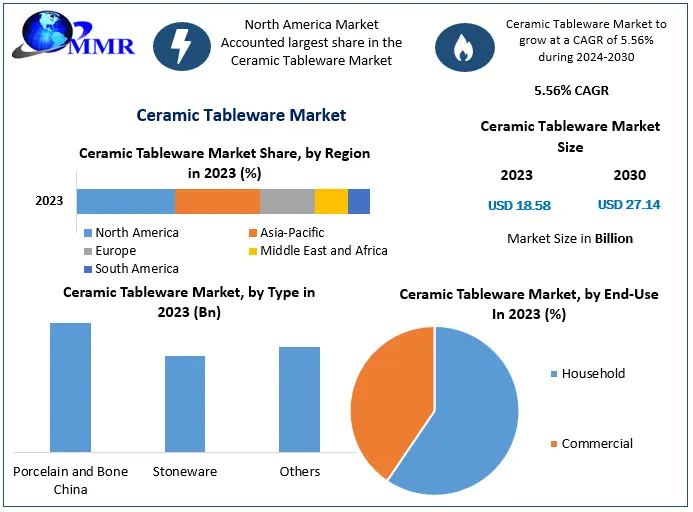
- The Ceramic Tableware Market was valued at USD 18.58 Bn in 2023 and is forecast to reach USD 27.14 Bn by 2030, giving tableware suppliers a larger premiumization and foodservice demand pool.
- The market is expected to grow at a 5.56% CAGR from 2024 to 2030, signaling steady category expansion through household spending, hotels, restaurants and home décor demand.
- Asia Pacific dominated with 41% share in 2023, supported by India and China, rising disposable income and branded ceramic tableware demand.
- Commercial end use is expected to grow at a 6.1% CAGR, making hotels, restaurants and dining businesses a faster demand channel than routine household replacement.
- Europe is expected to grow at a 6.35% CAGR, backed by Germany, the UK and France as key ceramic tableware producers.
Why This Matters Now
Ceramic tableware is no longer a slow household replacement category. It is becoming a branding tool for hotels, restaurants, home décor retailers and online marketplaces.
The Ceramic Tableware Market climb from USD 18.58 Bn in 2023 to USD 27.14 Bn by 2030 means volume growth is available, but suppliers must manage raw material volatility, counterfeit products and low-cost imports. Those pressures will separate premium manufacturers from price-led mass suppliers.
Market Overview
Ceramic tableware includes clay-based dinnerware such as bone china, porcelain, melamine and stoneware. It is used in restaurants, hotels and homes across cutlery, plates, glasses, mugs, vases, bowls and other kitchen items.
Its appeal comes from corrosion resistance, wear resistance, thermal insulation, non-stick behavior and ease of cleaning. The report also highlights ceramic tableware’s non-toxic nature and hard surface that does not absorb chemicals, which strengthens its appeal for food-contact use.
The market is segmented by type into porcelain and bone china, stoneware and others. Distribution channels include offline and online, while end use includes household and commercial buyers.
Key Trends Driving Growth
Household spending is the first driver. MMR links market growth to rising consumer expenditure on household goods, higher disposable incomes, population growth and increased demand for branded ceramic tableware in emerging nations.
Home décor is adding a lifestyle premium. Modular kitchen installation and renovation projects are increasing demand for coordinated tableware that matches interior design, not only functional dining needs.
Foodservice is changing the buyer profile. New hotels, restaurants and dining options are increasing demand for tabletop products, giving commercial buyers a larger role in volume and design requirements.
Consumer taste is shifting toward stronger visual identity. MMR cites rising demand for black and dark glazes, classic round plates, rectangular plates, irregular organic forms, artisan-created collections, indigo themes and global folk designs. These trends make design refresh cycles more important for suppliers.
E-commerce is widening access. Producers and suppliers are focusing sales and marketing on platforms such as Amazon, Flipkart and Snapdeal, while online promotion is creating new opportunities for ceramic tableware brands. Clean-label demand and quantified sustainability initiatives are not disclosed on the public page.
Request a Free Sample Report for Comprehensive Market Insights
Segment Insights
- Dominant Segment: The public MMR page does not identify a dominant type, distribution channel or end-use segment. Asia Pacific is the dominant region with 41% share, but no product or channel leader is disclosed.
- Fastest-Growing Segment Commercial End Use: Commercial end use is expected to grow at a 6.1% CAGR through the forecast period. Hotels, restaurants and other dining formats are driving tabletop product demand.
- Type Scope: Porcelain and bone china, stoneware and others are covered. The report does not disclose type-level market shares.
- Distribution Scope: Offline and online channels are covered. E-commerce is identified as a growth factor, but online penetration figures are not disclosed.
- Restraints: Volatile raw material prices, low durability, high cost of top-quality products, counterfeit goods and substitute products such as opal glass dinnerware can restrict demand.
Regional Growth Story
Asia Pacific held 41% share in 2023 and is expected to retain the highest market share. India and China are key demand centers because rising income, brand awareness, population growth and residential development support demand for branded ceramic tableware.
Europe is expected to grow at a 6.35% CAGR. Germany, the United Kingdom and France are key ceramic tableware producers, while European brands are expected to dominate the global high-end tableware market through the forecast period.
North America, the Middle East and Africa, and South America are included in the report scope. The public page does not disclose country-level market values, production volumes, import-export flows or investment data for the United States, Japan, South Korea or other listed countries.
Competitive Landscape
The market includes Fiskars Group, Rosenthal, Libbey, Meissen, Seltmann Weiden, RAK Porcelain, Villeroy & Boch, WMF, Lenox, Churchill China, KAHLA Porzellan, SCHONWALD, Portmeirion Group, The Oneida Group, TATA Ceramics, Sitong Group and Narumi. Competition is shaped by product design, price, portfolio depth, regional presence and brand trust.
The public page does not disclose dated mergers, acquisitions, partnerships or divestitures. It states that the full report assesses key players by product, price, financial position, product portfolio, growth strategies and regional presence, but transaction-level details are not visible.
The visible competitive signal is clear. Premium European producers hold brand advantage in high-end tableware, while Asian suppliers pressure pricing through low-cost, mass-produced ceramic products. Over the next 12–24 months, rivals will need stronger design differentiation, online visibility and counterfeit defense.
Recent Developments
- E-commerce Expansion: Producers and suppliers are increasing sales and marketing on Amazon, Flipkart and Snapdeal. This signals stronger direct access to consumers and sharper price comparison across brands.
- Design Shift: Demand for dark glazes, round plates, rectangular plates and irregular organic forms is rising. This makes tableware design a faster product-refresh cycle.
- Commercial Demand: New hotel businesses are driving tabletop product demand. This gives suppliers a higher-volume channel outside household replacement.
Strategic Implications
For tableware brands, the growth opportunity sits in premium design and commercial contracts. Hotels and restaurants need durable, distinctive tableware that can survive repeated use while supporting presentation.
For retailers, online discovery is becoming essential. E-commerce platforms can expand reach, but they also intensify price transparency and expose brands to counterfeit competition.
For investors, raw material volatility remains a core risk. Commodity price swings can hit cash flow and earnings, especially for manufacturers competing against low-cost imports and discount-store products.
Future Outlook
The Ceramic Tableware Market is forecast to reach USD 27.14 Bn by 2030 at a 5.56% CAGR. Growth will come from branded tableware demand, home décor, modular kitchens, commercial dining, e-commerce promotion and Asia Pacific consumption.
Winners will control design, brand trust and online execution; losers will be trapped between counterfeit goods, raw material volatility and low-cost substitutes.
Analyst Perspective
“Ceramic tableware is becoming a lifestyle and hospitality category, not just a household utility,” said Siddhi Dole, Analyst at Maximize Market Research. “The strongest brands will combine design depth, food-contact trust, commercial-channel access and e-commerce visibility.”
About Maximize Market Research
Maximize Market Research Pvt. Ltd. (MMR) is a global market research and consulting company that provides reliable, data-focused, and practical business insights. The firm serves a wide range of industries, including healthcare, pharmaceuticals, technology, automotive, electronics, chemicals, personal care, and consumer goods. Through market forecasts, competitive analysis, strategic consulting, and industry impact assessments, MMR helps organizations understand changing market conditions, identify growth opportunities, and make informed business decisions for long-term success.
Contact Us
2nd Floor, Navale IT Park Phase 3
Pune Banglore Highway, Narhe
Pune, Maharashtra 411041, India
+91 9607365656
sales@maximizemarketresearch.com
